Spider plants are easy to grow and readily fill their pots; learn aerial-root cuttings and turn 1 pot into 10
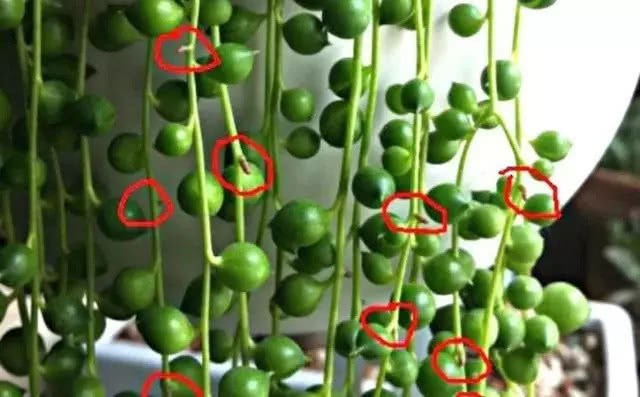
This "succulent" string-of-pearls plant is a flowering potted plant that many people love, a beautiful trailing succulent known as string of pearls (Senecio rowleyanus); casually pick a segment and root it as a cutting and it will fill the whole pot. We will share with you the cutting method for string of pearls, guaranteed 100 percent survival, give it a try right away!
1. Find the aerial roots
Many flower lovers, even those who have grown string of pearls, may not know where its aerial roots are. In fact, the small dark green tendrils on the stems and vines of string of pearls are its aerial roots. Cut off a vine with aerial roots and insert it into the soil as a cutting and it will root very easily. This cutting propagation method works on the same principle as propagating pothos.
2. Get the cutting shape right
The stems of string of pearls are soft in texture and are not suited to being inserted directly into relatively hard soil. Choose an angle and insert it diagonally into the soil to a depth of 2 cm, spread the remaining cutting stem evenly over the surface of the pot, press it down gently with soil, and water until thoroughly soaked. In just 3 days the string of pearls cutting will adapt to the new soil environment and begin to grow.
3. Cutting precautions
During rooting, avoid direct sunlight and place the potted cutting in a cool, well-ventilated spot. After 7 days, once you are sure the cutting has taken, you can gradually give it some sun. When watering, follow the principle of watering thoroughly only after the soil has dried out. Within 2 months, the plump round beads of the string of pearls will cover the entire pot.
Two small problems with string of pearls
1. Shriveled leaves
If string of pearls suddenly shrivels, the first step is to rule out accidental causes such as the plant being bumped or the vines being broken; the second step is to confirm whether watering is the problem, since too much water makes string of pearls rot and shrivel, while too little water leaves the beads short of water and shriveled; the third step is to use scissors to cut off the shriveled beads, determine the cause of the shriveling, and choose either to water or to ventilate so the water evaporates.
2. Bugs
String of pearls sometimes also gets sick and develops scale insects. Spray some insecticide right away; Jiebijiezhi and imidacloprid both work, and medical alcohol bought from a pharmacy can also do the job, poured into a spray bottle and sprayed, and the pests are killed off immediately.
String of pearls is as easy to propagate from cuttings as pothos. As long as you learn to propagate it using aerial-root cuttings, you will never need to buy one again, and you will no longer fear failing to grow spider plants well; in no time you can propagate another new pot.