Orchid black rot is as fierce as a tiger, and two oversights killed another pot
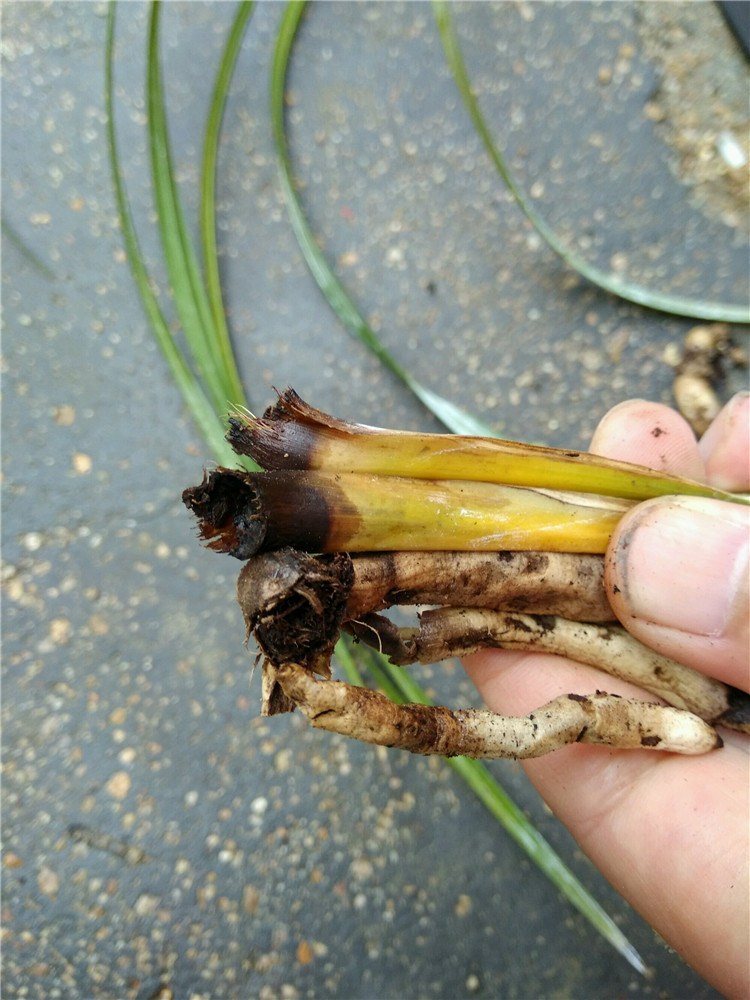
Everyone who grows orchids knows that "rot disease" is as fierce as a tiger. If it is not treated in time, the orchid is done for. Many orchid growers' plants have failed because of rot disease. For example, a grower in the forum recently had a problem with an orchid: the seedling rotted outright, and there was nothing that could be done. What happened?
1. When an orchid gets black rot, there is nothing that can be done
The one in the picture is her orchid. It has already rotted; when dug out, it broke right off. The roots were actually still fine, but the junction between roots and stem had black rot, and it was beyond saving. The situation is already very serious. If it had been discovered in time, it could still have been saved. In this state now, probably only the "holy water" in Guanyin's bottle could save it. Why does it rot so easily?
Look at the pot this grower used for the orchid. The seedling with a slightly yellow stem is the one with black rot, while the seedlings beside it are still very healthy. The reason it got this kind of rot disease, to put it plainly, is that harmful pathogens spread in the growing medium. When high temperatures and humidity are forecast, the disease breaks out. Once it breaks out, you get the "tragic scene" above.
2. Orchid black rot, one cause lies in the "growing medium"
Tracing the cause, the first point is the growing medium used for the orchid. From the picture, you can see that this grower mainly used granular stone, with quite a lot of fine soil mixed underneath, and clearly too much granular stone on top. The water retention was too good. With too much water, the orchid roots could not breathe well, and combined with the recent high temperatures, the orchid was bound to have problems.
Therefore, regarding this point, the little gardener's advice to beginner orchid growers is that you can use half coarse growing medium and half fine growing medium (or 7 parts coarse growing medium and 3 parts fine growing medium). For the top dressing, you can use bark and small stones, but it does not need to be too thick. Second, use an organic nutrient solution specially made for orchids, such as Huadongde, together with it. This is more helpful for strengthening roots and growing white roots and jade-like roots.
3. Orchid black rot, the second cause lies in "depth"
The second reason is that this grower planted the orchid a bit too deep, burying the entire pseudobulb. Many small shoots probably cannot easily emerge. Covering the pseudobulb like this is not good for its growth and also makes it prone to disease. The little gardener suggests pulling it out a bit more, and then it will be fine.
Seeing that this grower still has quite a few orchid seedlings nearby, the little gardener suggests that at this time the other orchid seedlings should also be sprayed with carbendazim to sterilize and prevent disease, because this kind of disease is very easy to spread. Besides sterilizing, we also need to prepare an organic nutrient solution that strengthens roots and promotes flowering, and apply fertilizer in time. During the seedling stage, strengthen the roots of the orchid seedlings; before the flowering stage, promote flowering. Only by working on both fronts can orchid flowering be guaranteed.
Fellow skilled orchid growers, do you think this orchid can still be saved? If it can be saved, how should it be handled? When growing orchids, "rot disease" is as fierce as a tiger. We must prevent it in time so that the orchids in the pot can grow safely.