How to grow Sedum morganianum? Detailed daily management and care methods
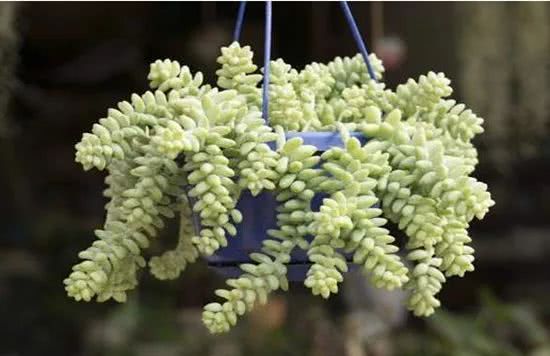
Sedum morganianum is native to Mexico and Honduras, also known as jade sedum (Sedum morganianum), jade curtain, jade string, and jade bead curtain. It is an evergreen or semi-evergreen succulent of the genus Sedum (formerly Sedum) in the Crassulaceae family. The name originates from Japan. When Japanese archaeologists were excavating ancient tombs, they found some jade ornaments made of gems such as jade or agate. These jade ornaments were curved like hooks, so they were called "magatama," which is quite common in Japanese manga and novels.
The plant is mostly emerald green, and its leaves are very small, but plump and spindle-shaped, appearing densely packed like strings of polished jade.
In addition, its flowers are not very large either, appearing quite small, and are deep rose in color. They usually all bloom in spring, which is quite beautiful.
1. Soil requirements
Generally, Sedum morganianum particularly likes soil with good drainage, as this allows its roots to breathe better. If drainage is poor, the roots will have difficulty breathing and will rot. So when choosing soil, you can mix peat soil and granular soil in equal proportions to meet its soil requirements.
2. Temperature requirements
Sedum morganianum generally prefers an environment with a large temperature difference, meaning the daytime temperature can be a bit higher and the nighttime temperature can be a bit lower, but the maximum should not exceed 33°C and the minimum should not fall below 4°C, otherwise it will enter a dormant state, thereby affecting the plant's normal growth.
In winter, if the temperature drops below 0°C, it is prone to frost damage or death. So in winter, when the temperature has already dropped below 5°C, you must quickly move it back indoors and place it in a spot with more sunlight, so it can safely overwinter. In addition, when the temperature is high in summer, be sure to ensure good ventilation and avoid high temperatures.
3. Light requirements
As mentioned earlier, Sedum morganianum really loves light. Apart from the intense sunlight in summer, you can let it enjoy light freely. Whether it is all-day exposure or half-day exposure, it can grow well. Moreover, with sufficient light supply, its leaves will grow more densely and look more beautiful. Conversely, if there is insufficient light, it will easily become leggy, which also makes its appearance look unattractive.
4. Fertilization requirements
When fertilizing it, there is one thing to note: it does not particularly like nitrogen fertilizer, so be sure to reduce the amount of nitrogen fertilizer. We only need to apply a little dilute liquid potassium fertilizer and phosphorus fertilizer once each month, and that will be enough to make it grow more beautifully and look more attractive.
5. Watering requirements
Sedum morganianum does not have a high water demand. It feels comfortable in an environment with 40-60% relative humidity. Normally, you can wait until the soil begins to dry before watering a little. About once a month, water thoroughly until water starts dripping from the drainage hole at the bottom of the pot. When watering, avoid the leaves to prevent them from rotting due to prolonged water accumulation, and make sure there is no standing water at the bottom of the pot.
Related: Introduction to the differences between Sedum morganianum, Sedum burrito, Sedeveria "Harry Butterfield," and Sedeveria "Silver Frost"
Sedum morganianum, Sedum burrito? Can't tell them apart? Some succulents really look so similar that they are hard to distinguish. But don't worry too much if you have succulent face blindness. After all, every succulent is unique, and no matter how similar they are, there must be differences. Let's take a look below.
I. Sedum morganianum
Family and genus: Crassulaceae, Sedum genus
Aliases: jade curtain, jade string, jade bead curtain
Quick facts
1. Sedum morganianum is the original species, native to southern Mexico and Honduras. Its Latin name Sedum morganianum commemorates the American botanist Andrew Price Morgan (1836-1907).
2. The fleshy leaves of Sedum morganianum are short lanceolate, about 2-3 cm long, closely alternate, slightly covered with white powder, with a white-green sheen. When the temperature difference is large, the leaf edges and tips of Sedum morganianum will turn slightly red, but overall they still appear a lovely ivory white. Leaf size, shape, and color are important bases for distinguishing it from other "zhui" varieties.
3. The stems of Sedum morganianum grow creeping and can also be grown hanging to let them trail downward, reaching up to 1 m long. The flowers are bell-shaped, peach-red, and bloom at the leaf axils near the branch tips.
II. Sedum burrito
Family and genus: Crassulaceae, Sedum genus
Quick facts
1. Sedum burrito was also first discovered in Mexico and was only formally named in 1977 (Sedum morganianum was named in 1930). Previously, many people thought Sedum burrito was a variety of Sedum morganianum, but there was not very strong evidence to support this view. It is now generally believed that Sedum burrito should also be an original species.
2. The fleshy leaves of Sedum burrito are short and round, about 1 cm long, slightly covered with powder, and white-green in color. The leaves grow in strings like jade beads, and when in peak condition the leaf color turns slightly orange-yellow. The leaves are easily knocked off, but leaf propagation is very easy to succeed with.
3. Like Sedum morganianum, Sedum burrito is also a master of the cascading look. Abroad, they are called "Baby Donkey Tail." The flowers are bell-shaped and light pink.
III. Sedeveria "Harry Butterfield"
Family and genus: Crassulaceae, hybrid genus (a cross between Sedum and Echeveria)
Aliases: Jingye jade string, thousand-buddha hands, chrysanthemum ball
Quick facts
1. Sedeveria "Harry Butterfield" is a hybrid product. Its parents are Sedum morganianum and Echeveria derenbergii. Strangely, the offspring produced by crossing the delicate Echeveria derenbergii always turn out more robust than she is, such as this Sedeveria "Harry Butterfield," a must-choose for beginners.
2. The leaves of Sedeveria "Harry Butterfield" are also lanceolate, larger than the previous two, and can be 4-5 cm long. When the day-night temperature difference is large, the leaves take on an orange-red blush that is very beautiful. Because the succulent world has a puzzling aesthetic that "big is not as beautiful," the robust and beautiful Sedeveria "Harry Butterfield" has always been looked down upon by everyone.
3. Sedeveria "Harry Butterfield" can also grow as a hanging plant, but because of its relatively large size, it is called "Super Burro's Tail" (Sedeveria "Harry Butterfield": Shut up!). Well, actually it can just quietly be a beautiful ordinary succulent.
4. Many people in China think the Latin name of Sedeveria "Harry Butterfield" is "Sedum sediforme," but that is actually incorrect. That corresponds to the even more disliked "Sedum reflexum."
IV. Sedeveria "Hummellii"
Family and genus: Crassulaceae, hybrid genus (a cross between Sedum and Echeveria)
Quick facts
1. Sedeveria "Hummellii" is also a hybrid, with parents Echeveria derenbergii and Sedum pachyphyllum.
2. The leaves of Sedeveria "Hummellii" inherit the plump cuteness of Sedum pachyphyllum, with relatively round and blunt leaf tips. When in peak condition, the leaves inherit the red blush of Echeveria derenbergii, with a touch of red at the leaf tips, a perfectly harmonious beauty.
3. Sedeveria "Hummellii" is relatively delicate and is also not suitable for hanging cultivation.
V. Sedeveria "Silver Frost"
Family and genus: Crassulaceae, hybrid genus (a cross between Sedum and Echeveria)
Quick facts
1. Sedeveria "Silver Frost" is a hybrid, and its parents are unknown.
2. Sedeveria "Silver Frost" is similar in appearance to Sedeveria "Harry Butterfield," but whether looking at the leaves or the overall plant, it is smaller and more charming than Sedeveria "Harry Butterfield." The leaves of Sedeveria "Silver Frost" are slender with gradually pointed tips, covered with a relatively thick layer of white powder, and when in peak condition the leaf tips turn slightly red.
3. Sedeveria "Silver Frost" is robust in habit and easy to get through summer, but it is not suitable for hanging cultivation.