What exactly is the little sun of the grasslands?
Last May I posted about corn poppies and Iceland poppies, which are plants commonly grown in urban landscaping. Iceland poppies are widely popular, blooming profusely every year in late spring and early summer; they come in rich colors with thin, delicate petals and tall, slender stems. When a spring breeze brushes past, it looks as if thousands of colorful butterflies are dancing.
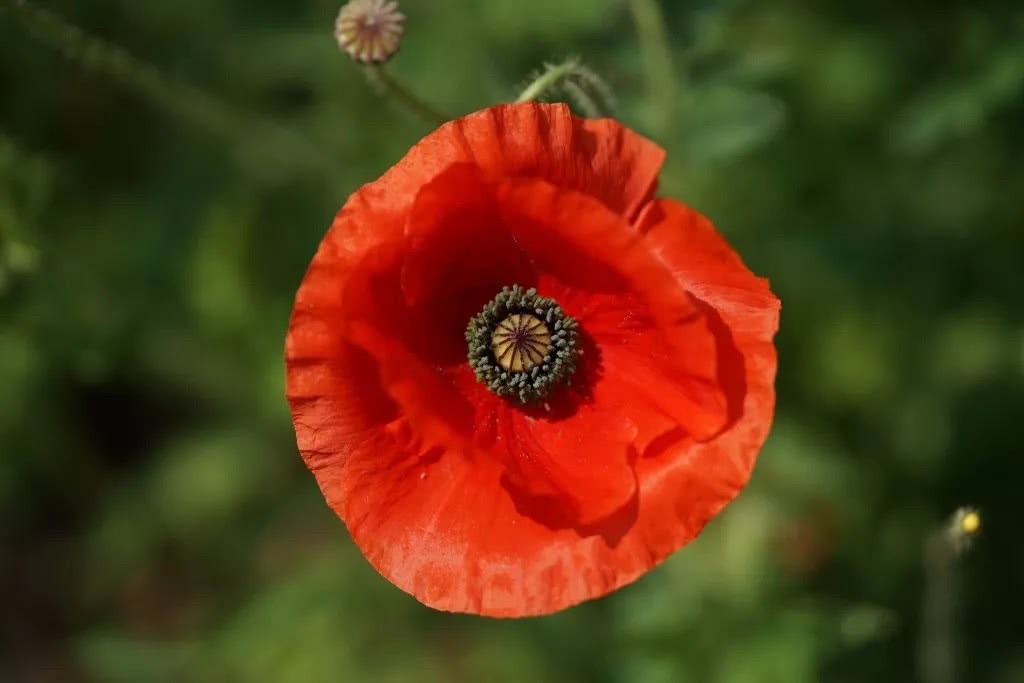
The corn poppy is less common than the Iceland poppy, and its usual color is only red. But that is enough; the bright red petals always bring to mind the tragic heroism of Consort Yu cutting her own throat by the Wu River.
But today I want to talk about the wild poppy, which is a relative in the same genus as the corn poppy and the Iceland poppy out in the wild. Last week I visited Saihanba in Hebei, and on the grasslands the wild poppies were in full bloom.
[Wild Poppy Papaver nudicaule] Papaveraceae >> Papaver
Actually, the Iceland poppy Papaver nudicaule "Iceland Poppy Flower" is simply a horticultural form of the wild poppy Papaver nudicaule. We can see that the two scientific names are basically identical, but the Iceland poppy has an extra cultivar name attached: "Iceland Poppy Flower." "Iceland" was later translated literally as Iceland, and "Poppy Flower" simply means poppy flower.
Compared with the horticultural Iceland poppy, the wild poppy commonly seen on subalpine meadows and grasslands of northern China has flowers a size smaller and somewhat plainer in color (basically yellow). After all, it is a wild plant, and in the two dimensions of "large" and "vivid" it can never compare with horticultural varieties.
But judging wild plants by size and vividness seems inappropriate; the beauty of wild plants cannot be measured by some universal standard of evaluation. Each has its own characteristics, and every wild plant is unique.
The wild poppy, for example, with its bright petals and tall stature, becomes one of the most captivating flowers on the grasslands of North China in July and August.
When the wild poppy blooms, its flower stem is about half a meter tall. But on grasslands with abundant water and grass it can only just poke its head out. Its flower has 4 petals, thin and with a slight waxy sheen. The four petals curl slightly upward, forming a bowl shape.
From petals to stamens, the wild poppy flower is golden yellow throughout. On clear days, the flower seems brighter than the sunlight, standing out among all kinds of grasses and flowers, very eye-catching. Such bright flowers seem to have a strong attraction for insects, and you can often see all kinds of insects flitting around the flowers.
Like the corn poppy and the Iceland poppy, the wild poppy's buds also droop, and both the flower stem and the bud are covered in fine hairs.
After flowering, the wild poppy's ovary begins to swell, and countless tiny seeds form inside the fruit. The shape of the fruit is like the ancient vessel "ying" (a container with a big belly and a small mouth), and this is how the wild poppy and the opium poppy got their names.
In the north, the wild poppy has another name: mountain poppy. This less flattering alias reminds us of the connection between the wild poppy and opium. In fact, the corn poppy and Iceland poppy commonly seen in cities are also often mistaken by people for the opium poppy, and I often hear passersby quietly discussing them.
This is a very contradictory situation: on the one hand, many cities plant Papaver plants as ornamentals, even growing them into seas of flowers; on the other hand, Papaver plants are a group people avoid talking about.
Plants such as the wild poppy and the Iceland poppy cannot be equated with the opium poppy. According to the literature, the structure and pharmacological action of the papaverine contained in the wild poppy differ from the active components of opium; it is not narcotic and is not addictive. It is still a basic medicine recognized by the state and has not been placed under the scope of narcotic drug control. [1]
The genuine opium poppy
Over the past year I have also seen the genuine opium poppy. It is worth bringing out for comparison. It is clear that the leaves of the opium poppy differ greatly from those of the wild poppy and the corn poppy. The opium poppy leaf is one whole piece, with irregular serrations along the leaf margin.
And its plump fruit is the most eye-catching part (by comparison, the wild poppy's fruit is far too small). If the fruit is cut open, a white sap flows out, and once this sap dries it is called: opium.
References:
[1] Lan Rong, Cui Jian, Qin Xiaoyan, et al. Current status and development prospects of research on the chemistry and applications of the ethnic medicine wild poppy [D]. , 2006
Author: Jiang Mouren
Images: Jiang Mouren (unless otherwise noted)
This work is licensed under the (CC BY-NC-ND 4.0) license agreement
Please retain the above statement when reposting