How to grow a goji berry bonsai so it produces more fruit? Care experience shared
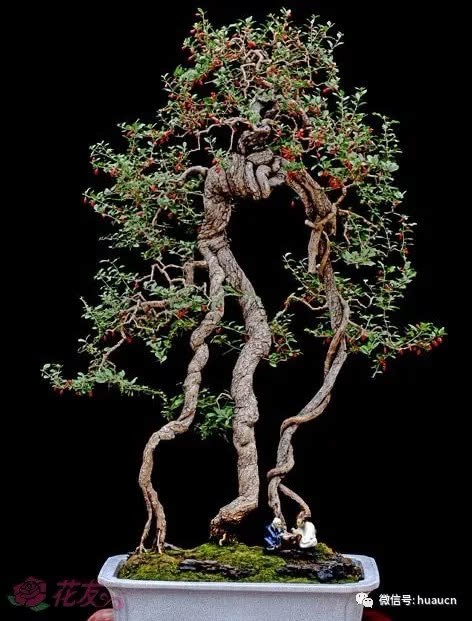
A goji berry (Lycium chinense) stump can be made into many forms of bonsai according to the creator's design. However, its branches are relatively long, somewhat vine-like, and short branches rarely bear fruit, so apart from the weeping-branch style, other bonsai forms find it hard to present a scene of abundant fruit on the ideal branch pads.
Exposed-root bonsai: Making and cultivating the exposed roots of a goji berry bonsai
The goji berry has two growth periods and two dormancy periods in a year. The dormancy periods are the severe cold of winter and the sweltering dog days of summer. The winter dormancy is longer, about four months, while the dog days dormancy is shorter, one month. Thus the growth periods are divided into the first-half-year growth period and the second-half-year growth period. The first-half-year growth period is mainly vegetative growth, only growing branches and leaves without flowering or fruiting; the second-half-year growth period is mainly reproductive growth, flowering and fruiting while growing branches and leaves.
Based on this characteristic, during its first-half-year growth I give it plenty of water and fertilizer to let it grow more branches and leaves, without pruning, so it stores more nutrients. During the short dog days dormancy I prune and shape it. During the second-half-year growth period, through techniques such as pinching tips, pinching branches and acupuncture, I make it branch more, age its branches early and bloom more, so that a goji berry bonsai with dripping red fruit can be enjoyed. My specific method is as follows:
Goji berry bonsai: Care experience for a goji berry bonsai to bear more fruit
In winter the goji berry bonsai should overwinter outdoors; in especially cold places the pot of the bonsai can be insulated and protected. In early spring when the leaf buds swell, prune it, then place it in a well-ventilated, sunny spot for care. After new branches and leaves grow, apply a dilute liquid fertilizer mainly of nitrogen once a week. During this growth process do not prune the branches and leaves; let them grow freely so the branches become thick and sturdy and the stump stores more nutrients. Of course, during this time the branches can be wired according to shaping needs.
In the hot, dry dog days it goes into brief dormancy again. During this dormancy keep the potting soil on the dry side, do not fertilize, let it rest for about one month, then prune once. After new branches and leaves grow, apply a dilute liquid fertilizer mainly of phosphorus and potassium once a week. On the day after fertilizing, water a bit more; the rest of the time withhold water. When new branches grow to 2~3 cm long, pinch the branches once or twice daily according to the direction of the branches in the design; pinch gently, first bending a small amount, then gradually increasing the bend, which can age the branches and promote flower bud differentiation. While pinching branches you can also pinch tips as required.
If an individual branch grows faster than the design requires, use a small needle to pierce one or two holes between two leaves on the growing section of the branch, deep to the center of the branch stem; this can slow the branch's growth and shorten the internodes. If it still grows too fast, use a needle to score vertically along the branch below the leaf stalk, not too deep; this is in fact the ring-barking technique in fruit tree cultivation.
After such management, by mid-autumn you can enjoy a goji berry bonsai full of red fruit. After winter begins, place it in a bright cold room and the red fruit can hang until after New Year's Day. To have abundant red fruit year after year, you should also repot into nutrient soil every year, in early spring; when changing the soil add some bone meal and de-alkalized lime powder to increase calcium, because the goji berry likes soil high in calcium.
·END·
An interactive platform for flower growing, flower planting and green plant enthusiasts to exchange ideas, show off and be a bit cheeky. An online home for sharing flower cultivation methods and home flower growing tips. A fresh flower subscription platform.
Fresh flowers: hyacinth|stock|plum blossom|carnation|camellia|kalanchoe|jasmine|gardenia|peach blossom|balloon flower|osmanthus|calla lily|lily|forget-me-not|clivia|apricot blossom|honeysuckle|aglaia|peony|sunflower|chrysanthemum|serissa|crown of thorns|tulip|narcissus
Green plants: poinsettia|money tree|pothos|spider plant|peace lily|lucky bamboo|asparagus fern|aloe|ivy|anthurium|monstera|bougainvillea|silk tree|peace lily|schefflera|boxwood|sago palm|rubber plant|maidenhair fern|snake plant|
huau.cn
……
Search the public account "Flower Friends" or "huaucn" for the latest information
Business cooperation, promotion. Please contact WeChat private ID:ihuaucn