A complete guide to evergreen plant varieties: which one are you growing?
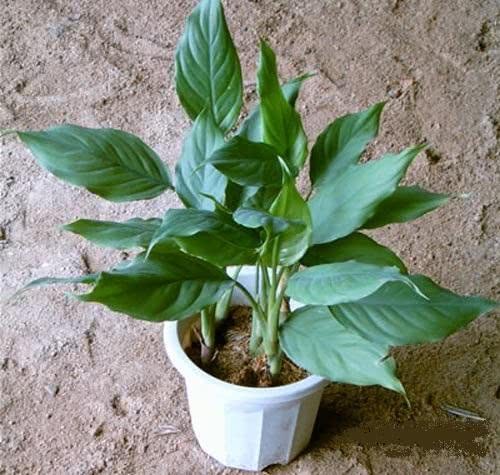
Traditionally speaking, "evergreen" is a general term for a number of plants, and many kinds of plants are called evergreens, including plants from different families and genera. Araceae, Liliaceae, Commelinaceae and others all have plants called evergreens. Below let us get to know the plants called evergreens, starting from the different families and genera!
Araceae
1. Chinese Evergreen (Aglaonema modestum)
Chinese Evergreen is the most common and ordinary kind of evergreen, and it has always been seen in flower markets. It likes a semi-shaded, humid environment, is robust, easy to care for, tolerates drought, cold and waterlogging, and is also very easy to propagate. Cuttings are the most common propagation method and root very easily, and division also works. Chinese Evergreen is suitable for gardening beginners, because it really does not need special care to grow well.
2. Ruyi Evergreen (Aglaonema)
Ruyi Evergreen is a foliage plant of the Araceae family, scientific name Aglaonema sp, also known as Ruyi Queen, painted-leaf Chinese evergreen and painted-leaf aglaonema. It is a herbaceous plant. The plant is 30-40 cm tall, with upright unbranched stems and obvious nodes, beautiful leaf color, and it is especially shade-tolerant.
3. Black Beauty Evergreen (Aglaonema)
Black Beauty Evergreen, also called striped aglaonema and striped Chinese evergreen, among other names. The leaves are long and elliptical, and the leaf surface varies with the variety, often inlaid with silver or white markings. Its notable feature is that the leaves are glossy black, or more precisely dark green to black, which is how it got the name Black Beauty. Black Beauty is also a variety with high ornamental value, suitable for indoor potting, and relatively easy to care for. In short, it is a very good foliage plant.
4. Silver Queen Evergreen (Aglaonema)
Silver Queen Evergreen, also called Silver Queen Chinese evergreen and Silver Queen aglaonema, among other names. This species looks very similar to Black Beauty, but on closer inspection the differences are still great: apart from the white markings, the leaves of Black Beauty are dark green, and the white markings are not vivid, while Silver Queen has more white markings, covering most of the leaf area, and the color is bright silver, which is how it got the name Silver Queen.
5. White-Rib Evergreen (Aglaonema)
There should be two kinds of White-Rib Evergreen. One is the kind shown in the picture above, with white markings on the leaves; its proper name should be white-stemmed Chinese evergreen, and flower sellers have also given it a very pleasant name, Snow White, which suits its character quite well. The other is the kind shown in the picture below, with white veins in the middle of the leaf, which is the true White-Rib Evergreen. I think it is precisely because of the unique white veins on the leaves that it is called White-Rib Evergreen! White-Rib Evergreen has very high ornamental value, with unique and beautiful stems and leaves, and is suitable for indoor cultivation and viewing.
6. Dieffenbachia (Dumb Cane)
Dieffenbachia is a very good green plant for purifying the air. Its leaves are broad, its branches and leaves are lush, and its colors are bright and strong, graceful and elegant, with high ornamental value. It makes a very comfortable and elegant accent for the living room or study. However, a reminder to everyone: the stems and leaves of this plant are also slightly toxic, so when caring for it at home you must be careful not to eat it by mistake. Many flowers are like beautiful poisonous mushrooms: for viewing only, not for playing with.
Liliaceae
7. Chinese Evergreen (Rohdea japonica)
Actually its real name is simply Evergreen, with aliases such as Iron Shoulder Pole, Nine-Node Lotus and Winter-Not-Withering Grass, among others. It is the only species in the genus Rohdea of the Liliaceae family, mainly distributed in China and Japan and other places. Its leaves are emerald green and evergreen in all four seasons, and in winter the green leaves paired with red berries are elegant and beautiful, carrying the fine meanings of eternal youth, health and longevity, enduring friendship, and wealth and good fortune. The Olympic promotional song "Beijing Welcomes You" has a line: "My family grows evergreens, opening up every legend, sowing seeds for the traditional soil, leaving memories for you..." The evergreen sung about there should be this plant.
8. Star of Bethlehem (Ornithogalum)
Star of Bethlehem, with aliases such as sea onion, glass ball and sea hoya, among others. Its most notable feature is the bulb at the base of the plant; the bulb surface is smooth and green, and can reach 10 cm in diameter. For every leaf it grows, several small bulbils appear on the bulb skin, shaped like tiger eyes, which is how it got the name Tiger-Eye Evergreen. Note that as the bulb swells, the thin film on the surface of the bulb naturally cracks, reducing the ornamental effect, so this outer skin should be peeled off. After peeling off the first layer of skin, it "takes on a new look": the bulb is emerald green, beautiful and elegant, and is called "jade-like face."
Commelinaceae
9. Purple-Back Evergreen (Tradescantia spathacea)
Purple-Back Evergreen, with aliases such as purple brocade orchid, blood-seeing sorrow and mussel-shell flower, among others. It is an evergreen perennial herbaceous plant whose leaf surface is bright green and whose underside is purplish red, which is how it got the name Purple-Back Evergreen. It is a common potted foliage plant, suitable for placing on a family balcony or in the living room. Purple-Back Evergreen is also a very easy plant to grow, tolerating drought, cold and poor soil, and it can be propagated by division and cuttings. With proper care, it will quickly fill the pot.