Areca palm, Hawaiian palm, parlor palm and Areca lutescens - tell them apart in 3 steps
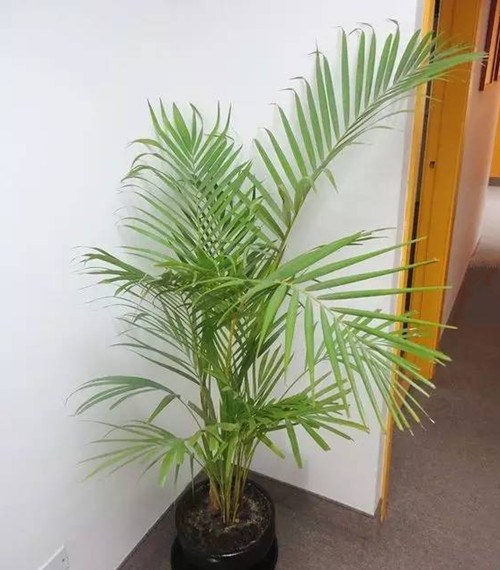
Areca palm, Hawaiian palm, parlor palm and Areca lutescens - when you first see these four plants, it is completely impossible to tell them apart. So how exactly do you distinguish the four of them? Come and take a look with the good-care green plant experts.
Distinguishing areca palm, Hawaiian palm, parlor palm and Areca lutescensThree steps:
Step one: look at plant height - taller plant type - rule out parlor palm (here the leaves can be used as a supplementary clue; parlor palm leaves are wide, short and flat-spreading)
Step two: look at whether there are stem nodes - none - rule out Hawaiian palm
Step three: look at the appearance of the stem - yellow-green, slightly swollen - rule out Areca lutescens (here the regularity of the leaves and their drooping state can be used as a supplementary clue)
Conclusion: this is an areca palm
1. Areca palm (Phoenix-tail palm)
It is also called yellow coconut and purple palm. It is an evergreen small shrub or small tree of the palm family, genus Areca. Its rhizome is smooth, generallyyellow-green, and its leaves are relativelysmooth and slender, of coursespread out in a tail shape。
It likes a warm, humid, ventilated semi-shady environment and is not cold-tolerant. It can be seen everywhere in the south; in the north it is an indoor green plant. It is fairly shade-tolerant, but cannot take scorching sun!
2. Hawaiian palm
Also known as bamboo-stem parlor palm and Chamaedorea seifrizii, it is a parlor palm, also known as green-stem cane palm, root cane palm, Chamaedorea seifrizii, bamboo-stem graceful coconut, etc. The plant has a graceful form and easily flowers and sets seed. Its appearance is dense in branches and leaves, with deep green and glossy leaf color, and elegant pinnae, giving a sense of dignity, elegance and delicate beauty. It can be placed indoors for a long time, and its flowers, fruit, leaves and stems can all be enjoyed together, which helps purify the air and beautify the environment.
Its care is not difficult either. It is a common indoor green plant, likes to grow in a warm and humid environment, and can grow normally with bright light. It fears scorching sun and has relatively strong adaptability. For soil, loose, fertile, well-drained sandy soil is best!
Stem differences:
The areca palm is yellow-green and has green spots on it. The stem is smooth, cylindrical, and relatively broad at the base.
The stem of the Hawaiian palm is like bamboo, with nodes. The stem nodes are very short, and the middle of the stem is hollow, yet it is slender, growing new shoots from a creeping form onto the stem, and it has no branches.
Leaf differences:
The areca palm's leaves are lush, evergreen through the four seasons, smooth and fine, and hard, in bright green, with yellow petioles, growing overall in a pinnate pattern.
The Hawaiian palm has few leaves, which are dark brown and glossy, growing on the upper part of the stem in a pinnate pattern, with no petioles, and the branches are straight.
3. Parlor palm
Also known as graceful bamboo palm, parlor bamboo, dwarf coconut, dwarf palm, living room palm, happy palm, parlor palm, and parlor palm. It is an evergreen small shrub of the palm family, genus Chamaedorea. Potted height generallydoes not exceed 1 m. Because the plant shape closely resembles a tropical coconut tree, and its form is small, exquisite, beautiful and unique, it is named parlor palm. In addition, it is shade-tolerant, so it is very suitable as a small to medium indoor potted plant.
Itis a short plant with upright stems bearing irregular markings. It likes a high-temperature, high-humidity and semi-shady environment. The suitable growth temperature is 20-30°C; at 13°C it enters dormancy, and the overwintering temperature is 10°C.
4. Areca lutescens
Also called tassel coconut, its leaves are very lush, with leaves on both the upper and lower parts of the whole plant, looking very luxuriant, giving a feeling of prosperity arriving! The leaf surface is glossy and the form is elegant, and it can even bear fruit. If well cared for, you can see strings of green fruit in autumn and winter!
Areca lutescens likes a warm and humid climate. When caring for it, be sure to provide shade; growing it in a bright spot is fine. If it is planted in the ground and has grown strong, scorching sun is also acceptable, but for potted plants there is no need! Its cold tolerance is relatively good, and flower lovers in the north can also grow it freely. It can still survive at minus 4 degrees, which is quite good!
PS: The best way to distinguish Areca lutescens from Hawaiian palm is to look at the plant's leaves. If there are leaves on both the upper and lower parts and it is very lush, it is Areca lutescens; while if the lower part of the rhizome has no leaves and is bare, and the upper part has leaves but they are relatively sparse, then it is Hawaiian palm.