Wild fruits have now become a rare commodity; what we played with as children now sells for as much as 500 yuan per unit
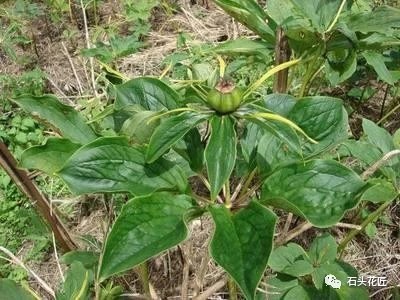
For those born in the 1970s and 1980s, childhood was often spent playing in the mountains. Picking all kinds of wild fruits and wildflowers. Some could be eaten, some could be played with. We also often heard family members say that some were Chinese herbal medicines that could be dug up and sold for money; some were poisonous herbs that you absolutely had to stay away from.
The wild fruit I am introducing to you today - Chonglou (Paris polyphylla) - was often picked for fun when we were children. Back then it grew everywhere, and in some places it was also called Qiye Yizhihua (Seven Leaves One Flower). This is because the plant grows seven leaves at a single node, and then at the very top, above the seven leaves, a single flower blooms, and in autumn it produces a black fruit, which is how it got the name Qiye Yizhihua. Of course, it has other names too: Dengtai Qi, Tiedengtai, Baiheche, Zhihuatou, Hailuo Qi, Luosi Qi, and so on
The "wild fruit" we "played" with as children has now become a "rare commodity," with a unit price as high as 500 yuan
But now, Chonglou has become a rare commodity, especially wild Chonglou. Its tuberous root has very high medicinal value and can treat hemangiomas, cancerous tumors, otitis media, snakebite, and carbuncles and boils and other diseases. When used in combination with other Chinese medicines, its therapeutic effect is even better. Because market demand is large, Chonglou is also planted artificially on a large scale; however, there is still a certain gap in medicinal efficacy between artificially cultivated Chonglou and wild Chonglou.
For this kind of wild Chonglou, the plant generally has to grow for six or seven years before its tuberous root can be dug out for use as Chinese herbal medicine. But because its price has been relatively high in recent years, Chonglou tuberous roots of good quality can reach around 500 yuan per jin. Chonglou grows in wild fields, and because of its distinctive leaves and upright stems, it is very easy to identify and very easy to find in the wild.
For farmers, being able to dig up wild Chonglou every year is also a pretty good source of income. After all, the market for wild Chonglou is good now, and the unit price is high.
But many people, for the sake of profit, dig it up whenever they come across it, regardless of whether it can be harvested. In fact, Chonglou that has not grown to the right age does not have very good medicinal efficacy either. Moreover, this kind of indiscriminate harvesting and digging also causes great damage to vegetation. So when digging up wild Chonglou, we must also protect the ecological environment; only in this way can there be long-term development.
What do you think about the current high price of Chonglou?