After its summer dormancy, Cyclamen wakes up in autumn. Do these few care steps well, and you will have flowers to enjoy in winter and spring.
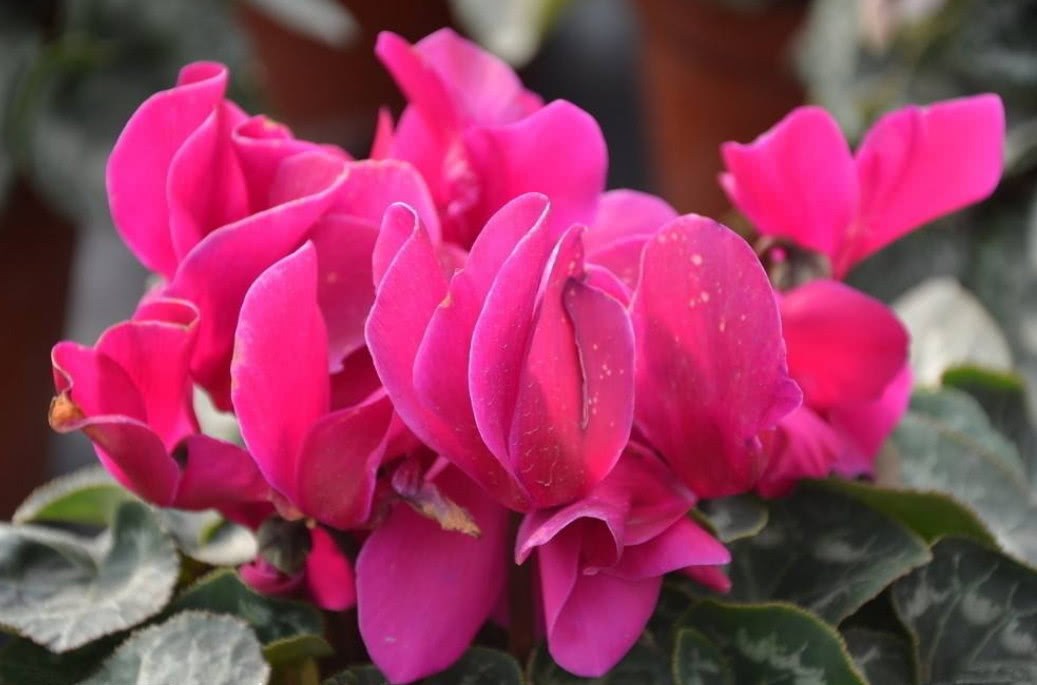
For the winter- and spring-blooming plant Cyclamen, after a summer of dormancy, autumn care and management are especially important. Because the high summer temperatures are unsuitable, many growers' Cyclamen are not in very good shape, and some have even lost all their leaves, with only the tuber still buried in the soil. If you want your Cyclamen to grow leaves and stems again and bloom again in winter, the following care and management steps need to be kept up.
First give the corm of the Cyclamen that went dormant in summer a little water, to revive the tuber and prompt it to sprout. After the new shoots emerge, wait until the soil is slightly dry, then dig out the corm buried in the soil and check whether there is any rot. If the roots are healthy, wash off the soil, cut off old roots longer than 2~3 cm, soak the corm in a carbendazim solution to disinfect it for half an hour, and after it dries, replant it in soil. For the soil mix, it is recommended to choose loose, fertile pine needle soil or leaf mold, suitably combined with a small amount of garden soil and river sand, to ensure good water permeability and air permeability.
When replanting, be sure to plant it shallowly; it is recommended that one third of the corm be exposed above the soil surface, to prevent the water level from being too high when watering later and causing the corm to rot. After planting, do not flood it with a large amount of water; once the potting soil is slightly moist, gradually increase watering and light according to how the plant sprouts. Once new leaves have grown, you can care for it normally.
Autumn is the peak growing season for Cyclamen, so keep the potting soil slightly moist and give it plenty of light and ventilation. Cyclamen does not like strong direct light in summer, but when the autumn temperature drops below 28°C, let it get as much sun as possible. For home growing, you can place it on a sunny balcony or a bedroom windowsill. Because watering was reduced in summer and fertilizing was stopped, it is recommended to first supplement twice with a compound fertilizer complete in nitrogen, phosphorus and potassium, to make up for the plant's nutrient deficiency. After that, you can increase the application of nitrogen fertilizer, for example by watering the plant at the roots with diluted, fully fermented soybean water or fruit peel enzyme, to promote faster growth of leaves and stems.
Around November, Cyclamen shifts from vegetative growth to reproductive growth and enters the flower bud differentiation stage; reduce nitrogen fertilizer intake and increase phosphorus and potassium fertilizer. You can bury an appropriate amount of fully fermented chicken manure, or crushed bone meal and fish meal, around the pot in advance; these are all very good phosphorus fertilizers. You can also give the plant a fully fermented organic liquid fertilizer once every 10 days, such as alum fertilizer water or fish intestine water, combined with a 1:1000 potassium dihydrogen phosphate solution for root watering and foliar spraying, to promote flower bud differentiation and bud formation in Cyclamen.
Generally, the corm of a mature Cyclamen can bloom around December, and the flowers of Cyclamen open gradually, lasting until around May of the following year, making it truly a "flowering machine." During the flowering period, it is recommended to water Cyclamen by the soak-pot method, to prevent the plant from toppling over when watered heavily. Cyclamen has beautiful flowers and leaves together; when in full bloom the leaves surround the outside and the flowers are in the center, with a unique flower shape that is delicate and eye-catching, giving it high ornamental value. Cyclamen also has a strong resistance to the toxic gas sulfur dioxide in the air, making it very suitable for indoor viewing.