Though nettles may sting, they are a countryside delicacy
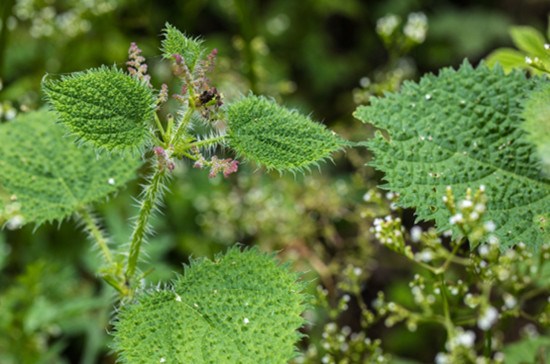
Nettle, commonly known as huoma. In ancient times it was called maomiao or xuncao. In the Ming Dynasty, Li Shizhen wrote in the Compendium of Materia Medica: "Nettle, xun is pronounced xun." He also said: "Nettle is also called maosou. The character xun was originally written as sou. Du Zimei wrote a poem on removing sou grass, which is this." Nettle has very strong survival ability, so its figures can be seen on field paths, grassy slopes, beside ditches, on field ridges, and even beside main roads and around houses. Its appearance is also very easy to identify, with bright emerald green color and a body covered in fine hairs.
The nettle that can "bite"
Research shows that the reason plants in the nettle family can sting is a type of epidermal hair on the plant body. The tip of this hair is sharp as a thorn, the upper middle part is hollow, and the base is a gland made of many cells. Normally the basal gland secretes formic acid and other substances that strongly irritate humans and animals, and this gland fills the cavity in the upper part of the hair tip. Once a human or animal touches it, the tip of the stinging hair breaks off, releasing formic acid and stimulating the skin to produce an itchy, painful sensation. It can be said that this behavior of nettle is legitimate defense, making herbivores shrink back in fear. When you are collecting specimens or cutting grass under trees, beside ditches, or in damp shade near dwellings, you may sometimes feel a sudden sharp pain, as if stung by a scorpion, and small red swollen spots appear, which often take some time to fade. At this point, do not be too nervous; you have likely been injured by the stinging hairs of a plant called scorpion grass, and washing immediately with soapy water can relieve it.
The stinging hairs of nettle grow on their stems, leaves and inflorescences. They are no more than one or two mm long and are transparent. Although the stinging hairs on stems and leaf stalks are relatively obvious, the hairs are after all very small, and in the wild, trying to avoid being stung by observing the stinging hairs is often already too late, so it is still necessary to know what nettle itself looks like. Most nettles are herbs about one meter tall, with slender, four-angled, much-branched stems, thin leaves, five basal main veins, slightly raised parts between the veins, and wide serrations along the edges; the shape varies considerably, from unlobed margins to shallowly lobed and then deeply lobed.
Nettle is monoecious, with female inflorescences growing in the leaf axils of the upper part of the plant and male inflorescences borne in the leaf axils of the lower part. Both are loose spike-like in shape. The inflorescence axis has many fine hairs, and sparse stinging hairs also hide within, waiting for a chance to teach a lesson to greedy herbivores; the fruit is a flat round achene shaped like a convex lens.
A body full of thorns still cannot resist its fate of being eaten
The most easily thought of and also most incredible way to use it is to eat it. The leaves of nettle are high in protein, low in fiber, and also tough, making them a very good green feed for livestock. The Ming Dynasty dictionary Shuyu records that nettle "fed to pigs with leaves makes them strong easily." Nettle can also be eaten by people, and people in many places do eat it. In quite a few regions of our country, there is a custom of picking the tender leaves of nettle and narrow-leaved nettle as wild vegetables. Europeans have also eaten nettle for a very long time. Not long ago, at a site in the UK more than three thousand years old, people found some bronze vessels with traces of nettle soup preserved inside.
The edible value of nettle
The stems and leaves of nettle are rich in protein, multiple vitamins, carotene, and various trace elements such as phosphorus, magnesium, iron, zinc, manganese, silicon, sulfur, calcium, sodium, cobalt, copper and titanium. The stems and leaves of nettle can be cooked and processed into all kinds of dishes. There are cold dressed dishes, soups, roasted dishes, nettle juice, drinks and seasonings, etc. The protein and fat content of nettle seeds is close to that of oil crops such as hemp, sunflower and flax. The oil pressed from nettle seeds has a unique taste and the function of strengthening the body.
Friendly reminder:When gathering tender nettle leaves to eat, remember to wear gloves.
The economic value of nettle
Domestic and international scientific research results confirm that nettle is a wild plant and crop with great economic value, usable for fiber, food, medicine and high-quality feed. The stem bark fiber of nettle has good toughness, strong tensile strength, good luster and is easy to dye. It can be used as a textile raw material, or to make hemp rope, weave carpets, etc.
The nutritional value of nettle is no less than that of feed crops such as alfalfa, clover and beans. It plays an important role in livestock development and is a high-quality feed. Every summer and autumn, harvest the nettle, dry it, cut it up, boil it with boiling water, mix in some concentrated feed such as bran, and it can be fed to pigs. Within ten days to half a month, the pigs' bodies become glossy and they begin to grow fat and strong. In midsummer, when nettle branches and leaves are lush, livestock on the grasslands are unwilling to touch it. However, after the autumn frost, especially in winter and spring when the seeds are abundant, after most of the bitter and astringent taste in the nettle stems and leaves has disappeared, cattle, horses, camels and sheep compete to eat it.
The medicinal value of nettle
In China, there have long been records of using nettle as medicine. Li Shizhen's Compendium of Materia Medica records: "Nettle, its stem has thorns, two to three chi tall, leaves resemble flower mulberry, either green or purple, and the purple-backed ones can be used as medicine." The Song Dynasty's Tujing Bencao also records: nettle grass can be used as medicine; its taste is bitter and pungent, its nature warm, and it has slight toxicity. It has the effects of dispelling wind and calming convulsions, promoting digestion and relieving constipation. It mainly treats rheumatoid arthritis, postpartum convulsions, infantile convulsions, sequelae of infantile paralysis, hypertension, indigestion, and constipation; for external use, it treats the early stage of urticaria, snake bites, etc. Therefore, farmers and herders regard it as a treasure. Pounding nettle and applying it externally to treat venomous snake bites and rheumatoid arthritis and other conditions is quite effective. The dried leaves of young plants are an indispensable ingredient in some medicines, and the treatment of many diseases cannot do without these drugs.
In Europe, nettle is a popular medicine, used as a diuretic, astringent, hemostatic, expectorant and galactagogue, and for treating arthritis, chronic skin diseases, etc. Nettle preparations are used externally to treat seborrheic dermatitis, dandruff and hair loss.
In Turkey, local herbal medicine experts use nettle grass as medicine to prevent various diseases, and it can almost replace all medicinal plants, so it is called the "king of a hundred herbs."