How to Make and Care for Apple Bonsai
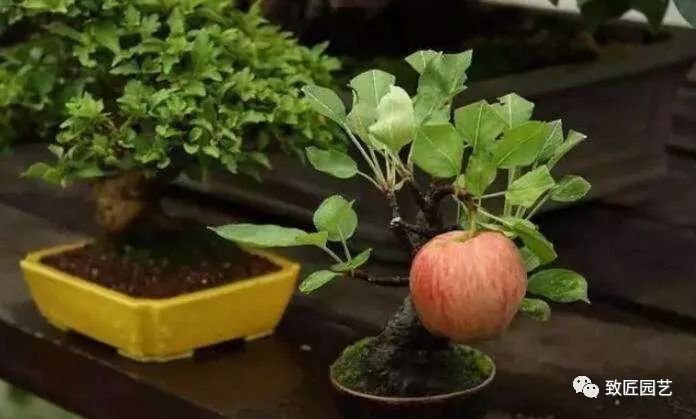
Apples are delicious and tasty, and are one of the fruits most often eaten in daily life. Their skin is smooth and their colors are vivid, and besides being eaten, they can also be made into bonsai. The apple is a deciduous tree of the genus Malus in the rose family (Rosaceae), with many cultivars, reaching up to 5 m tall; the young branches are covered with grayish-white down, while old branches are hairless, and depending on the cultivar the branches may be grayish-brown, yellowish-brown, purplish-red and other colors. The leaves are elliptic to broadly elliptic, and the leaf color gradually transitions from yellow-green to dark green, with many intermediate shades of green in between; the leaf margins have rounded blunt teeth. The inflorescence is a corymb, with pale pink or white flowers, opening in spring. The fruit comes in many shapes, including oblate, ovate, flat-topped and five-ridged, and when ripe takes on different colors such as yellow, red and purplish-red. Today, we will introduce the making and care of apple bonsai, and we hope everyone can study it together.
For making bonsai, choose apple cultivars with small plants, early fruiting, strong self-pollination and fruit-setting ability, medium-sized fruit and vivid colors. Use seedlings of crabapple, Malus baccata or apple as rootstock, and use vigorous branches or plump buds slightly above the middle as scion? Graft by the cleft graft, cut graft or bud graft methods. You can also use old stumps that have grown for many years and have peculiar, antique forms as rootstock, and 1- to 3-year-old branch groups as scion for grafting; this method not only speeds up forming but also brings fruiting earlier. Transplant the rootstock before bud break in spring or after leaf fall in autumn, first planting it in a clay tile pot of suitable size; before planting it should be pruned appropriately, cutting off branches not needed for the design to reduce nutrient consumption and increase the survival rate. The root system should also be pruned, cutting off thick main roots and keeping more lateral roots and fibrous roots; roots of suitable thickness and length can first be coiled into the pot to prepare for later root exposure. In the first year after survival, let it grow freely so that the branches develop fully and the root system becomes complete. In the second year, carry out grafting and cut off the branches on the rootstock to ensure sufficient nutrients are supplied for the growth of the scion.
Depending on the form of the stump, apples can be trained into many different styles of bonsai, such as formal upright, curved trunk, double trunk, slanting trunk, semi-cascade and exposed-root styles. For young trees, the trunk can be wired and shaped to make it twist attractively, combining hardness and softness. For stumps lacking an aged appearance, the trunk can be treated by splitting, carving or hollowing to achieve a clear, striking and antique artistic effect.
Apple branches are soft and quite flexible, so in May each year you can wire 1- to 3-year-old branches to give them a certain bending variation; since wired branches grow downward or spread horizontally, their apical dominance can be removed, causing the plant to gradually change from vegetative growth to reproductive growth, which is favorable for the formation of flower buds. You can also expose the roots according to the needs of the design and the cultivar of the rootstock; among these, apple bonsai grafted onto tree-form rootstock, because of their well-developed and thick roots, are especially suitable for making exposed-root bonsai, and root exposure should be carried out year by year in stages, not all at once. You can also select fresh roots of suitable form, thickness and length and graft them by the subcuticular insertion method. This makes the roots naturally twisted and vigorous and antique.
The apple is a temperate tree species that likes a cool, dry environment with plenty of sunlight, is cold-resistant and fears damp heat. During the growing season it can be kept in a sunny, well-ventilated place; if light is insufficient, the color and quality of the fruit and the plant's shape will all be affected. Because most apple cultivars have very low self-fruitfulness, to increase the fruit-setting rate you can hand-pollinate with pollen of different cultivars during the flowering period. To balance the tree's vigor and let different branches bear fruit in turn, you should also thin flowers and fruit to improve the ornamental effect and prevent alternate bearing. When watering during the growing season, follow "water thoroughly only when completely dry" and avoid waterlogging in the pot soil; when flower buds begin to differentiate in June, watering must be strictly controlled for more than 20 days, and at this time you should water only when the young leaves wilt, to promote the formation of flower buds. During the growing season, fertilize once every 20 to 30 days; in the early stage, mainly nitrogen fertilizer, and after June stop or reduce nitrogen fertilizer and apply more phosphorus and potassium fertilizer as well as trace elements such as calcium and magnesium. During the branch growing period, promptly pinch out the tender tips at the apex to stop the branches from extending and make them redistribute nutrients; these measures can all make the branches develop fully, which is favorable for the formation of flower buds and achieves the goal of bearing more fruit and improving fruit quality.
Apples fear high temperatures; long periods above 35°C in summer will cause branches to grow leggy and fruit quality to decline, so ventilation should be strengthened and shading applied appropriately to lower the temperature. In winter, move them indoors at ℃ to 10°C to overwinter, or bury the flower pot outdoors in a wind-sheltered, sunny spot to overwinter. Every winter or before bud break in spring, prune and shape the plant once, cutting off diseased and dead branches, crossing and overlapping branches, leggy branches and overly dense branches, and shortening overly long branches to keep the tree shape graceful. Every 2 to 3 years, after leaf fall in autumn or before bud break in spring, repot once; when repotting, tidy and prune the root system, remove 2/3 of the old soil, and replace it with fresh, loose, fertile culture soil rich in humus.
Highlights