This wild plant is very rare; if it grows on the rocks around your home, please do not remove it.
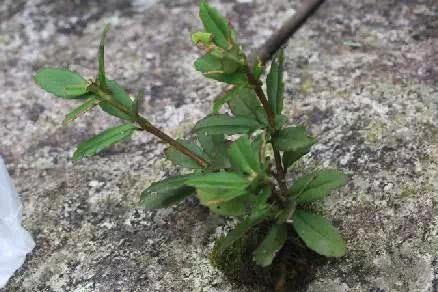
In rural areas there is not only fresh air, but also green, pollution-free fruits and vegetables to eat. Even in those naturally formed mountains there are many admirable wild plants to appreciate. During this period, the colleagues around me and I have all had this idea: after retiring in the future, we will build a thatched hut on the mountain, and when we have nothing to do, plant some flowers and grass and raise some poultry and livestock. Of course, this is just a plan made in advance, and whether it can succeed will depend on the future. Speaking of plants, it makes me unintentionally think of a "Lysionotus" that grows on rocks, and its value is also very high. Let me take this opportunity to share some knowledge about it with you.
The name "Shidiaolan" expresses something very close to its meaning. In some places it is called: Qianchuidia, Yanzedan, Shijiangdou and other names, and it belongs to the small shrub category. In addition, its leaves are leathery, and their shape varies quite a lot, sometimes lanceolate or linear. Its flowering time is from July to October, and it may also be delayed. Its flowers bloom very beautifully, and even I am fond of them. At present it is distributed in Guizhou, Yunnan, Guangxi, Shaanxi, Anhui and other regions abroad in China. If one day you come across it on the rocks around your hometown, I hope you will not directly remove it, because today it is a relatively precious medicinal material. Of course, it should not be harvested at will for the sake of certain interests. Generally, it grows on tree trunks, rocks, and hilly areas.
This kind of Shidiaolan is rarely cultivated by people among the general public. Even if it can be seen in medicinal material shops on the market, it is all wild. Decades ago, because local farmers worked in the mountains, they often saw Shidiaolan on rocks, but due to the lack of knowledge in this area at the time, it must be admitted that they overlooked it. However, some people who knew how to appreciate it even took it home to cultivate in their rooms, thereby adding extra scenery. It also has a characteristic: its leaves are usually in whorls of 3 all year round, but sometimes they are opposite or in whorls of several leaves, and the edges have small teeth.
Reference on the uses of Lysionotus:
Judging as a whole, besides having high ornamental value, it also has precious medicinal uses, such as having certain effects on: cough, dispelling wind and removing dampness, head stuffiness and blurred vision, rheumatic arthralgia, clearing heat, and so on. Generally it is not recommended to test it on yourself, as risks always exist. It is best to consult a professional physician in detail to see whether it is suitable. This article is intended for popular science, thank you.