A few planting tips for indoor potted carnivorous plants - which one do you prefer?
Carnivorous plants hold a huge appeal for many hobbyists. They are also called meat-eating plants, and they get their nutrients by eating insects, which is different from the way other plants absorb nutrients from the soil through their roots.
Most carnivorous plants grow in marshes or damp low-lying areas with plenty of sunlight. The soil in these environments is extremely poor in nutrients, but insects are abundant, so the leaves of these plants have evolved into traps specially designed to catch insects, absorbing the insects' nutrients in order to survive.
These carnivorous plants give off a sweetness that insects love, attracting butterflies, moths, ants and other types of small insects. There are more than 600 species of carnivorous plants in the world, and the environments they grow in are being destroyed. If you see wild carnivorous plants, you must not dig them up yourself - they may be endangered species. It is best to buy them from a garden center.
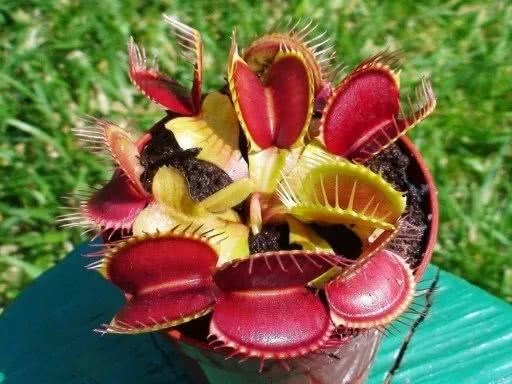
The carnivorous plant above is the Venus flytrap (Dionaea muscipula). Its traps have small spikes on them, and as soon as an insect touches them, the trap closes. Of course, it is harmless to humans.
Carnivorous plants need plenty of light and a humid environment to grow. They usually grow in tropical and subtropical regions, so friends in the north can only keep them as indoor potted plants. There are also a very few extremely cold-hardy carnivorous plants that can survive in the harsh cold of the north.
Most carnivorous plants are very afraid of the cold. Once the temperature drops to around 10°C, they need to be moved indoors to avoid freezing. In winter, you can place them on a sunny east- or south-facing windowsill and give them as much indirect light as possible every day.
For beginners at growing plants, caring for carnivorous plants is not difficult at all. They like sunny and humid environments, so you can simply grow them in a glass container with 3-5 cm of clean water in it, then place the potted carnivorous plants inside. This will greatly promote their growth.
To grow carnivorous plants as a beginner, you need to prepare some crushed stone, sphagnum moss and coarse sand. Carnivorous plants have no requirements for soil fertility - they do not like fertile soil. They prefer loose, airy peat soil with strong water retention. Never add fertilizer to the soil when growing carnivorous plants, because they simply love poor soil.
Before planting carnivorous plants, you can first lay a layer of granular stone at the bottom to maintain good drainage, then wrap the potted carnivorous plants with sphagnum moss. Do not remove the peat soil and perlite around the roots.
After the potted carnivorous plants are planted, water them thoroughly. Always use a container with drainage holes for carnivorous plants. You can put some clean water in the tray under the pot to keep the sphagnum moss moist and maintain humidity.
When caring for carnivorous plants, you also need to make sure they get plenty of light. Avoid keeping them in shady places - at the very least keep the light bright. Apart from shading them appropriately when summer temperatures are high, you can give them plenty of sunlight in other seasons, as long as you avoid scorching.
Note:
Not all varieties of carnivorous plants like a sunny environment. For example, butterworts (Pinguicula) and bladderworts (Utricularia) both prefer cool, well-ventilated spots.
A few common types of carnivorous plants:
1. Venus flytrap
The Venus flytrap's features are very obvious. It has very distinctive traps, which are the snares it uses to catch insects such as the common mosquito, ant and fly and other small insects. However, note that its traps only open a few times in their lifetime, so do not play with its traps.
The Venus flytrap likes plenty of light and a humid environment. Keep the humidity up and avoid infection. As the plant grows, the leaves at its base will turn black and wither, and you need to cut off these blackened leaves promptly.
2. Sundew
The sundew (Drosera) is a carnivorous plant that looks like felt. It has many different species and likes plenty of light. The growing environment should be kept moist, and you should maintain high air humidity and avoid dry air.
The sundew's stems are covered with many fuzzy sticky hairs, which are the traps it uses to catch insects. When an insect flies onto them, it gets stuck.
3. Pitcher plant
The pitcher plant (Sarracenia) looks somewhat similar to the tropical pitcher plant, but its leaves are very distinctive - they look like individual pitchers. Inside the pitcher there is a trap used to attract insects, and there are fine hairs at the mouth of the pitcher, which are used to catch bugs.
4. Tropical pitcher plant
The tropical pitcher plant (Nepenthes) looks very distinctive. At the end of each leaf it grows a small pitcher-like trap, which is what they use to catch bugs. If you want the pitchers to last longer, it is best to mist around them often to maintain high air humidity and avoid dryness, and keep the growing temperature above 10°C.