How to make succulents quickly fill their pots in autumn - don't say you don't know
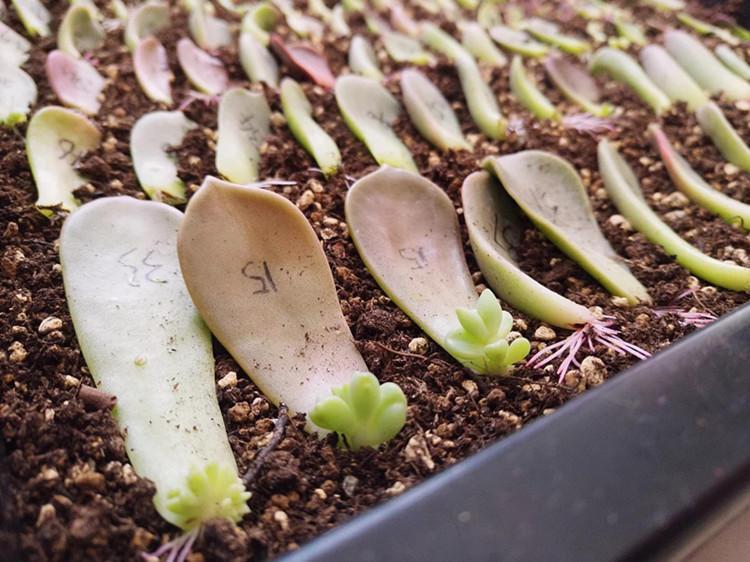
Leaf propagation of succulents is truly a very meaningful thing for enthusiasts, and we all know that leaf propagation has a relatively high success rate and can easily make succulents fill their pots. So, before autumn arrives, master the skill of leaf propagation first, and you won't have to worry about your succulents not filling their pots in autumn.
1. Timing for succulent leaf propagation
Although it can be done in spring, summer and autumn, the editor suggests choosing spring and autumn if possible. Generally speaking, as long as the temperature is above 15°C there is no problem, but after all, summer temperatures are too high, which will have some impact, and the success rate is slightly lower.
2. Selecting succulent leaves
Not all succulents are suitable for leaf propagation, so at the beginning don't go in the wrong direction - choose some inexpensive succulents to practice with so you won't feel bad about it. The leaves used for leaf propagation should be mature, healthy, plump in shape, and preferably the older leaves from the lower layers. In addition, to help the leaves achieve a plump condition, it is best to pay attention to supplementing some nutrients to the succulents normally, using liquid fertilizer and watering the roots once a week.
Note that there are three types not to choose: do not choose insect-damaged leaves, do not choose yellowing leaves, and do not choose tender leaves. After selecting a good leaf, you can gently pull it off - first pinch the leaf with your hand, then rotate it in a circle or rock it left and right; this way the growth point of the leaf will remain intact. For a freshly snapped-off leaf, the growth point is green - everyone must keep this in mind.
3. Air-drying succulent leaves
Place the healthy leaves under indirect light and let them dry for 3-5 days until the wounds heal. During this process the leaves may slightly collapse or wrinkle; if the leaves are healthy this is completely fine. If they collapse severely but still have not grown roots or buds, it also shows that the leaves are not very healthy - of course you can keep them and continue to observe. If the air humidity is suitable (40%-50% during the day, and can reach above 75% at night), the leaves will begin to sprout and grow roots in the air.
4. Choosing the environment, container and soil mix for succulent leaf propagation
As for the environment, before the leaves sprout and grow roots, if the humidity is sufficient (such as in southern regions), soil is not needed at all. But in northern regions where the air is relatively dry, because the environmental humidity is not enough, you can use seedling soil or vermiculite to grow leaf propagations, so that you can manually spray water on the soil surface to provide the necessary humidity.
As long as you don't mind the trouble, any soil can be used for leaf propagation - it's just more troublesome and requires spraying water a few more times. As for the container, as long as it's not too deep, anything works; people who really have the skill can even propagate succulents from leaves in plastic bottles. There is also one most important point: be sure to place a certain number of leaves together in a ventilated, indirectly lit place.
5. Placing succulent leaves on the pot
The young lady also said it is "placing on the pot", not "potting up" - be sure to distinguish clearly. Place the leaves horizontally, with the front side of the leaf facing up (that is, the side that faced up when the leaf was growing on the succulent). The position of the growth point must not be buried in soil; burying the growth point in soil will cause the situation of only roots growing and no buds. What you don't know is that the back side of the leaf has more numerous and more active stomata, and only when these stomata smell moisture will the leaf wake up from dormancy and then grow roots and sprout.
During this period, besides waiting patiently, what we need to do is control water and protect from sun; watering once every two or three days is enough, and remember the unit is "drops", otherwise it is very likely to turn yellow or rot. Also, try not to expose them to direct sunlight; just place them on a balcony or other well-ventilated place for indirect sun exposure.