Lessons from Wild Cymbidium faberi: The Natural Environment Is the Best Environment for Growing Orchids
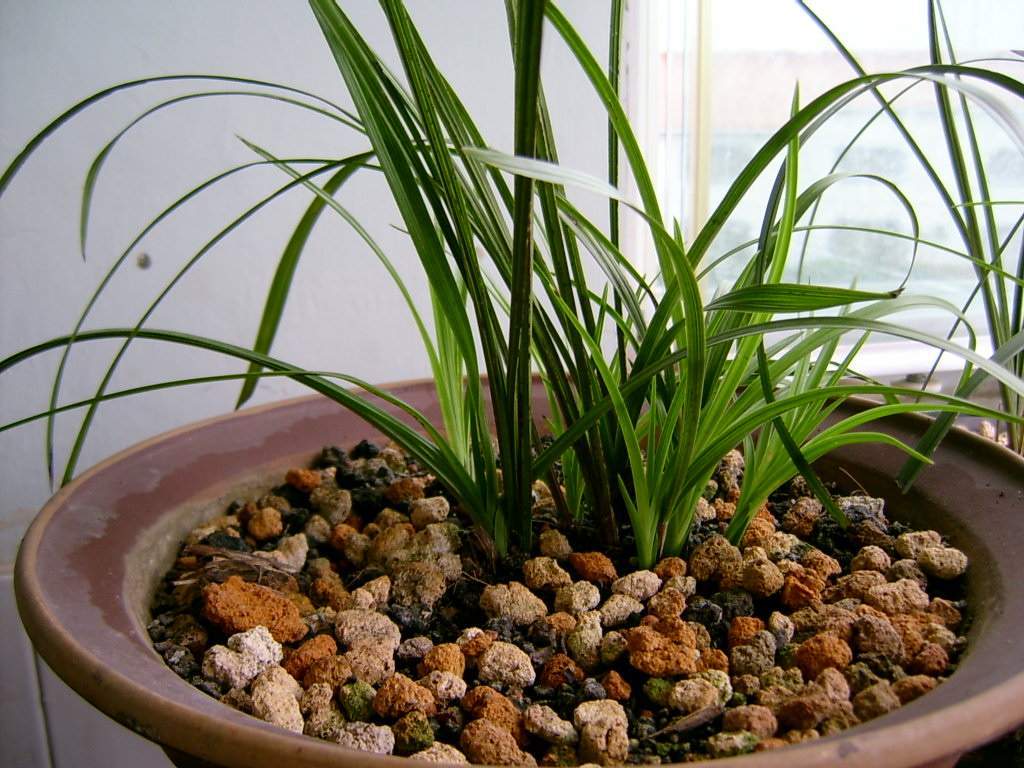
The growth conditions of Cymbidium faberi in nature set us thinking: its native habitat is at a higher altitude than that of Cymbidium goeringii, and it is relatively cold-tolerant and drought-tolerant, preferring to grow on hills and hilltops in sunny, well-ventilated places. Because Cymbidium faberi grows at relatively high altitudes, with strong winds and small pseudobulbs, in order to adapt to its living environment, Cymbidium faberi: (1) relies on thick, sturdy orchid roots that develop deep and far. If the layer of leaf mold soil is deep, the orchid roots will surely penetrate deep into the soil, and because of the wind's movement, the pseudobulbs will naturally be buried deep within it; Cymbidium faberi grown in this environment becomes especially tall, and on the mountain you will see Cymbidium faberi growing over 1 m tall. (2) It relies on its well-developed clustered roots, working together in unity, hand in hand and heart to heart, to draw nutrients from the earth. This kind of Cymbidium faberi mostly grows in shallow soil layers on cliff faces; its characteristic is that it is not tall, but has many shoots, and sometimes you will see a clump of native population with more than 70 shoots, which is quite spectacular. You only need to gently pry with a wooden stick and the whole thing will come out of the soil; seeing such clustered roots with only a little leaf mold soil among them will give you great inspiration for growing Cymbidium faberi.
Wild Cymbidium faberi
What the growing environment of wild Cymbidium faberi teaches us:
1. The key to growing Cymbidium faberi well is: sufficient light, high humidity with large temperature differences, and good ventilation. (Because in modern orchid growing, growing medium, water and fertilizer are no longer the main issues.) How to combine these three elements organically and reasonably is where success lies. Although Cymbidium faberi requires an environment with sufficient light, strong direct sunlight is not suitable in summer; the best light intensity is 15000-25000 lux. With sufficient light, the plant grows robustly, with upright, spirited and glossy leaves; with insufficient light, the plant becomes weak, with slender, drooping, lusterless leaves and fewer flowers. Generally in summer, shading with one layer of 50% light-blocking shade net is better. Keep humidity at around 70-85%, open windows at night for natural ventilation to meet the temperature difference requirement, and in summer use various methods to cool down, controlling the temperature below 31 degrees Celsius; in this way, Cymbidium faberi leaves will not develop spots or scorched tips, and will be emerald green and elegant, appearing more grand and more graceful than Cymbidium goeringii.
Wild Cymbidium faberi
2. The issue of shoot production rate: if the mother plant is a strong seedling and you want more shoots, you need to plant it shallowly, because if planted relatively deep and kept in a moist state for a long time, the reserve buds that the orchid plant possesses will be killed by excessive moisture and dampness, and even with many shoots it will be hard for new shoots to grow. Here I want to share with everyone the experience I have gained over many years: to make Cymbidium faberi produce more shoots, besides strengthening photosynthesis, another key point is to withhold water in March, letting the potting soil dry out completely, which can force new shoots; this is rarely mentioned in orchid books. You may all know the fact that withholding water in July can promote flower buds; in fact, the principle is the same. For several years, my Cymbidium faberi shoot production rate has been above 100%, and this year it even set a new record of seven shoots from four pseudobulbs on two old plants. In addition, if the orchid is not very healthy or is still at the stage of preserving the variety, it is not easy to use the deep-planting method, otherwise the core is prone to rot. If there are many shoots but the plant needs rejuvenation, you can plant Cymbidium faberi slightly deeper; deep planting in a large pot has a good effect, easily producing strong shoots and helping the orchid rejuvenate, but the shoot production rate will be lower than with shallow planting in a small pot. Of course, the premise of deep planting in a large pot is that the orchid grower must be able to perform the correct care actions for watering and withholding water that correspond to deep planting in a large pot, otherwise unfavorable situations will also occur.
Wild Cymbidium faberi
Fellow orchid enthusiasts, do you grow wild Cymbidium faberi? If you also like growing orchids, you are welcome to follow and share, and thank you for your comments and likes, thank you!