If I say the lotus seed pod is not a fruit but a flower, no one's going to argue, right?
A while back, I wrote about the "earthy charm" of the lotus (Review | The lotus isn't as ethereal as you think - it's absolutely delicious!). Many readers said their love for the lotus grew even deeper.
But writing about the lotus just once isn't enough. Last time I talked about the flower, and this time I want to talk about the fruit - the lotus seed pod.
In Siyue's eyes, the lotus seed pod is as magical as cotton. Originally, both were humble cash crops, until one day people walked past a flower shop, discovered them, and thought, hey, these can be used in flower arrangements too? Not bad at all! And they bought a few stems without hesitation.
Siyue guarantees that after reading this, you'll be head over heels for lotus seed pods too.
In this world
In this world
Wang Yuliang
00:00/03:08
{Peony Girl Vol.850 }
x
Lotus Seed Pod Flower Arrangements
In the Jiangnan water towns of August and September, the roaming stalls put away their magnolias and gardenias and start selling lotus seed pods. A touch of green and lotus fragrance is the most heat-clearing, fire-purging "miracle remedy" under the blazing southern sun.
When you mention lotus seed pods, you think of the edible lotus seeds. Children are the first to eat them: "The most delightful is the mischievous child, lying at the stream bank peeling lotus seed pods" - the seeds were still tender when they were peeled open and eaten.
Think Siyue is going to write about eating lotus seed pods again? No, no, no - I'm not a foodie. There's really not much to say about how to eat them.
My personal favorite is eating tender lotus seeds raw.
Lotus seed pods picked in the early morning, having absorbed dew all night,
are at their sweetest and most refreshing.
Or else you just peel and peel, then boil
boil them in soup, boil them in congee, and gulp them down.
Simple, plain, no fancy ways to eat them, and the taste is always bittersweet with a return of sweetness,like its appearance - a single stem with a jade-green head, completely unadorned.No matter how you look at it, you'd never use the word "beautiful" to describe it.
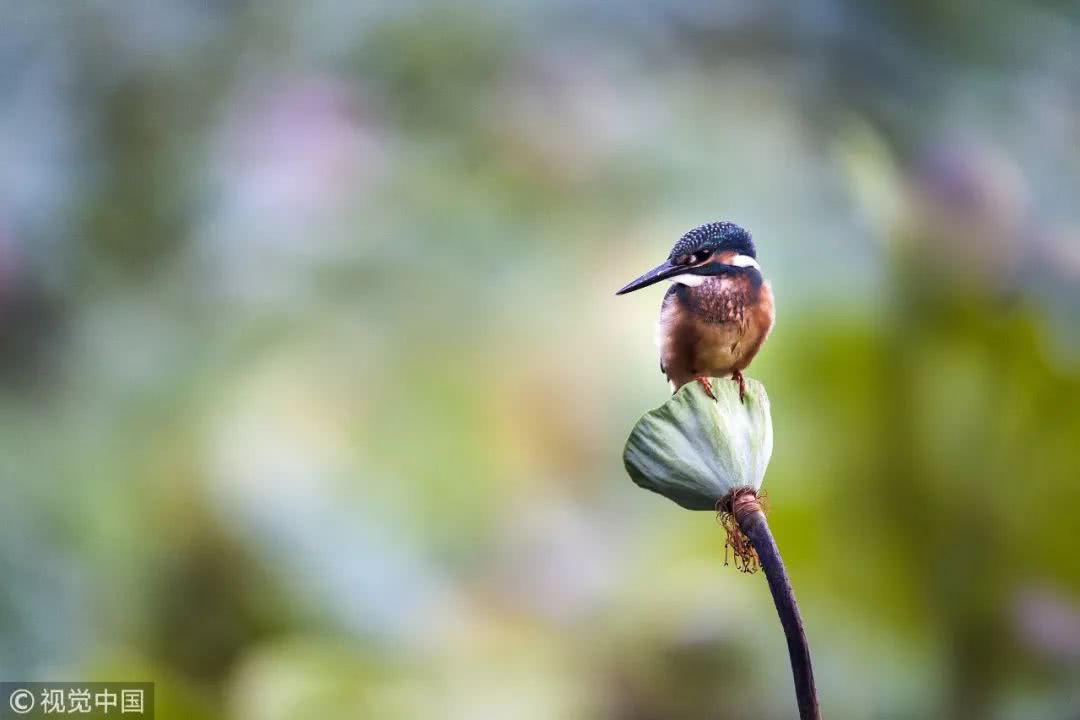
But when someone places a lotus seed pod in a vase, with just one slender stem, this thing's character suddenly transforms. At that point, "beautiful" is no longer enough to describe it.
Perhaps it's love me, love my dog - the lotus seed pod is the receptacle that holds the lotus's pistil, so some of our affection for the lotus transfers to the pod.In our country, the lotus seed pod, like the lotus flower, carries the meaning of holiness and serenity.
The lotus pedestal of Buddha statues is also lotus petals surrounding a lotus seed pod. The lotus flower is elegant and beautiful, while the lotus seed pod is substantial and plain, fitting the Buddhist aesthetic of combining elegance with solemnity.
Using lotus seed pods in flower arrangements wasn't a sudden flash of inspiration from some florist.As early as the Six Dynasties period, lotus seed pods became a trendy floral material for summer and autumn.Scholars liked to place one or two stems of lotus seed pods on their desks to express their aspirations.
In a mural in the tomb of Princess Changle of the Tang Dynasty, a palace maid
holds a vase containing red lotus buds and lotus seed pods,
and the palace maid's dress even matches the flowers.
In the Qing Dynasty, when Fuheng was about three or four years old,
the missionary Giuseppe Castiglione painted a work titled "Auspicious Omens" (Jurui Tu),
with lotus flowers, lotus leaves, and lotus seed pods arranged in a vase,
at varying heights, with free-flowing lines and abundant spirit.
In Japanese ikebana, which is deeply influenced by traditional Chinese culture, the lotus seed pod is also a very important floral material. Toshiro Kawase said in "Flower Correspondence of the Four Seasons": "When I was young, I believed that the lotus carried the mission of bringing people to heaven."
The lotus seed pod's long, straight stem
and the "rikka" (standing flowers) principle of the Ikenobo school of ikebana
are in perfect harmony. In Ikenobo works,
we can often see lotus seed pods.
Pure white lotus, curling lotus leaves,
and the aloof, independent lotus seed pod
together form a scene of quiet solitude.
But the lotus seed pod, freed from the deep imprint of traditional culture, is used much more freely in Western flower arranging, and what it presents is no longer the esoteric beauty of wabi-sabi.
The lotus seed pod's head is round and heavy,
so it can serve as a round mass flower in a bouquet,
pairing beautifully with lotus flowers and hydrangeas.
At the same time, it has a beautiful stem,
with curved or upright lines,
that can give an arrangement more depth and a sense of freedom.
In terms of color pairing in flower arrangements,
the lotus seed pod has no major taboos either.
The most common is in white-and-green bouquets,
paired with large leaves or linear floral materials.
Paired with pink and purple tones,
you actually find the round lotus seed pod somewhat cute -
what's going on?
In yellow-toned bouquets,
the substantial lotus seed pod
creates a feeling of autumn harvest.
To the table! Each one tilting and leaning in its own way~
The lotus seed pod is not only elegant and noble but also symbolizes many offspring, so it's often used in wedding bouquets. Except, a bouquet with lotus seed pods - getting hit by luck might hurt
White-and-green hydrangeas, roses, lotus seed pods,
plus some simple foliage,
and a natural-style bouquet is done~
In cascade bouquets,
the substantial lotus seed pod is needed to support the main bouquet,
making the trailing part appear more flowing.
A bunch of green leaves and lotus seed pods,
a forest-like bouquet.
Compared to fresh lotus seed pods, the seemingly quiet, Zen-filled dried lotus pods are actually even more brilliant in bouquets.
Paired with red and orange tones,
the lotus seed pod has no sense of incongruity,
instead adding a touch of elegance to the vivid colors.
In bouquets with light colors,
the dried lotus pod gives the arrangement a rustic charm.
In a bouquet with a king protea as the focal point,
lotus seed pods clustered around make it look fuller.
Paired with pink-and-white tones and daisies,
the lotus seed pod can surprisingly become fresh and sweet too.
Freed from the specific context of bouquets, the dried lotus pod takes on a Zen-like beauty - desolate yet restrained and free.
When the jade-green lotus seed pod grows in the water, most people don't find it beautiful - instead they think it looks bare and unattractive. But once the autumn wind passes, the lotus flowers scatter and turn to mud, the lotus seed pods are scorched to a purplish-copper color by the autumn heat, and the upright stems bend under the weight of their heavy fruit.
No matter how heartless a person walks by, they can't help but marvel at its desolate beauty, wanting to take a few stems of dried lotus home to place on their desk, watching its withering and flourishing - brilliant yet lonely.
Arranged together with fresh flowers and dried leaves,
it is the lonely master standing alone among the flowers.
A large lotus seed pod hidden among yellow-toned small flowers,
like a handful of small flowers picked up in an autumn field.
Pick up a few fallen leaves, arrange a stem of dried lotus,
and the desolation of autumn arrives.
Pair with pine cones and dried flowers,
and you can make a wreath full of rustic charm.
In fashion-world floral headpieces,
the dried lotus pod displays a cool, aloof beauty.
If you're eager to arrange dried lotus but can't buy any right now, why not buy fresh lotus seed pods and dry them yourself. The drying method is very simple:
1. Choose flawless lotus seed pods with long stems, hang them upside down in a shaded, well-ventilated spot to dry.
2. A dry environment makes drying easy; about 10 days is enough. Never let them get damp during the drying process.
3. After drying, the lotus seed pod naturally develops a purplish-copper color.
Whether fresh lotus seed pods or dried lotus, before they are cut for flower arranging,they are always a single "sinew"- either looking up at the blazing sun, or bending down toward the pond water. On one hand it proudly holds its head high, on the other it plainly bears seeds. What seems contradictory is exactly where its beauty lies.
Appreciating lotus seed pods - whether it's the blazing sun and clear lotus, or withered lotus listening to rain,freshness and elegance together, brilliance and desolation coexisting - that is where its greatest beauty lies, and it's also the philosophy of living that the lotus seed pod teaches us.
The season for enjoying lotus seed pods is short,
so buy a few stems and arrange them at home,
like bringing home a whole lotus pond of Jiangnan.
So, Siyue says the lotus seed pod is also a kind of "flower,"
Do you agree or not?
END
Some images in this article are from Instagram and Pinterest
Images sourced from Visual China Group have had copyright purchased