Foxtail grass has strong vitality, so why did it never become a grain crop in ancient times?
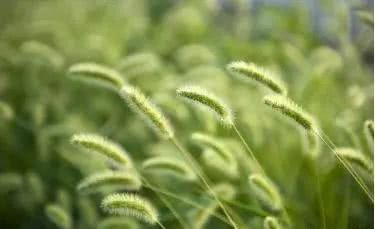
Foxtail grass has nothing at all to do with wheat, but it does have a connection with millet. Below I will explain the origin of the wheat we usually grow, and then explain the relationship between foxtail grass and foxtail millet.
Speaking of the origin of cultivated wheat. This calls for telling everyone a story. In the early 19th century, two Japanese men, Sakamura and Kihara, while studying wheat, discovered that the chromosomes of wheat are very complex. The chromosomes of many organisms come in two sets, but cultivated wheat actually has 6 sets, and these 6 sets come from three different plants. Isn't that strange? Don't worry, let me explain it to you step by step.
The original ancestor of wheat is called einkorn in academic circles, and it has two sets of chromosomes. When it grew naturally in nature, in western Asia where it often grew, there was also a plant called jointed goatgrass. After growing together for countless generations, the two plants developed feelings for each other and successfully combined to produce the next generation. Note that this next generation is a sterile one, just like the mule born from the union of a donkey and a horse. Everyone knows that mules cannot reproduce. The product of the union of einkorn and jointed goatgrass could not escape this fate either.
But by a stroke of luck, the product of their union successfully doubled naturally in nature, and this became what academic circles now call emmer wheat.
Because its chromosomes doubled, emmer wheat gained the ability to continue its line, and then it flourished across the vast lands of western Asia. After countless more generations of reproduction, it seems it inherited einkorn's daring-to-love character, and, just like a wolf falling in love with a sheep, it fell in love with a species different from itself, a species called Aegilops speltoides, or spelt-like goatgrass. The product of their union also could not escape the rules set by nature, and their offspring were sterile.
But fate is just so miraculous, and there is always a way out. After countless attempts and efforts, their offspring also naturally doubled under accidental conditions. At this point, it had evolved into common wheat, which is what we now call cultivated wheat. And this process was successfully simulated again by people after 1940. So the relationship between foxtail grass and wheat is probably not even half a hair's worth.
The relationship between foxtail grass and millet. Legend has it that Shennong tasted all kinds of herbs in the Shanxi area, and finally selected foxtail millet with large ears, heavy grains and good quality from foxtail grass, and taught people to sow and produce it. This freed the tribes in various places from a hunting life and brought them into an agricultural and pastoral farming life.
From Shennong tasting all kinds of herbs to now, 5,000 years have passed. Myth is myth, but when archaeologists excavated the Banpo site in Banpo Village, Xi'an, Shaanxi, they found that a nested pottery jar contained millet (su) from more than 6,000 years ago. After the husk of foxtail millet is removed, it is what we call millet. In fact, the history of Chinese people domesticating foxtail grass can be traced back tens of thousands of years. Conversely, when millet reproduces naturally in nature, it can still degenerate back into foxtail grass. The newly grown foxtail grass and millet are very hard to distinguish, and this is also the origin of the idiom "good and bad mixed together."
This is Science and Agriculture, welcome to follow, and let us grow knowledge together.