The rubber plant needs little care, and when grown by a windowsill it can even climb upward as it grows.
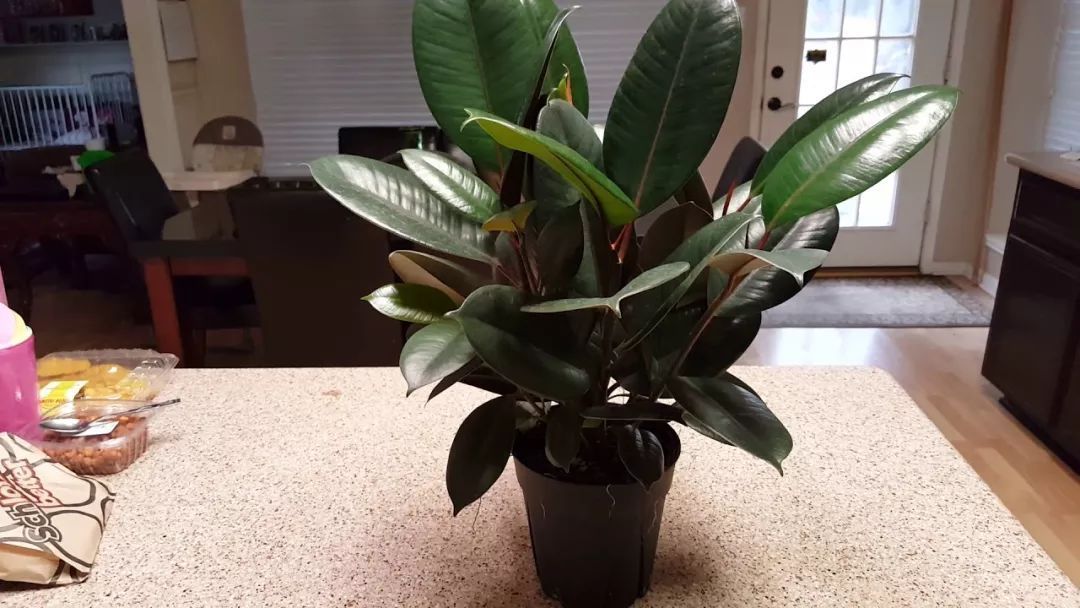
If you want to grow some large-leaved plants but do not want to care for them often, how many plants can you think of? The common Fiddle Leaf Fig, Snake Plant and Chinese Evergreen are all close competitors, but do not overlook the understated yet stately rubber plant (Ficus elastica). It also has many varieties, so let's take a look below.
The one above is the most common rubber plant with emerald green leaves.
1. The growing environment
The rubber plant is also a type of ficus, and it is a medium-sized indoor plant that easily becomes the focal point of a room. Its ornamental value is very good, and it adapts well to indoor environments, growing in both full sun and partial shade.
In an outdoor environment, the rubber plant grows very quickly, especially in a warm and humid environment year-round. If grown indoors, its growth slows down because the pot restricts its growth.
2. Notes on soil selection
The rubber plant is very afraid of waterlogged soil, so be sure to choose a well-draining, loose and airy sandy soil for cultivation. You can choose peat soil, pine bark and perlite mixed at a ratio of 1:1:1.
Be sure to mix an appropriate amount of river sand or perlite into the soil to maintain good drainage, and adding some pine bark is also a good choice. You can lay a 3 cm thick layer of compost soil or decomposed manure at the bottom of the pot.
3. Light requirements
If you want to promote vigorous growth of the rubber plant, then be sure to give it as much light as possible and avoid growing it in excessively shady places. When the temperature is high in summer, avoid direct light or scorching sun.
You can grow the rubber plant by a south-facing or east-facing windowsill, where there is plenty of scattered light every day, which will promote leaf growth. If grown in a dark place, its leaves will lose their luster, and the lower leaves are also prone to dropping.
The one above is a rubber plant with yellow spots. Its leaf veins are red, and the leaves have irregular yellow markings, so do not think it is a disease.
4. Watering and fertilizing
Watering the rubber plant varies depending on the environment. During the spring and summer growing season, keep the soil moist, and you can regularly mist water around it to maintain a certain air humidity and promote good growth. After the weather turns cold in late autumn, you only need to water 1 to 2 times a month.
If you notice the leaves of the rubber plant starting to droop, that proves it needs more water. If the leaves turn yellow and brown, that proves it is being overwatered.
If the air is dry, mist water around it. Otherwise the leaves tend to dry out, especially in winter, when a rubber plant grown indoors is prone to drying up. In winter you can directly use warm water to mist around it.
When watering, be careful not to use tap water directly. You can let it sit for two or three days before using it, otherwise the chlorine in the tap water will make the soil alkaline, which easily causes the rubber plant's leaves to turn yellow.
The rubber plant is only fertilized in late spring or summer, and fertilizing should be avoided in other seasons. Generally, giving a light fertilizer once every 3 to 4 weeks is enough.
5. Pruning techniques
The rubber plant does not need much pruning. Just cut off some withered or yellowed leaves. If you want the rubber plant to grow an attractive shape, you can wait until it reaches a certain height and then pinch off the tender buds at the top, so that it can also grow new branches. This also maintains a good form. The best time for pruning is in spring and summer.
6. Propagating the rubber plant
Many people do not know how the rubber plant is propagated. Actually, you only need to use a section of rubber plant stem and insert it into soil for it to take root and sprout. The cut stem should be about 9 to 12 cm long.
The leaves at the bottom of the stem should be removed, and about 2 to 3 leaves at the top are enough. Cut the bottom end at an angle and soak it in rooting solution, then after 30 minutes insert it into the soil. You can use peat soil mixed with perlite for rooting cuttings, at a ratio of 1:1. During the cutting propagation process, maintain humidity and temperature, and keep the soil moist and avoid drying out.
7. Differences between indoor and outdoor care
The rubber plant is a tropical foliage plant. During care, avoid freezing, and keep the minimum care temperature above 5°C. If the rubber plant is cultivated outdoors, move it indoors when the temperature drops to around 10°C. Only in places without frost year-round can the rubber plant be grown outdoors.