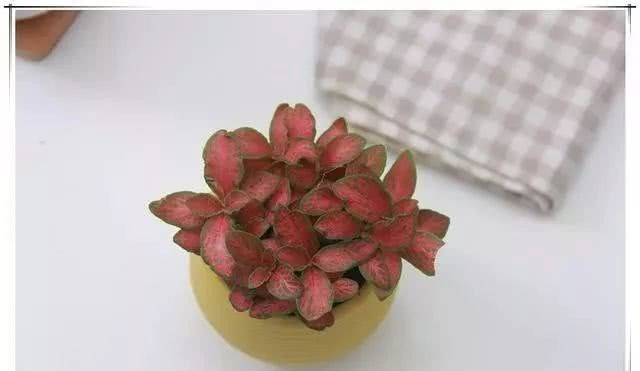
Fittonia has elegant, delicate leaf colors with clearly defined veins and well-proportioned patterns.
Naodong Handmade
You have 40 friends following this official account!
Fittonia is a fairly popular small potted plant right now. It is compact and comes in many varieties, and is deeply loved by plant enthusiasts.A short little plant, it has striking red and green leaves, pink and white veins. Placing different colors together also makes a beautiful scene.
So Fittonia has also become a unique interest for many people. Fittonia is very easy to grow and quite adaptable to its environment. So what should be noted when growing Fittonia? Today Hua Shao will share some growing experience with Fittonia.
Fittonia soilIt can be mixed like this: first place a coarse granular substrate or expanded clay pebbles about 2 cm thick at the bottom of the pot as a drainage layer, then sprinkle a layer of fully decomposed organic fertilizer as a base fertilizer, about 1-2 cm thick, and cover the top layer with leaf mold.
Fittonia likes a humid environment, and during the growing season it needs relatively high air humidity. Especially in the high-temperature summer season, water evaporation is high and the air is dry. In addition to watering to increase the humidity of the potting soil, misting the leaves and sprinkling water on the ground are even more necessary. In summer, air ventilation needs to be strengthened to maintain relatively high air humidity, which is beneficial to the growth of Fittonia stems and leaves.
Fittonia likes diffused light, and dislikes direct strong light. It is fairly shade-tolerant and can be placed on a bright balcony or by a window. Fittonia should be watered in the morning when the temperature is lower. In summer, water once each in the morning or evening when the temperature is low, and also mist the plant frequently. On the contrary, during the winter dormant period, watering should be arranged as much as possible at noon on sunny days when the temperature is higher.
Fittonia likes shade, so indirect dappled sunlight is enough for them to grow. They are very afraid of being sunburned, so it is best not to expose them to direct sunlight. Indoors, they can simply be placed in a bright place. If the environment is fully shaded, Fittonia will not grow well either. The ideal amount of light for a plant is the same as the light it receives in its natural habitat. In winter, you need to let the plant receive more sunlight to maintain the color of the leaves.
Fittonia likes moisture, and the environment should maintain high humidity. Mist the plant frequently to keep it moist, or add water to the substrate or tray. During its growing season it needs relatively high air humidity. If you have a humidifier at home, you can place the Fittonia nearby when using it so it can absorb moisture at all times. If the leaves wilt, this means the plant needs more humidity. Water the plant thoroughly to keep the soil moist, which is also good for the growth of Fittonia, but also avoid water accumulation and poor drainage that cause root rot.
Fittonia likes a warm environmentand is especially sensitive to temperature. The suitable temperature for growth is 18°C-24°C. In winter the temperature cannot be lower than 13°C. 13°C-16°C can maintain its normal growth. At temperatures below 13°C it will stop growing and begin dormancy, and some leaves will begin to fall, but the stems will not freeze. If the room temperature rises back above 18°C, it can continue to sprout new leaves. However, if the temperature is lower than 8°C, the plant is prone to freezing and dying.
Fittonia can grow in peat soil. A substrate based on peat moss is closest to the natural conditions Fittonia needs. Giving it a well-drained soil environment will make it grow more luxuriantly. Fittonia likes light fertilizer. During the growing season, it can be watered with a one-week dose of weak liquid fertilizer or controlled-release fertilizer, or apply houseplant care fertilizer every two weeks, using 1/8 teaspoon of fertilizer in 1 cup of water, and water with the solution until it drains from the bottom of the pot.
Tips:
Fittonia can easily collapse due to lack of water. If it dries out, although watering and soaking the pot will let it recover quickly, this will cause harm to it. On the other hand, soaked plants may turn yellow, the leaves become soft easily, and they are prone to infection by pathogens and attracting insects. So if you want them to live in a place with high humidity and diffused light, you can choose a glass container to grow them, making a small greenhouse for them.
All the wonderful things are in the Hua Yipai Youzan Mall
Flowers and love | Hua Yipai