A pineapple crown planted in the yard for three years finally bore fruit, only to be stolen and eaten by rats.
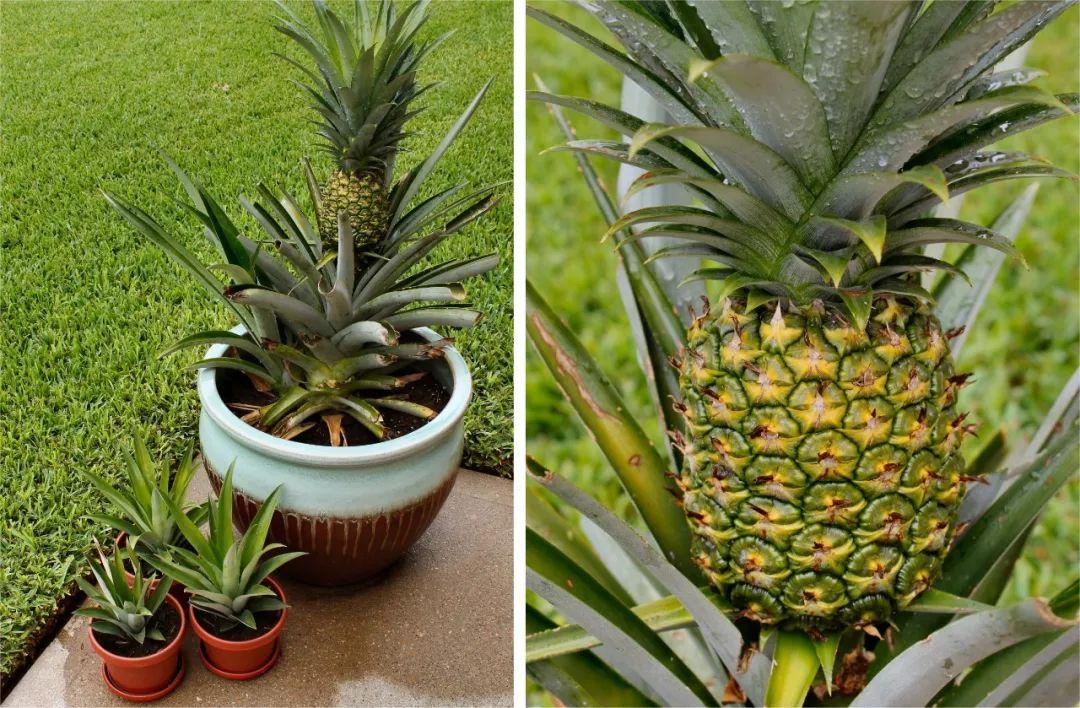
The pineapple is a very healthy food and also a highly ornamental tropical fruit. You can absolutely grow it in your garden, and you can even plant it in a fairly large flower pot. After you twist off the crown of leaves from the top of the pineapple, don't throw it away. You can grow it in a flower pot or in the yard, and after a few years, you will be able to harvest fruit.
There are many pineapple varieties on the market. Some are simply called fengli (pineapple), and some are called bolo (pineapple); there are still differences between them. You can choose some fresh pineapples that have not been refrigerated. The crown of leaves at the top should be fresh; avoid choosing ones that are about to wither.
To judge whether a pineapple is ripe, look at whether the color has turned yellow. If you sniff it up close and there is a fresh, sweet aroma, that proves it is already ripe.
Notes: Do not choose ones that are damaged, spotted, or withered. Do not choose the leaves of an overripe pineapple, otherwise its leaves will have a very hard time re-rooting and sprouting.
1: Cutting off the top crown of leaves
After bringing it home, twist off the crown of leaves from the top of the pineapple. Just twist it several times to pull it off, or cut it off with a sharp knife.
After that, remove the 4 to 5 layers of leaves at the base of the crown, so that you can see some exposed small aerial roots.
Some people like to directly twist off the top crown of leaves. This method is also very convenient, and it avoids cutting off excess fruit flesh.
Of course, I prefer to cut with a sharp knife; even if the pineapple is not very ripe, it is still very easy to handle. Before planting, first remove the excess fruit flesh. Remove all the fruit flesh at the base of the crown, so that some small roots are exposed, looking like small white spots, and keep only some of the longer leaves at the top.
2: Removing excess fruit flesh and bottom leaves
Too many pineapple leaves can also affect rooting, because too many leaves will consume a great deal of nutrients, and the aerial roots at the base cannot be exposed either. This will affect encouraging the pineapple crown to re-root and sprout.
All the fruit flesh at the base of the pineapple crown must be removed. If it is not removed, the entire crown will easily rot.
3: Drying the wound
After the pineapple fruit flesh has been cleaned off, do not rush to plant it. You can first place it in a shaded, ventilated spot for 2 to 3 days, letting its wound and cut area dry completely. Only after the wound has healed can you proceed to the next step. This is also to avoid the crown rotting.
4: Planting notes
Once the cut on the pineapple has healed, it can be planted. Some people like to soak the pineapple crown in clean water to root it, changing the water once every 2 to 3 days, and place it on a ventilated windowsill with light, avoiding direct sunlight. This is rather troublesome; I prefer to plant it directly into soil.
You can choose pot cultivation, using loose soil with good drainage. Just choose peat soil mixed with perlite at a 2:1 ratio, and you can add some compost soil at the bottom of the pot.
For pot cultivation, you can choose a 30 cm diameter clay pot or plastic pot, avoiding damage to the roots. Add an appropriate amount of river sand or perlite to the soil to maintain good drainage, and avoid using heavy clay soil. Generally it takes about three weeks to resume growth.
5: Indoor care tips
For the first two to three weeks after planting the pineapple, water it regularly to keep the soil moist, but avoid water accumulating in the soil. After that, you can grow it in a sunny, ventilated place. Avoid growing it in an overly dark place, and pay attention to watering to avoid the soil becoming overly dry. For the first one or two months, the soil must not be too dry.
After two to three months, you can begin regularly supplementing with some nutrient leaf fertilizer, preferably a water-soluble organic fertilizer. Give a dilute organic liquid fertilizer or balanced fertilizer once every 2 or 3 weeks.
The pineapple is a tropical fruit, and during care it needs sufficient light. Growing it on a south-facing balcony or in the yard is very suitable. It must receive at least 6 hours of direct light every day. For indoor care, also pay attention to regular misting to maintain higher air humidity and avoid the air becoming overly dry.
6: Flowering and fruiting
Growing a pineapple takes a very long time to bear fruit. It is a very slow-growing plant, and it must be planted in a place without frost all year round. In cold winters (temperature below 4°C), it must be moved indoors. Generally it takes 2 to 3 years to flower, and when grown in a flower pot it generally takes 3 to 5 years to flower and bear fruit.
7. What if it does not flower?
Some people say their pineapple has been grown for 2 to 3 years without flowering. That is very likely because no fertilizer was added, or there is insufficient sunlight.
Generally it takes about three years to flower and bear fruit. You can place some fully ripe apples beside it, which will produce a certain amount of ethylene gas to induce the pineapple to form flower buds and encourage fruiting.
You can cover the apple and pineapple together with a plastic bag, which will encourage fruiting, because the apple will release ethylene gas and promote flowering.
Note: Do not place other flowers next to the apple, otherwise it will cause the flowers to rot.
The pineapple above is one I painstakingly grew for three years, also cultivated by the same method: twisting off the crown of leaves from the top of the pineapple, planting it in the yard, and watching it slowly grow and slowly bear fruit. Unexpectedly, it was stolen and eaten by rats.