Is Cymbidium goeringii 'Sixi Die' easy to bloom and does it have a delicate fragrance? Detailed guide to growing methods
How is the growing method for Cymbidium goeringii 'Sixi Die' done? Is Cymbidium goeringii 'Sixi Die' easy to bloom? Sixi Die generally has 8-10 flower buds per pot, so it is easy to bloom. Does Sixi Die have a delicate fragrance? Yes, but it is not a delicate fragrance, it is a strong fragrance. The petal type of Sixi Die is multi-petaled and multi-lipped.
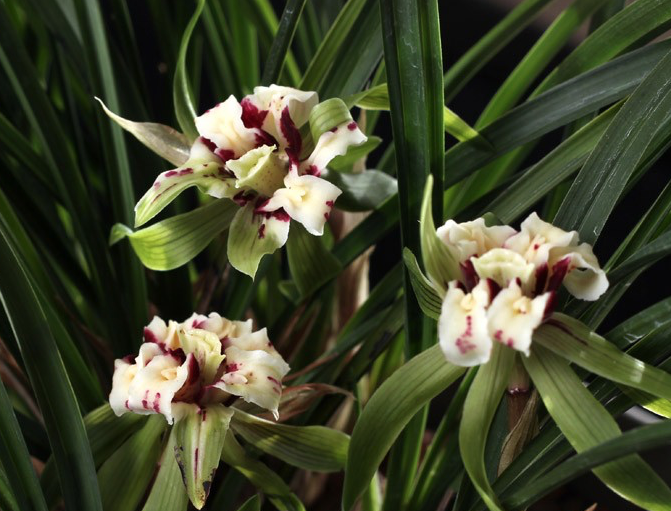
The characteristic of Sixi Die is that the four petals of the outer whorl are opposite, forming an X shape; the three petals of the inner whorl have transformed into a half-length white lip.
Growing methods for Cymbidium goeringii 'Sixi Die':
Pot selection: the size of the pot is related to how many Cymbidium goeringii 'Sixi Die' are planted, and a suitable size is best. Potting: then according to the length of the roots of Cymbidium goeringii 'Sixi Die', place Cymbidium goeringii 'Sixi Die' suitably in the middle of the pot, shake several times to settle the soil, and fill the soil to just cover the roots.
Watering: after the orchid is planted, it needs to be watered thoroughly, and afterward it should only be watered once the soil has dried out completely; fertilization emphasizes light fertilizer applied slowly. Generally, the potting-in period for orchids is fifteen days. Orchids like semi-shade and semi-humidity and dislike strong light and temperature; when the temperature exceeds 12°C, flower buds formed in autumn are also prone to dying under the soil surface or the flower stalk not elongating, and flowering will be abnormal.
Therefore, orchids like semi-shade, like humidity, and dislike strong light. Generally in winter, 50%-60% shading should be used, and in summer 70%~85% shading; on cloudy days no shading is needed. Orchids can be exposed to light rain, but must avoid moldy rain, showers, or continuous rain. During the moldy rain season, rain prevention work must especially be done well. From late June to mid-September, there are often showers. If the rain time is short and the rainfall is also small, more watering should be done in the evening to let the hot air in the pot escape; otherwise the orchid will be damaged, or even the roots will rot and the plant will die. If the sun comes out again right after a shower, shade should be provided in time to prevent the hot air rising from the ground from affecting the growth of the orchid. In the rainy season, which is exactly the stage when orchids send out leaf buds, if the potting soil is too warm it will cause poor leaf bud growth or invite disease.
Pest and disease control
Sterilization treatment should be carried out (the most important thing is to focus on prevention) to prevent diseases from occurring. Orchids are most prone to southern blight and soft rot in the rainy and high-temperature season. A 800-fold solution of thiophanate-methyl or a 3000-fold spray of streptomycin can be used for prevention. If the disease is severe, a 1500-fold dilution of Lingnanmycin + 1200-fold prochloraz can be used, sprayed once every 7-10 days. Among insect pests, scale insects occur the most; this insect attaches to the base of the leaves. If scale insects are found, they should be removed promptly. To avoid scale insect infestation, starting in April, a 1500-fold solution of chlorpyrifos can be used for control.