With proper watering, the anthurium (Anthurium andraeanum) blooms beautifully. Can it be kept indoors?
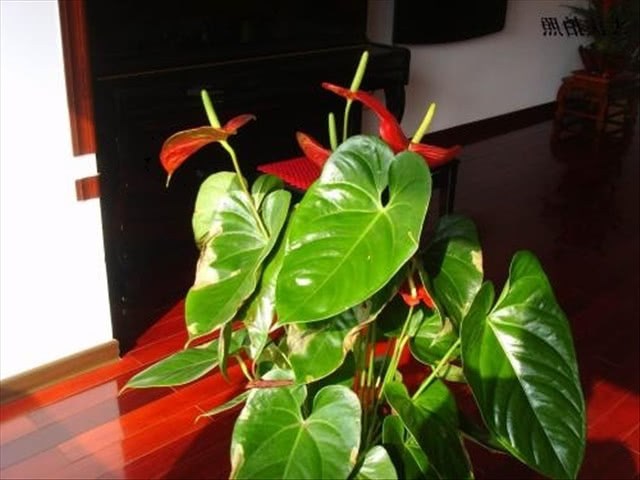
Original title: How should you water an anthurium? Find the right method and it will bloom beautifully. Can it be kept indoors?
Summary: How should an anthurium be cared for? When growing an anthurium, yellow leaves always appear. We only need to find the cause and the anthurium can go back to blooming beautifully. The anthurium's symbolism is also very good - it stands for a grand future and great fortune - and the anthurium's flowering period is especially long, reaching 2 to 7 months. With proper care, it can even bloom continuously throughout the year.
Watering
But when we care for an anthurium, we don't know how to keep it alive, and yellow leaves always appear. So let's talk about how an anthurium should be cared for, and how we should water an anthurium. Watering is already a very difficult problem for many flower lovers, so how should an anthurium be watered? The anthurium actually prefers acidic soil, and we also have certain requirements for water quality. We need to choose somewhat acidic water, and we must also pay attention to how often we water.
Watering time
We can spray water 2 to 3 times a day. Medium and young anthurium plants need more water, so the water we give must be sufficient. During the anthurium's flowering period, we can appropriately reduce its water a little, and the watering time is also different. In spring, autumn and winter, we can choose warm weather to water, and we must not water during cold, overcast times. In summer, we can choose to water in the evening; do not water the anthurium at noon.
Watering method
As for our watering method for anthuriums, water quality also has certain requirements. Anthuriums are relatively sensitive to salt. For water we can choose somewhat acidic water. If we use ordinary tap water from home, we need to let it sit for 2 to 3 days before using it. Although the anthurium prefers acidic soil, if the water is too acidic, it will reduce the anthurium's ornamental value. Natural rainwater is the best water source for caring for anthuriums. When it rains, we can store up more for the anthurium. And when we grow it at home, we can choose mineral water bottles, fill them with tap water and let them sit for 3 to 4 days. We can spray the leaf surfaces, which increases humidity, and after the tap water has sat for a certain time, the chlorine in the water can properly evaporate.
Sufficient water
As for watering anthuriums, our potted anthuriums will be at different stages, so their water quality requirements are naturally different. During the anthurium's seedling stage, its root system is relatively weak, it is distributed rather shallowly in the substrate, and it is not drought-tolerant. Right after planting, we spray water 2 to 3 times a day, and we must frequently keep the substrate moist; this can also encourage it to grow more new roots. During the anthurium's medium and large seedling stage, growth is relatively fast at this time, and it needs relatively more water, so we must give it sufficient water. When our anthurium is blooming, we should water a little less and can add a little more fertilizer, such as phosphorus and potassium fertilizer, which can also promote blooming.
Watering time
When watering anthuriums, we also need to pay attention to the watering time. In the three seasons of spring, autumn and winter, we should choose to water when the weather is relatively warm; we can choose morning and noon. We must not water in a cold, overcast environment. When watering in summer, we can generally choose to water in the evening, and we must not choose to water at noon. We can also choose to water at 10 to 11 in the morning, or we can water after 3 in the afternoon.
Points to note
When watering anthuriums, there are also points to note. We need to pay attention to the water temperature, which we can keep at around 15°C; this is very important in both severe cold and relatively hot weather. Also, the medium should not be too wet, because we all know the anthurium's root system is semi-succulent and can store a lot of water itself. If there is too much water, it will cause oxygen deprivation and it will be unable to breathe. Being in this state for a long time will also cause its root system to rot.
Humidity
We also need to maintain its humidity. We all know the anthurium prefers a humid environment, that is, the humidity of the air, not the water content in the soil. The weather in our north is relatively dry, and windy, so water evaporates relatively quickly. At this time we need to replenish water in time; if we do not replenish water in time, the humidity will drop. Keeping the anthurium's humidity at 70% to 80% is enough. If we don't know how to ensure its humidity, we can observe its leaves. If the tips of its leaves become dry, it proves the humidity is not enough, and we can spray some water to increase the humidity.
Can anthuriums be placed indoors?
Many people ask whether anthuriums can be placed indoors. If we are only doing it for ornament, they can be placed indoors. But if we are placing them in a bedroom, this editor does not recommend putting plants in the bedroom, because most plants absorb oxygen at night and release carbon dioxide. In other words, most plants absorb oxygen together with us at night and compete with us for it. Also, the anthurium is slightly toxic; if we don't eat it by mistake, it doesn't matter, and the anthurium's toxicity is mainly in its sap. As long as we don't touch its sap, there is no problem.
Slightly toxic
So is the anthurium toxic? Actually, the anthurium does have some slight toxicity, but as long as we don't eat it by mistake, it doesn't matter. In fact, only its sap is toxic. When we prune the anthurium, we can wear gloves, and after pruning the anthurium, be sure to remember to wash our hands in time.
Very uncomfortable
So many netizens are asking: if an anthurium is eaten by mistake, or we accidentally touch its sap, what should we do? If we accidentally eat an anthurium by mistake, it is a very uncomfortable thing, and it will make us feel a very burning pain in our mouth.
Symptoms
It will also cause blisters, make our voice very unpleasant and hoarse, and make swallowing a problem too. But these symptoms will slowly disappear over time. If we want to relieve this pain as quickly as possible, we can choose a cooling liquid or some pills to swallow. If our skin accidentally touches the anthurium's branches and leaves, it will make our skin feel sore and painful and also become red and swollen. At this time we need not worry; it will get better slowly. In our daily care, it doesn't matter if we touch its sap.
Indoor display
Also, the anthurium can absorb harmful gases in our air, such as trichloroethylene, and can also purify the air for us. Moreover, the anthurium's flowering period is especially long, making it very suitable for growing indoors. And the anthurium in our indoor display.
It is possible
It is possible and will give us an excellent home style. These anthuriums can be placed indoors. If we really want to admire them and also want to add a touch of green to our bedroom, that is also possible, but this editor does not recommend placing anthuriums in the bedroom, because at night they will compete with us for oxygen and release carbon dioxide. But if some of you don't mind the trouble, we can keep them in the bedroom during the day and move them to the living room at night.
Conclusion: So anthuriums are actually quite easy to grow. We only need to water them reasonably and they will bloom beautifully. And anthuriums can indeed be kept indoors, it's just that this editor does not recommend keeping them in the bedroom.