79% of oats found to contain glyphosate, which may harm children; Food and Drug Administration: not imported into Taiwan
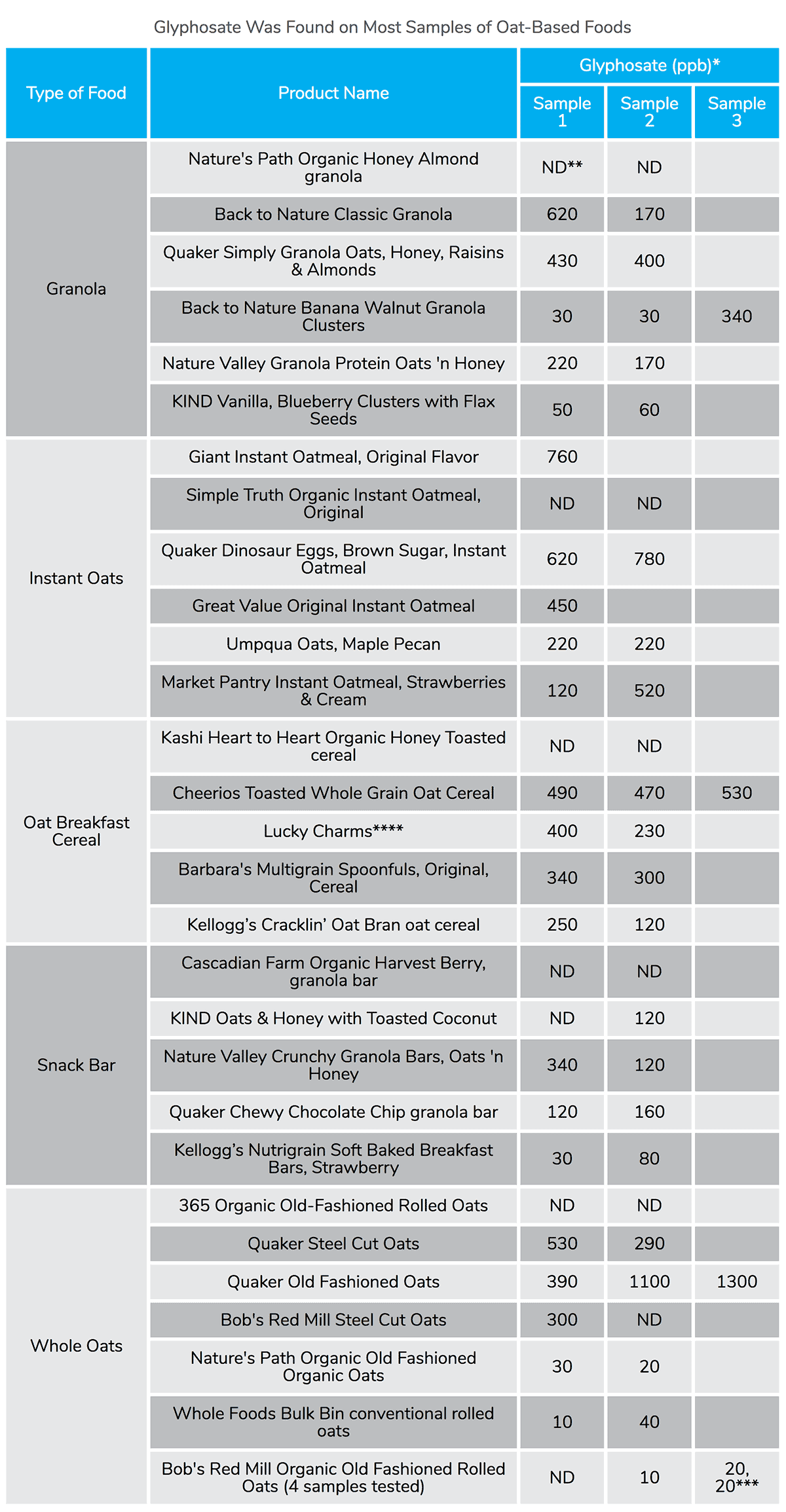
A US environmental group tested widely sold oat products on the market, taking 61 samples in total, and 79% were found to contain the herbicide "glyphosate," with most products exceeding children's daily safe intake by two to three times, even products from well-known major brands Quaker and Kellogg's being caught. Among the conventional farming products, 43 of 45 samples were found to contain "glyphosate," while for organic oat products, 5 of 16 samples tested positive for glyphosate residue, though the residue levels were far lower than those of conventional oats.
The Food and Drug Administration stated that the named oat products have not been imported into Taiwan from January 2017 to the present, and that Taiwan has currently included "glyphosate" in routine pesticide testing for oats and grain products, with a residue standard of "not detectable."
EWG testing: 95% of conventional oat products contain glyphosate residue; Quaker, Kellogg's and others exceed children's safe intake
The purpose of the US environmental group EWG (Environmental Working Group) is to study chemicals harmful to the environment and people's health, conduct testing of products on the market, and disclose relevant information. In EWG's latest report on oat products sold to the public in the United States, conventional and organic oat products were tested separately. Among the conventional oats, 43 of 45 samples were found to contain the herbicide "glyphosate" (glyphosate), a detection rate as high as 95%, including products from well-known brands Quaker and Kellogg’s. For organic oats, 5 of 16 samples tested positive for residue.
Glyphosate is the main ingredient in "Roundup," a best-selling product of the US agricultural company "Monsanto," and is also the pesticide with the second-highest sales in Taiwan (2016). EWG pointed out that glyphosate is widely used throughout the United States and can be found in almost all processed foods containing oats, beans, wheat and barley ingredients. People eat these oats and grains every day, and the chemical substances also accumulate in the body over the long term.
FDA: products named by EWG have not been imported into Taiwan; Taiwan's glyphosate standard is "not detectable"
Wei Renting, deputy director of the Food Division of the Food and Drug Administration under the Ministry of Health and Welfare, said that the Ministry of Health and Welfare compared the names of 29 oat products named by EWG and found that there had been no import records from January 1, 2017 to the present.
In 2016, the FDA tested 36 oat products on the market, and 28% were found to have glyphosate residue and failed inspection. Wei Renting pointed out that oat products sold in Taiwan mainly rely on imports, and every batch must be submitted for inspection upon import and must pass the domestic routine 373-item pesticide test; starting in 2016, "glyphosate" was additionally tested for oats and grain products. He stressed that glyphosate has been included in routine pesticide testing for oats, and Taiwan's standard for "glyphosate" content in imported oats is "not detectable."
He further explained that Taiwan's tolerance standards for glyphosate residue vary depending on the nature of the crop. The tolerance for glyphosate in citrus fruits, sugarcane and rice is 0.1 ppm, for wheat (including triticale) it is 5 ppm, and for soybeans (yellow soybeans, black beans) it is 10 ppm. However, because Taiwan has limited oat cultivation area and mainly relies on imports, domestic oats have less need for cultivation-related pesticide use, so the FDA has not yet set a herbicide tolerance level for oats, and the current standard for glyphosate remains "not detectable."
What is Taiwan's standard for setting pesticide residue tolerances? Does it follow EWG in setting different safe intake levels for sensitive groups such as children? Wei said that when Taiwan sets residue standards for various pesticides on different crops, it has already taken into account the conditions of different age groups. "Although there is no special grading like abroad, the tolerances set all conform to the safe intake levels for all age groups."
Quaker Taiwan: raw materials for products sold in Taiwan are imported from Australia
Quaker Taiwan posted on its official website that the Quaker oat series products sold in Taiwan are manufactured by Standard Foods Corporation, "the oat raw materials used are imported from Australia, produced and manufactured in Taiwan, and have passed 426 pesticide tests." However, before the reporter's deadline, Quaker Taiwan could not be reached.
EWG: non-GMO crops use glyphosate as a desiccant, and residue risks need attention
In addition, Alexis Temkin also pointed out that "Roundup," usually used as a herbicide, is in fact also widely used as a desiccant. Even non-GMO crops such as wheat, barley and soybeans are often treated with it shortly before harvest, resulting in residue in oat products. She stressed that the risk of pesticide residues from desiccants should not be overlooked.
In response, Zou Huijuan, deputy director-general of the Bureau of Animal and Plant Health Inspection and Quarantine, said that in Taiwan glyphosate is mainly used as a herbicide and can only be used for weed control; it is prohibited for use in desiccation treatment.
She also explained that after Taiwan announced a ban on paraquat in 2017, sodium chlorate was mostly used instead, mainly for drying plants before harvesting red beans. It belongs to plant growth regulators and was opened for farmer registration and use after the Bureau of Animal and Plant Health Inspection and Quarantine assessed that there was no risk of harm. She pointed out that the Bureau of Animal and Plant Health Inspection and Quarantine and the Agriculture and Food Agency currently strictly monitor whether farmers use improper desiccation agents, stressing that " domestically, paraquat and glyphosate must never be used to treat plant drying."