A flower-and-plant love letter beats a business-trip guy who only knows how to give roses. If no one is keeping you company tonight, come take a look.
Today is Qixi. Did you get a gift as soon as you got out of bed? And how many of you got flowers? If not, Siyue is giving you some! Read carefully to the end of the article, there is a Qixi surprise.
As for what flower to write about for Qixi, Siyue thought about it for a long time: the flower of secret love, the flower of confession, the flower of passionate love... When it comes to love, flowers have ten thousand ways of expressing it, but it seems we rarely give flowers any love.
Once flowers are received and love is obtained, the flower's mission is complete, and then it is discarded. Everyone is used to using flowers to express love, yet some people use a lifetime of devotion to express their love for flowers, portraying one "love letter" after another with delicate brushwork.
Ito
SARAH
Sarah àlainn
00:00/04:05
{Peony Girl Vol.847 }
x
Writing love letters for flowers
Several hundred years ago, a few infatuated men spent a lifetime writing love letters for flowers. These "love letters" are not like the mushy ones Zhu Shenghao wrote to Song Qingru, nor as sweet as those Wang Xiaobo wrote to Li Yinhe.
I flipped through the entire book, and not a single word in the text mentions love, with no mushy or sentimental ink at all, and it is even extremely serious. Yet on closer reading, the eyes and the heart are filled entirely with this delicate flower; it seems to come alive before your eyes, lovely, gorgeous, serene; the flower's myriad forms all flow out onto the paper.
Silk tree
Chinese milk vetch
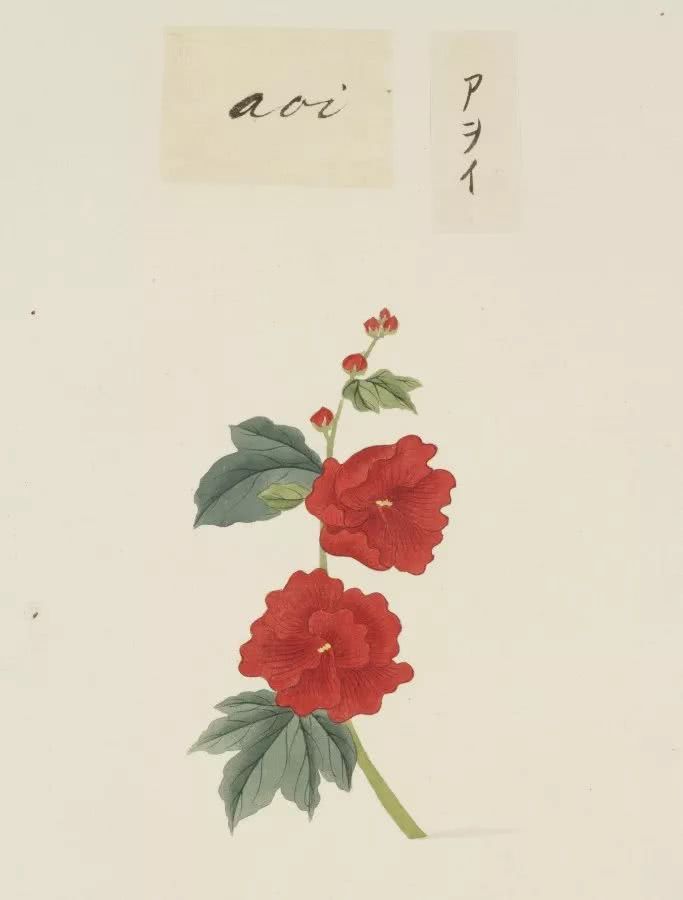
The love letters Siyue is talking about are actually paintings of flowers made by Japanese painters. I define them as love letters because these paintings let people see a feeling of heart-fluttering.
Unlike other botanical scientific illustrations, these works,one book depicts only one kind of flower; they wanted to leave behind in time their love for this flower, and preserve its once most flourishing blooming season.
Spanish broom
Japanese spirea
Now, follow Siyue and read these love letters dedicated to flowers~
Illustrated Catalogue of Cherry Blossoms
Although Japan has no official national flower, the importance of cherry blossoms to Japan is self-evident; the spirit and essence of Japanese culture can all be embodied in cherry blossoms.
Every year when March arrives, from the first cherry blossom beginning to bloom, television stations track the whole process of the cherry blossoms' first bloom, full bloom, and falling. In earlier times, without advanced filming equipment, Japanese people who loved cherry blossoms would record the most meticulous beauty of the cherry blossoms with a paintbrush.
Illustrated Catalogue of Cherry Blossoms includes 112 cherry blossom varieties. The painter Manabu Miyoshi was the first person in the world to study cherry blossoms and is known as "Dr. Cherry Blossom."
"Not seen for just three days, and the world is full of cherry blossoms."
There is no mighty rain of cherry blossoms sweeping in,
just one after another displayed quietly.
More than 100 kinds of cherry blossoms differ only slightly,
and the colors are mainly just pink and white.
Without years of meticulous observation,
and love from the bottom of the heart, how could this cherry blossom love letter ever have been born?
Manabu Miyoshi is like a devout worshipper of cherry blossoms,
showing the most meticulous and truest side of cherry blossoms,
as if displaying a precious jewel to people.
Thirty-Six Morning Glory Flowers
The first time Siyue learned of morning glory was in The Tale of Genji. At the time, I only half understood the book and had forgotten most of the plot, but my impression of morning glory was extremely deep.
The morning glory in the book, namely "Lady Morning Glory," is noble and beautiful, independent and brave, and is one of the few women in the book who dared to directly reject Genji. She is as radiant and strong as the morning glory.
Thirty-Six Morning Glory Flowers was created in 1854, a love letter to morning glory painted by the famous naturalist painter Hattori Setsusai.
The whole book depicts 36 kinds of morning glory in colorful paintings,Although far fewer than the number of morning glories recorded in the Flora of China, the morning glories depicted in the book are all rare treasures, and many have already been lost.
"The morning glory grows a flowering vine,
twisting a hundred turns and a thousand bends around the well bucket,
only asking for water from someone."
The morning glory's vines twist their bodies and grow in the book,
small flowers of various colors, some gentle, some baring teeth and claws,
as if still competing in splendor.
Morning glories open in the morning and wither in the evening, their bloom is brief,
but precisely because of their vitality when blooming,
they are regarded as a symbol of courage and strength.
The flower language of the morning glory is eternal love,
its supple vines and vivid flowers,
are just like the appearance of a woman guarding love.
Camelia Flower Illustrations
Tsubaki flowers are not the edible Chinese toon, but camellias.In legend, camellia flowers grow only in secluded valleys far from the noise of the world. Their status equals that of cherry blossoms, and they are praised as "sacred flowers."
Everyone only knows that Japan has famous cherry blossom viewing spots, but they do not know that on Oshima near Tokyo, the camellia viewing spots are no less impressive. Every early spring, young girls put on kimonos printed with camellia flowers and go to view the camellias.
When camellia flowers fall, the whole blossom withers and drops, carrying a rather heroic, tragic beauty. This is called "fallen camellia," and it is regarded as the soul of the samurai.
"The camellia has fallen, and spring is shaken by it."
The camellia flowers painted in the book,
it is unclear whether they are fallen camellias or blooming on the branch,
without branches or leaves, huge flowers bloom on the paper.
White, pink, red,
or pink and white interspersed, red and white interspersed,
each color is very clear and elegant, and seeing them makes one forget vulgarity.
The petals are layered again and again, full of vitality,
on the paper, displaying their proud and enchanting posture.
Lotus Register of Lord Shirakawa
In Japanese tradition, feelings toward the lotus are completely different from those in China.
In our country, the lotus is a symbol of purity and the noble gentleman, but in Japan, the lotus is an ominous flower.Because the lotus often appears in Buddhism, and Buddhism represents the world of ultimate bliss, it is generally used only in temples and funerals.
To paint such an "ominous" flower may require great courage. It is unknown who the painter was, but he must have loved the lotus terribly; every lotus, whether blooming or closed, is just like still growing in pond water, swaying gracefully.
The veins on every petal,
are clearly visible, as if they could still be touched.
The whole book contains more than 50 kinds of lotus,
the most common being pink and white,
the number of petal layers varies,
at first glance they look very similar, but on closer look each has its own charm.
The green lotus and Jiangnan lotus with white and green,
and the brocade-edged lotus whose petal tips look stained with blood.
There are also rare kinds with purple and white interspersed.
They are the most bewitchingly gorgeous among lotuses~
Illustrated Catalogue of Japanese Iris
Japanese iris and calamus are two completely different plants.Calamus is a plant of the genus Acorus in the family Araceae, while Japanese iris is a variety of Iris ensata and belongs to the genus Iris in the family Iridaceae.
Japanese iris originated in Northeast China and was introduced to Japan in the ninth century. After long-term selection and breeding by horticulturists, 100 varieties have already been cultivated.
Japanese iris is one of the few flowers that combines both feminine softness and masculine toughness. The upright, hard leaves and the delicate flowers are just like the two sides of the chrysanthemum and the sword.
Every stalk of Japanese iris stands gracefully,
blooming within old book pages.
The flower shape and colors of Japanese iris are varied,
white is elegant, purple is charming, brown is eerie.
The Japanese iris painted on paper,
is not the kind that can attract people in an instant,
it has a gentle and subtle power,
and its beauty gradually seeps into our hearts.
The 5 flower illustrated catalogues Siyue introduced today are merely a drop in the ocean of ancient botanical catalogues still existing in Japanese libraries. After looking at these paintings, my heart is full of gratitude and admiration.
From Shanhai Shupin
Several hundred years ago, when material goods were still not abundant, there was already a group of plant lovers using their whole lives to record the beauty of plants. Several hundred years later, looking at these paintings, we can seem to imagine how flourishing the blooming seasons were at that time.
The paintings botanists made of flowers are love letters dedicated to flowers, and also precious wealth for humanity. They let flowers from long ago shine amid the dust of history, still fragrant and enchanting.
From Shanhai Shupin
Note: The images from Illustrated Catalogue of Cherry Blossoms in this article come from Douban user Yarenshu's album; other images come from scanned files from the Tokyo National Library, the National Diet Library of Japan, and other libraries.
Qixi bonus
To express love for plants, words are also a pretty good way,
so why not write a line of love poetry for plants in the comments today.
The top three comment love poems by likes
will receive Peony Girl and HeartBeat's
floating plant specimens prepared for everyone.
The deadline is August 19 at 12:00,
and I will notify the winning friends in the comments.
(Prize images are for reference; the plants in the bottles are shipped randomly.)
END
The floating plant specimen images come from HeartBeat Studio.
The copyright belongs to them.