How to grow Hippeastrum? Master a few tricks and the blooms will be bright red
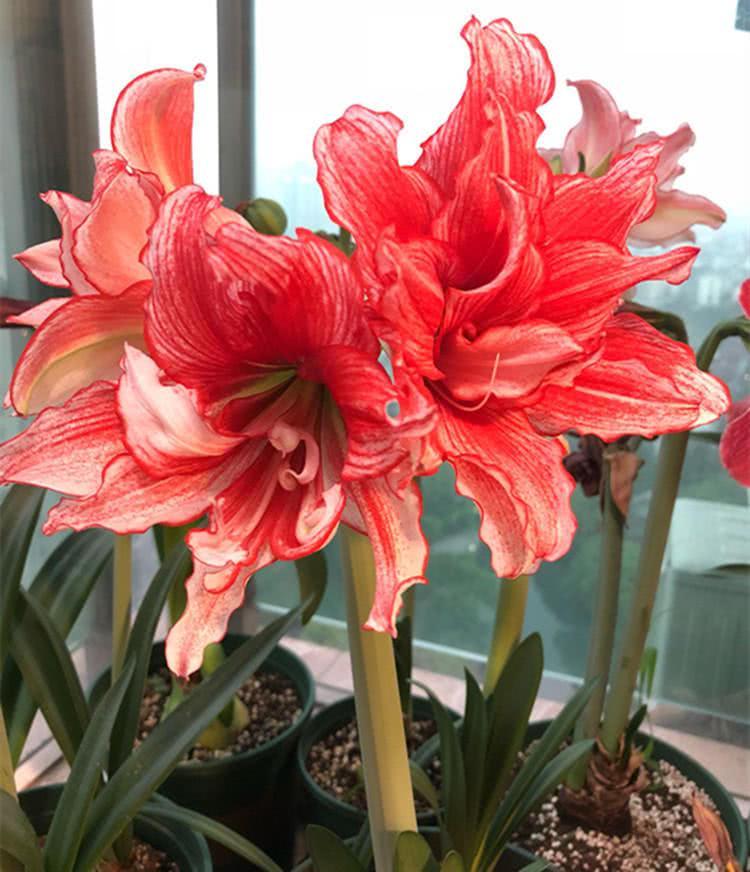
Hippeastrum (amaryllis): when it blooms, the flower stalk is pushed up out of the bulb, thick and hollow, with large funnel-shaped flowers in white, red, or white-striped colors. It is a very representative flowering plant among bulbous flowers. So, autumn will be the season for bulbs. How do we grow Hippeastrum well so that its flowers are big and red? This requires gardeners to fully "master" the cultivation techniques.
1. Master the cultivation techniques and the stems will be thick and the growth vigorous
Gardeners, bulbous Hippeastrum can be repotted in May, and the offsets under the bulb can be broken off and planted separately. For the potting soil mix, you can choose 3 parts humus soil, 3 parts compost, and 1 part sandy soil. As a base fertilizer, chicken manure granular fertilizer can be used.
When planting, leave the top 1/3 of the bulb exposed above the soil surface. After planting, water once thoroughly, and afterward keep the soil moist. When the leaves grow to 5-6 cm, topdressing can be applied, using horsetail-sole fertilizer water with sauce residue once every 10 days. If you find this kind of fertilizer water, use a general-purpose organic liquid fertilizer for flowers instead, diluted 500 times, watered at the roots once a week, and the Hippeastrum will grow vigorously.
2. Master the summer and winter techniques, and you need not worry about blooming
When caring for Hippeastrum in summer, avoid direct sunlight; it can be placed under a shade shed. In the rainy season, prevent water from accumulating in the pot, so as to avoid bulb rot. At the time of frost's descent, place it in a greenhouse and then gradually reduce watering to bring the plant into dormancy.
When caring for Hippeastrum in winter, gardeners need to dig out the bulb, cut off the roots and leaves, bury it in sandy soil in a cold cellar, and replant it in spring. Strengthen light exposure, apply fertilizer water frequently, and during the flower bud stage spray potassium dihydrogen phosphate solution several times, with a ratio of 0.5%.
3. Master the post-bloom techniques, and next time you will welcome big flowers
The flower buds of Hippeastrum are formed during the growth stage after the flowering period. Therefore, after flowering, promptly cut off the faded flowers, leave the flower stalk, and place the pot in a sunny spot, with appropriate shading in hot weather. After the flowers fade, apply organic fertilizer once, such as a general-purpose organic liquid fertilizer for flowers. Usually take care to keep the potting soil moist.
In July, the young leaves of Hippeastrum grow quickly, so increase the application of potassium fertilizer; in August, apply phosphorus fertilizer as topdressing, which helps flower bud differentiation. In late autumn, when the temperature drops below 15°C, the Hippeastrum can be moved indoors to a sunny spot to extend the growth period and improve flower quality.
4. Master the water culture technique, and the blooms will be bright red
Hippeastrum can also be grown in water. The specific method is as follows: take out the bulb that was stored in sand in winter, wash it clean, and plant it in a shallow dish filled with clear water and plain sand, propping it upright to encourage rooting. When the bulb has grown roots 0.5 cm long, move it into a glass bottle, with the bottom of the bulb slightly touching the water surface.
Keep the room temperature at around 20°C, change the water once every 7-10 days, and without special care it can bloom normally. After flowering, move the plant into a pot for soil culture, supply water and fertilizer, and it will quickly plump up the bulb and restore its vigor, preparing for the next round of water culture.