Mushrooms Growing in a Rose Pot: Good or Bad?
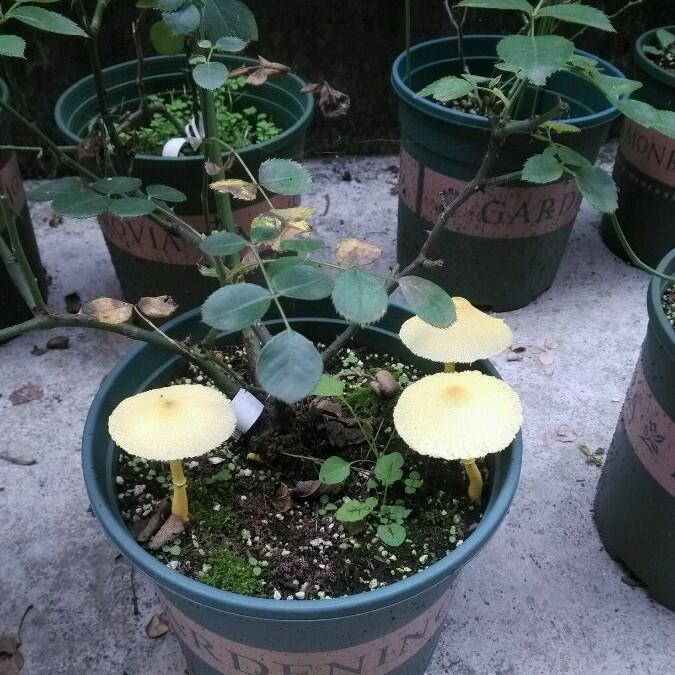
Growing roses is a happy, leisurely pursuit, but now and then even a tiny problem can leave you flustered, anxious and unable to figure out the cause. And sure enough, another gardener says mushrooms have sprouted in their rose pot, the pot is full of spores, and the smell is strong. Although it seems not to affect the roses' growth, it looks unpleasant. What should be done?
In some gardeners' pots, the spores come with the soil they used, possibly from pine bark mulch or other leaf litter that contained mushroom spores, which is quite normal, just as mushrooms grow in forests. In other cases, they drift in on the wind and happen to land there and settle in. Either way, never eat them carelessly. Gardeners often joke about waiting a bit longer, then adding some meat and stir-frying them, but joking aside, a serious reminder to everyone: without knowing what kind of mushroom is growing in the pot, it is best not to eat it carelessly. Even insects only eat the non-toxic ones, so we should be careful too and not take that risk.
With the cause identified, conditions are also needed for such mushrooms to grow, and most of the time it is moisture. Mushrooms themselves are naturally fond of damp and humid conditions, so when you water too much and the wet-dry cycle of the potting soil does not flow properly, the water in the soil cannot drain through, naturally creating a humid environment. If the pot is placed in a rather shady spot, they are even more likely to grow. So when watering roses, be sure to let the soil dry out thoroughly and then water thoroughly, and do not be too casual about it.
In daily care, pay attention to the moisture level of the potting soil. If the soil conditions cannot be improved, you can increase ventilation to promote evaporation of water from the soil and improve the humid environment. Likewise, change the shady environment and give more sun exposure, thereby preventing mushrooms from appearing.
The common mushroom species found in rose potting soil is Leucocoprinus birnbaumii (the yellow houseplant mushroom), which has strong reproductive capacity and whose spores spread everywhere; in the substrate it is found in peat or pine bark. Common fungicides cannot kill it. In the short term, aside from being unsightly and consuming soil organic matter, it does little harm to the plants. Because it spreads widely, take care to isolate it when dealing with it to avoid spreading it to other plants. If conditions allow, it is best to replace the soil; spores are already present in the soil, and if left untreated, they will grow as soon as conditions allow, at a rate that absolutely cannot be stopped.
When changing the soil, note that choosing a loose, breathable soil specially formulated for roses is best. For growing roses, it promotes root development and strong seedlings, and since it is fully fermented, it will not contain fungi, naturally preventing mushrooms from growing in the potting soil.
No matter which kind of mushroom it is, it basically has little effect on roses, so it is recommended to repot and change the soil after winter pruning, control watering and place the plant in a dry, non-shady spot, and by the following year it will basically be kept in check. In addition, gardeners are advised not to casually use organic fertilizers that are not fully fermented. Although the effect is good, improper handling can damage the structure of the potting soil. You can use some organic liquid fertilizer that improves the soil, diluted and poured at the roots, for a better effect.
Mushrooms belong to the fungi kingdom, so simply pulling them out is not enough. It is still recommended to repot and change the soil; even if it is a bit more trouble, it is reliable and safe. During the period before repotting and changing the soil, if you cannot stand the sight and want to pull them out by hand, remember to wear gloves and take protective measures to avoid poisoning.
And during this period, isolation is also a must; this point allows no carelessness, otherwise a large-scale infection is not good news.
When mushrooms grow in rose potting soil, the most important thing is still to prevent poisoning. Households with children need to be even more careful. Mushrooms may look nice, but do not let carelessness lead to big trouble.