Heart-shaped plants are the ultimate Valentine's Day confession tool, a must-have for singles
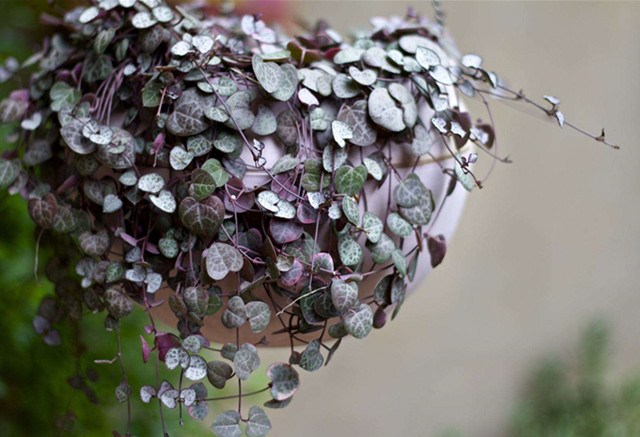
Today is Qixi, the Chinese Valentine's Day. Want to give your loved one a bouquet of flowers? Isn't that a bit cliché? Fresh flowers wither easily. Actually, it's better to give her a "heart-shaped" plant. I think they're cuter than roses and Chinese roses, more meaningful, and they will never wither. You can keep them for a very, very long time. These heart-shaped plants will also make your life more enjoyable. See how many of them you recognize?
1. String of Hearts
String of Hearts (Ceropegia woodii) is a succulent plant in the genus Ceropegia, family Apocynaceae. Its leaves look like little pink hearts, very beautiful. String of Hearts is perfect for giving as a gift, suitable as a love gift with a beautiful meaning.
String of Hearts can be planted in hanging baskets, suspended by the door or in front of a window, with its stems and vines swaying in the wind, very amusing; placed indoors in a ceramic pot at a corner, on a tall flower stand or on top of a bookcase, its stems and vines hang down, reaching about 150 cm in length, flowing freely, and are very popular.
The suitable growing temperature for String of Hearts is 15-25°C, but it can also tolerate the high temperatures of summer at 35°C, and can tolerate low temperatures of around 10°C in winter. It has strong adaptability to temperature and prefers scattered light, avoiding direct strong light. It does not like fertilizer, and especially avoid applying high-phosphorus-potassium fertilizer. Because its roots have large tubers that can store nutrients and water, it is a very drought-tolerant plant.
2. Heartleaf Hoya
Heartleaf Hoya (Hoya kerrii) is originally a vine-like succulent plant in the genus Hoya, family Apocynaceae. It likes shade and humidity, and its shape is like a heart, so it is also called "love leaf" and "valentine hoya." Plants propagated from leaf cuttings can survive for a long time after rooting. Heartleaf Hoya can also be used as a gift exchanged between couples to express their feelings, and a flower language has formed: one leaf means "wholehearted devotion," two leaves represent "two hearts as one" and "kindred hearts." There is also a variegated variety of Heartleaf Hoya, Heartleaf Hoya variegata, with golden-yellow markings on the leaves.
The flowers of Heartleaf Hoya are elegantly colored, like wax handicrafts, and the thick fleshy leaves are like pieces of "heart," very peculiar, and can be placed indoors for viewing. Besides being planted in potting soil, it can also be grown in other forms such as hydroponics or soilless culture.
Heartleaf Hoya prefers loose, breathable, fertile potting soil that drains well and has a certain degree of granulation. Watering should follow the principle of "don't water if not dry, water thoroughly when you do." You can mist Heartleaf Hoya frequently to increase air humidity, making the leaves thick and plump, and to clean dust off the leaf surface. Apply an organic liquid fertilizer or compound fertilizer once a month; the fertilizer solution should be dilute rather than concentrated. In winter it can tolerate low temperatures of around 5°C; it should be placed indoors in a spot with plenty of sunlight, and watering should be controlled. In summer during high temperatures, pay attention to ventilation and avoid a stuffy, hot environment. Repot once every 1-2 years in spring; when repotting, cut off rotten roots and plant in fresh potting soil.
3. Oxalis
Oxalis is a perennial herbaceous plant, with sparse soft hairs all over; stems prostrate or ascending, much branched. Leaves alternate, palmately compound with 3 leaflets, obcordate, leaflets sessile.
Flowers yellow, likes sunny, warm, humid environments. In hot summer areas, it should be given half shade. It has strong drought resistance and is not cold-tolerant. It can generally grow in ordinary garden soil, but grows most vigorously in sandy loam rich in humus. It has a short dormancy period in summer.