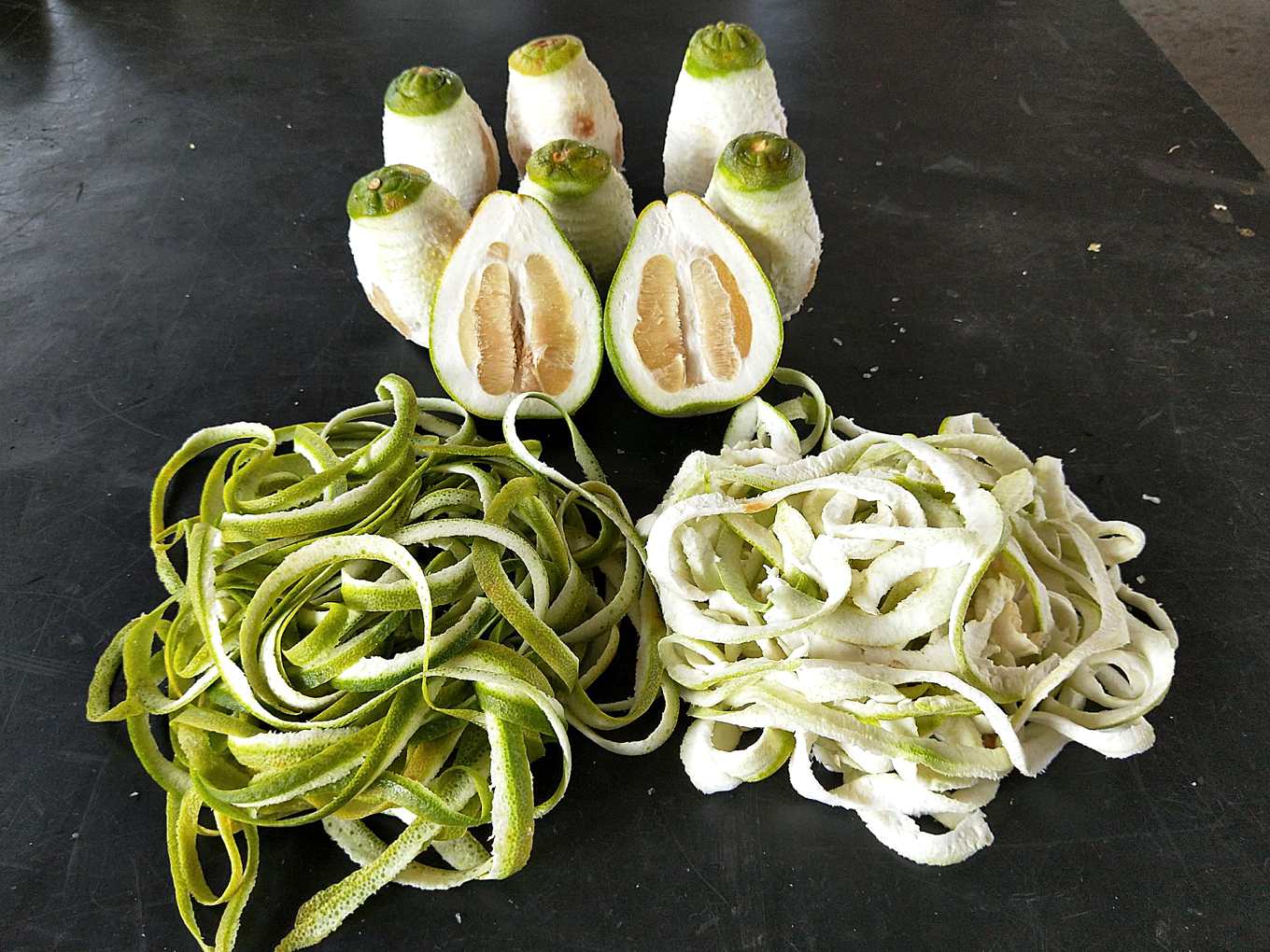
Peeling pomelo just got easier! Hualien District Agricultural Research and Extension Station develops a peeling machine to separate the green peel, white pith and flesh
Peeling pomelo can be more convenient! The Hualien District Agricultural Research and Extension Station ("Hualien DARES") has adapted a machine originally used for peeling pineapple to handle pomelo processing tasks such as cutting the peel, removing the white pith and keeping the flesh, hoping to reduce farmers' workload, improve operational efficiency, make pomelo peel quality more consistent, and further benefit downstream processing procedures.
Hualien-Taitung farmers: peeling machines can assist processing, but must be linked to the overall industry chain
What is the willingness to buy a mechanical peeling machine? Zeng Guoqi, head of "Dongfeng Shisui Farm," produces organic rice and pomelo, and on average about 20 to 30 percent of his pomelo is used for processing each year. He points out that pomelo peel can be processed into essential oil, cleaners, handmade soap, mosquito coils and candied pomelo peel snacks, but peeling, separating the white pith and the flesh all require manual work, which is time-consuming and labor-intensive, so he mostly delivers "whole fruit" (meaning the entire pomelo) to processing plants for unified handling.
Regarding the development of an automatic peeling machine, Zeng believes it can indeed help pomelo farmers handle the peel. But he stresses that supporting agricultural product processing "is not something that can be solved entirely just by one machine coming out." He believes all technological development must be linked to the downstream end of the industry chain, for example how to mechanize the flesh processing part, processing plants' willingness to use mechanical peeling machines, and what other pomelo processed products can be developed.
Peng Yurong, founder of "Hualien-Taitung Vegetable Market," returned home to start a business many years ago, hoping to help solve the production and marketing problems of Hualien pomelo through processing. Currently the pomelo raw material used to make candied pomelo peel is mainly the peel. In addition to using normal fruit, last year he also purchased some large fruit or off-grade pomelo with partially damaged peel.
He describes that in making candied pomelo peel, you first use a steel brush to break the oil cells on the surface of the peel to reduce the bitter components, then "remove the head" and cut several slits with a knife, then peel by hand, taking off the peel together with a little white pith and green peel, cutting it into pomelo peel strips with a shredder, blanching to fix the color, and finally adding sugar to pickle it.
In the past he pointed out that there was a lack of easy-to-use peeling machines on the market. Regarding the new version of the peeling machine launched by Hualien DARES, he said, "I haven't used it yet, but it looks like it could solve the peel processing problem." However, he also pointed out that the peel length for making candied pomelo peel does not need to be too long, while the machine performs the peeling action on a whole pomelo as a unit, and the blade will cut off one long strip of peel, so it still needs a further cutting step in use and may not be convenient for direct use in candied pomelo peel processing.
As for how pomelo flesh should be handled? Peng explains that currently the peel utilization rate is higher than that of the flesh. The peel can be made into cleaning, cosmetics, baking and tea beverage related products, with wide uses. The flesh is more labor-intensive to process. The fruit must first have its "head and tail removed," then the flesh must be peeled open by hand, removing the bitter segment fibers. If the segments are not fully processed, it will affect the taste of the flesh when made into juice or jam, and these all affect processing operators' willingness to use it.
Tainan farmers: more helpful to peel processors
Xie Yujie, a pomelo farmer in Madou, Tainan, says Madou pomelo is mainly for the fresh fruit market, and processing demand is not large. In addition, most Tainan pomelo farmers are small-scale units, with orchard area averaging below five fen. "When it's time to peel, I just peel them one by one, anyway the quantity isn't too much." She believes the peeling machine is more suitable for orchards with large processing demand.
Zhang Wenzhao, associate researcher at the Tainan District Agricultural Research and Extension Station, also points out that pomelo processing still needs to consider the part of extracting the flesh, but the machine currently can only solve the peeling problem and cannot help pomelo farmers handle the separation of segment fibers and flesh, so he believes the peeling machine may be more helpful to peel processors.