An Exclusive Interview with Chinese Bonsai Art Master Hu Leguo: The Evergreen Pine of the Bonsai World
Special Feature by China Flowers & Penjing Magazine
A Memorial Album for Chinese Bonsai Art Master Hu Leguo
The Evergreen Pine of the Bonsai World
- An Exclusive Interview with Chinese Bonsai Art Master Hu Leguo
Written by Yang Dongxu
This article is an original piece by "China Flowers & Penjing Magazine," and China Penjing has been authorized to publish it.
On August 11, 2018, Chinese bonsai art master Mr. Hu Leguo passed away, which is undoubtedly a tremendous loss to the bonsai world. Hu Leguo devoted himself to bonsai art creation for decades and made indelible contributions to the development of China's bonsai industry, remaining active on the stage of bonsai art well into his later years. To this end, China Flowers & Penjing Magazine has compiled a memorial album featuring articles published by Master Hu Leguo in China Flowers & Penjing magazine, as well as articles from China Flowers & Penjing magazine's exclusive interviews with him, to express our highest respect for Master Hu Leguo!
Master Hu Leguo is immortal!
- The Editors of China Flowers & Penjing Magazine
Hu Leguo
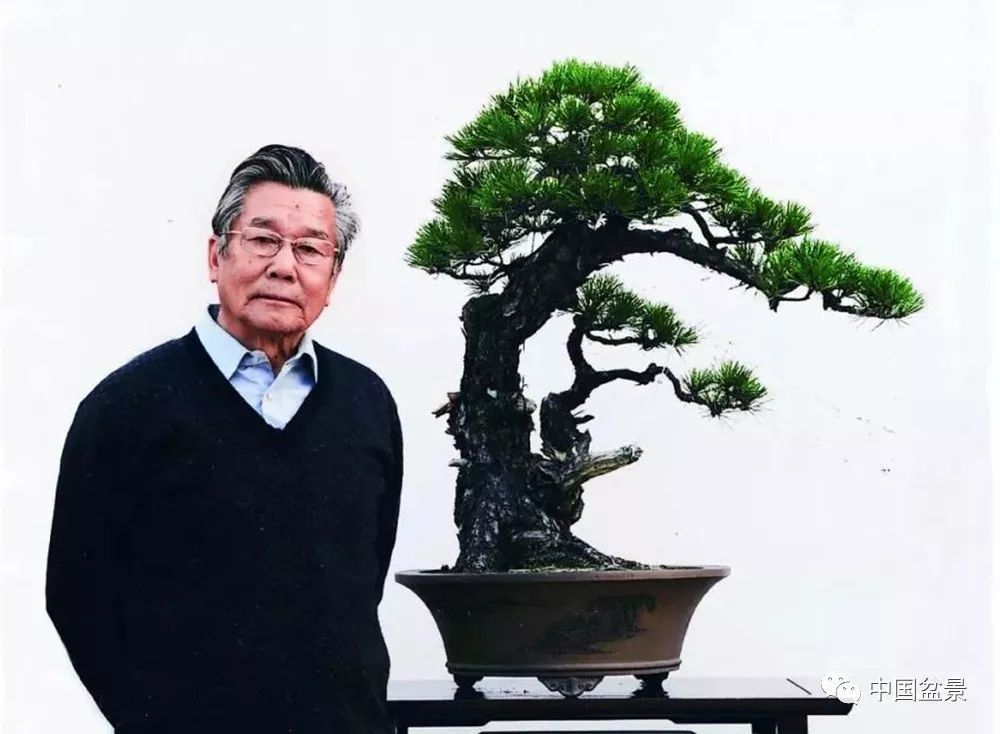
Meeting this thin, elderly man for the first time, one would never connect him with the brilliant achievements and great fame I had heard of; he was clearly an ordinary old man, nothing more. The marks of time covered his face, with kind eyes and a gentle expression. But as you talked with him, you gradually felt his inner energy and wisdom. Though approaching eighty, his mind was sharp and his views clear, and in conversation he revealed a touch of elegance and refinement. Like the bonsai behind him, outwardly calm and serene, carrying a strong scholarly temperament, yet inwardly persistent and aspirational, etched with the distinctive characteristics of the times. Whether it was him or his bonsai, both had endless stories to tell and inexhaustible brilliance to share.
Hu Leguo was born in Wenzhou, Zhejiang. During his school days, he was especially fond of music. Loudspeakers were installed along the road to school, and every time he passed by on his way home, he would stop, stand beneath them, and carefully listen to the Russian songs being played, humming along. At the time, he had dreamed of one day making his mark in music, but due to various constraints, it did not come to pass. Yet the seed of music had already been planted in his heart and remains unchanged to this day. Perhaps it was precisely this deep love of music that gave his bonsai creations a stronger artistic sensibility than others.
Moonlight Shining Through the Pines
A Fated First Encounter with Bonsai
In April 1959, upon graduating from high school, Hu Leguo was arranged by his family to work as a temporary worker at the Wenzhou Parks Department. Because he wrote beautiful artistic calligraphy and had a certain love for fine arts, he was mainly responsible for advertising stencil work, but this kind of work was not available year-round. When there was nothing to do, he was assigned to help out at the flower nursery. It was only after arriving at the nursery that he learned there was such a special potted plant as bonsai.
Upon first contact with bonsai, he felt a kind of magnetic attraction drawing him in. First, the composition of bonsai was very close to fine arts, with a strong artistic sensibility; second, the temperament of bonsai was very special, with an indescribable charm; and third, and even more importantly, creating bonsai involved communicating only with plants, without having to deal with people, which made him, who inwardly preferred quiet and solitude, feel very free and comfortable, able to shield himself from outside interference and let his thoughts soar in the world of bonsai. So gradually, he developed a deep interest in bonsai and fell in love with this trade from the bottom of his heart. Because he worked seriously, his superiors praised him highly. He was selected as a "model worker" every year, and thus began a lifetime accompanied by bonsai.
Song of the Wandering
At that time, bonsai creation concepts and techniques were in a period of transition between old and new. The bonsai technician responsible for mentoring him, Xiang Yanshu, had a strong sense of innovation, unlike other veteran masters. He advocated breaking away from the traditional rule-based bonsai styling forms and pursuing a novel, natural feeling. Hu Leguo emphasized: "Teacher Xiang believed that rule-based bonsai was already outdated and needed new bonsai forms to replace it." But this was by no means something that could be achieved overnight. Although Xiang Yanshu did not develop new bonsai forms, his attitude of not making rule-based bonsai was firm, and he also made some beneficial attempts. For example, he placed two trees in one pot and simply pruned them a few times, achieving a distinctive effect. Teacher Xiang's ideas and actions had a great influence on the young Hu Leguo, who took note of them and kept them in mind.
Moving Forward with a Grateful Heart
Hu Leguo studied under Xiang Yanshu for more than 10 years and benefited greatly. After Xiang Yanshu passed away, he inherited his mentor's spirit and continued forward on the path of innovation, taking even bigger strides than his teacher. He abandoned traditional forms of bonsai, making bold moves, cutting back old-fashioned bonsai and reshaping them into new forms. Speaking of his innovations in bonsai, Hu Leguo was very grateful for his teacher's guidance.
Afterward, taking advantage of his work, he came into contact with bonsai styles and bonsai practitioners from many regions, while also carefully observing the forms and growth of trees in nature, learning about their natural growth patterns. During this period, he met many famous seniors in the bonsai world at the time, learning from them and exchanging ideas, all of which greatly expanded his thinking space.
Japanese Five-Needle Pine
In his early years in the field, his workplace submitted his bonsai works for exhibitions, and he felt very honored, and of course he also won honors for his workplace. He boldly transformed rule-based forms into natural forms, giving birth to a number of works. For example, his early black pine work "Emerging Out of Nowhere" won considerable praise, and this was also a milestone in his entry into the bonsai world. In terms of styling, he drew on the practices of Shanghai bonsai, replacing palm fiber with metal wire, making the branches and trunks of bonsai more natural. During the Cultural Revolution, everything was in decline, but by chance, he came into contact with Japanese bonsai through books.
In 1979, the first National Bonsai Art Exhibition held at Beihai Park in Beijing left a deep impression on Hu Leguo. At this event, he came into extensive contact with outstanding talents from the national bonsai world and gained a comprehensive understanding of different bonsai schools and styles, which greatly inspired him and also made him aware of the level he had already reached in bonsai creation. His works such as "Weather-Beaten" and "Love Beyond Life and Death" won praise from many people at the exhibition. Later, these two works were even printed as postage stamps.
Hu Leguo believed that bonsai shares common ground with literature, music, poetry, and other arts - all have poetic sentiment, all have rhythm, all have charm. The rise and fall of poetry, the high and low notes of music, the high branches and low branches of bonsai - all are cadenced, echoing up and down, arranged in pleasing disorder, displaying an elegant inner meaning and artistic conception. In order to enhance his own artistic feel for bonsai, he delved deeply into the Mustard Seed Garden Manual of Painting. Through slow rumination and exploration, his artistic attainments improved greatly. Subsequently, some of his bonsai works carried even more scholarly flavor and deeper cultural richness, stirring great response in the industry and injecting new vitality into the overall style of Zhejiang bonsai.
In 2001, the Urban Construction Department of the Ministry of Construction and the Chinese Society of Landscape Architecture jointly awarded Hu Leguo the title of "Chinese Bonsai Art Master." In 2011, the Chinese Society of Landscape Architecture jointly awarded him the "Bonsai Art Lifetime Achievement Award."
Song of the Hero
Innovation Is the Unchanging Theme
From his first encounter with an innovation-minded teacher at the beginning of his career, to later trying innovative bonsai forms himself, to producing innovative masterpieces after accumulating rich experience - along the way, constant innovation and constant transcendence seemed to have become the unchanging theme of his bonsai career. Even after retirement, he never stopped his pace of innovation.
After retirement, Hu Leguo built a small bonsai garden on his rooftop, continuing to study bonsai in depth, hoping for new breakthroughs. What he was quite proud of was a Huangshan pine work created after retirement, "Song of the Wandering." When creating it, he made the side that everyone agreed was the front into the back of the work, and the original back into the front, because he felt that this side could reveal the branches and had dynamic movement. This decision led to continuous praise when the work was unveiled; some said it had the charm of calligraphy and extremely strong dynamism.
Perhaps many people wonder: since Hu Leguo's works are mostly pines, does he only favor pine bonsai? Actually, he also liked deciduous tree bonsai, but since pines are relatively common in the Wenzhou area, he had a particular preference for pines. Having worked with pines his whole life and achieved remarkable results in pine creation, he still constantly sought new feelings from nature. In order to capture the truer and more beautiful forms of pines in nature, Hu Leguo climbed Huangshan 8 times and traveled to famous mountains in the surrounding areas. Each time he went, he was attracted by those strangely shaped pines. Especially the famous Guest-Greeting Pine on the left side of Yuping Tower - weather-beaten yet lush and verdant, which by contrast brought out the strength of the branches and the beauty of the lines. These natural scenes inspired new creative inspiration in him. He also discovered that pines grow upward when young, but as they gradually age over time, the branches slowly grow downward, and this naturally drooping form actually has a more unique charm. He also drew nourishment from painting manuals, and a new styling form gradually became clear in his mind. Later, when creating pine bonsai, he intentionally pulled the pine branches on the higher trunk downward, gradually forming his original "tall trunk with drooping branches" technique. He believed this was closer to the natural growth characteristics of pines and had more Chinese cultural flavor. "Hidden Dragon in the Deep Valley," "Moonlight Shining Through the Pines," and "Song of the Hero" are all typical "tall trunk with drooping branches" works, revealing a rich Chinese cultural temperament. "Tall trunk with drooping branches" was undoubtedly a major highlight of his later years.
The pine is the painting he could never finish in his lifetime, the pine is the book he could never finish reading in his lifetime, the pine is the song he could never finish singing in his lifetime, the pine is the dream he could never stop chasing in his lifetime.
He is the evergreen pine of the bonsai world.
(This article is from China Flowers & Penjing magazine, 2015, Issue 8)
Hu Leguo's Huangshan Pine Bonsai "Unending Love"
A Brief Discussion of the Creation of "Unending Love"
Original Author | Hu Leguo
The Huangshan pine bonsai work "Unending Love" is a work I created 20 years ago. I have always liked it and felt it was beautiful.
Where is the beauty? The beauty lies in the very special coordination between the two trunks, which is both unified and varied. The unity lies in the change of the two trunks from facing away from each other to facing toward each other, which creates the unity of the entire tree's momentum - this is the important key! The variation is shown in the front (left) trunk becoming a shari (deadwood) trunk, while the back (right) trunk becomes a vibrant green crown. This is what we call contrast and variation in bonsai aesthetics. Furthermore, the green crown symbolizes the beauty of yin and softness, while the powerful shari trunk symbolizes the beauty of yang and strength; the two harmoniously combined together perfectly conform to the way of balancing hardness and softness. It implies the cyclical nature of life and endless vitality, expressing the beauty of "harmony and balance," which is the "aesthetic realm" we pursue.
The styling of "Unending Love" began only after the original material had been tended for 1 year. During that 1 year of tending, I was constantly pondering its styling. So I already had a clear plan for working the material. It was only necessary to apply pressure at a certain point in the middle of the right trunk, pressing it toward the lower left, so that the two trunks would have a similar facing-toward-each-other extension (as shown in the image), and that was enough.
For the branches, all the branches growing on the left trunk were cut off, making it a beautiful shari trunk - older than the right trunk, thicker than the right trunk, with more variation than the right trunk. The length of the trunk was also just moderate, which is the ideal expression.
The treatment of the branches on the right trunk was also relatively simple. In principle, they were arranged to form a scalene triangle, joining with the main trunk under appropriate conditions, and then the branches and needles were arranged with proper density and spacing, giving the crown an appropriate sense of openness. Only in this way could the green crown and the shari trunk produce a strong contrast between decay and vitality, and allow the branches and trunk of the tree to display the beauty of lines and the variation between solid and empty.
The styling method and process sound this simple when described, but in the actual creative process, no detail can be treated carelessly - every detail should be taken seriously, because details determine success or failure.
(This article is from China Flowers & Penjing magazine, 2017, Issue 9)
Leaping Flight, horizontal length 38 cm, by Hu Leguo
Leaping? Flying
Original Author | Hu Leguo
The styling of tree bonsai focuses on working according to the material, which is a careful and meticulous thinking process. It includes all aspects from the root base up to the treetop, such as the thickness of the trunk, the changes in curvature, and the direction of the roots; the positions where branches attach to the main trunk, as well as the thickness, density, and length of the branches. Then one must consider what form is most suitable for displaying the bonsai.
The work "Leaping - Flying" uses a medium-sized short-needled Japanese five-needle pine (commonly known as Osaka pine) as its material. Looking at its main trunk, it is not suitable for making formal upright and other styles; it is best treated as a semi-cascade bonsai. The top of the main trunk raises its head upward, which conforms to the plant's growth characteristics and also stays close to the theme - leaping - flying.
Regarding cascade bonsai, the intent is to imitate the scene of trees clinging to cliffs in nature. This is a special tree form growing in a special environment. It symbolizes the perseverance of trees struggling and fighting for survival in harsh conditions. This spirit is deeply praised and admired by people, and therefore cascade bonsai is also deeply loved by everyone. Trees grow mainly in the formal upright form, while cascade bonsai emerges dramatically, making people gasp in amazement.
In the Yangtze River basin, cascade bonsai was formerly subdivided into three forms: semi-cascade, cascade, and inverted hang. The work "Leaping - Flying" belongs to the semi-cascade form. In cascade style, the tree body generally extends beyond the rim of the pot and droops downward, with the tree body lower than the pot rim; in inverted hang style, the trunk goes vertically downward, as if hanging upside down over the pot rim, with a distinctive charm.
Different regions have different names for cascade forms. For example, Lingnan calls cascade bonsai "scooping the moon style," and its bonsai form is indeed different. The main characteristic of "scooping the moon style" bonsai is that the trunk extends horizontally either left or right beyond the front of the pot, resembling scooping the moon from the bottom of the water - quite vivid. It is a traditional form with certain conventions. In addition, other cascade styles are characterized by the main trunk drooping and then spiraling downward irregularly and freely; as long as artificial traces are not excessive, it is fine, otherwise it is not acceptable.
The cascade form of creation is flexible and varied, with strong dynamism - it is a bonsai creation form that can greatly exercise the imagination.
Leaping - Flying.
(This article is from China Flowers & Penjing magazine, 2017, Issue 1)
Composed and Calm, Yet Dignified, Japanese five-needle pine, 88 x 64 cm, by Hu Leguo
Reflections on "Composed and Calm"
Original Author | Hu Leguo
Chinese pine painting and Chinese pine bonsai both have a long-standing cultural heritage, both originating from the hands of ancient Chinese literati, both embodying noble morality, sentiment, and inner meaning.
"Composed and Calm" is one of my recent bonsai works. The title of the work carries the intent of striving to express the moral character and sentiment of the pine.
My first contact with bonsai began with the Japanese five-needle pine. Zhejiang is the second home of the Japanese five-needle pine. In Chashan on the outskirts of Wenzhou, farmers have cultivated Japanese five-needle pines for generations. To this day, many young people are still determined to stay on the mountain growing pines. Wenzhou bonsai practitioners all keep Japanese five-needle pines at home - one could say they have a particular affection for them. As a Wenzhou native, the Japanese five-needle pine is also a species I particularly favor, and I feel more inspired when working with it.
All trees grow with straight trunks upward. So-called curved trunks can only be a special tree form under special circumstances. Therefore, I have always valued tall, straight trunks, because this is the true nature of the pine. As long as you age it well, it will likewise have the aged charm of a pine, and will be even more upright and dignified, and even more precious.
The styling of "Composed and Calm" is still the tall trunk with drooping branches style. Its material was originally a single-trunk tree. During styling, I noticed that the first branch was relatively thick, so I pulled it upward to grow together with the main trunk. Experience tells us that horizontal branches grow poorly, while vertical ones growing as trunks grow well. Therefore, this Japanese five-needle pine quickly became a well-proportioned double-trunk work with proper primary and secondary relationships. Experience also tells us that multi-trunk styles always look better than single-trunk styles, because they contain richer content and offer more points of interest.
The main trunk leans slightly from right to left, and the scalene triangle of the crown also tilts along with the lean of the main trunk - natural and harmonious, with a composed and calm dynamic. During styling, the large branches sacrificed quite a lot, resulting in many small branches in the lower part, which instead gave the crown a sense of ethereal openness.
(This article is from China Flowers & Penjing magazine, 2016, Issue 6)
Hu Leguo
Talent Is the Tree, Culture Is the Root
Original Author | Hu Leguo
Having written this title, I think to myself: no matter how we pursue mastery of styling or innovation in technique, culture is the ultimate standard for judging the quality of a work, and the golden rule for judging the caliber of a bonsai practitioner. For a work, culture is the soul; for talent, culture is the root.
I have made bonsai my whole life, and at this age, what I most hope to see is a abundance of talent in the bonsai world, with successors to carry on. At the turn of the year, this wish becomes even more prominent and hard to dismiss.
The Chinese nation has several thousand years of splendid culture. How fortunate we are to have such rich spiritual nourishment! Unfortunately, at some unknown point, the color of culture gradually faded from bonsai, and the cultural content in bonsai gradually weakened, replaced by a craving for technique and a yearning for money. Neither of these is wrong in itself, but lacking culture, they become trees without roots - it is hard to break through existing techniques, and hard to earn the wealth one hopes for, because the focus is misplaced, grasping at the branches while neglecting the root.
This mindset has influenced a group of people. In today's environment that calls for the return of culture, I hope we bonsai practitioners will be the first to wake up, to nourish ourselves with culture and discipline ourselves with it - this is the foundation for growing into a great tree!
Nowadays in the bonsai world there is a saying about becoming accomplished through self-study, and I very much agree with it. Because culture is something invisible and intangible, not taught by teachers, but accumulated and comprehended bit by bit by oneself. Whether it is those who apprentice to learn skills with strong practical ability but weak cultural level, or vocational school students who have some theoretical and cultural knowledge but lack practical skills, all need to improve their cultural cultivation through self-study, comprehend the true meaning of culture, and elevate both their hands-on ability and cultural level, ultimately embarking on the path to becoming accomplished. The "talent" spoken of here should also emphasize the requirement of having both ability and moral integrity - only then can one be a promising, outstanding talent.
One day I was watching a table tennis match on TV, and the commentator said: "We have established a table tennis university to provide athletes with cultural remedial education, thereby raising their athletic level." These words immediately inspired me - shouldn't friends in the bonsai world be even more in need of strengthening their cultural studies and elevating their cultural cultivation, thereby raising the artistic level of their bonsai creation?
In 2005 I wrote an article titled "Bonsai Is Culture." Looking back at it now, I feel it was not well written, and falls far short. It is a topic for a major work, yet I did not write it well - what a regret! At most, it can only tell everyone to read more books and study traditional Chinese culture well, for the way of bonsai styling is contained therein.
Chinese bonsai culture is rich in content, vast as the sea. But if we focus on one small point, it is the artistic laws of bonsai styling, or what may be called artistic dialectics... It is a required course that must be mastered in bonsai styling, and the study of this course has no end - it can never be fully mastered. Because it requires flexibility and adaptability; as bonsai materials differ and times change, the techniques to respond must also differ. Experience tells us that excellent works are certainly born through constant reworking or adjustment. And outstanding bonsai talents likewise grow through the process of constantly discovering mistakes and promptly adjusting.
Talent is the tree, culture is the root.
(This article is from China Flowers & Penjing magazine, 2016, Issue 1)
Hu Leguo
My Views on the Japanese Five-Needle Pine
Original Author | Hu Leguo
Having made bonsai my whole life and worked with pines my whole life, I have an inseparable bond with the Japanese five-needle pine.
The Japanese five-needle pine seems born for bonsai. It has a short stature, grows slowly, and its most valuable trait is its short, small needles - after being made into bonsai, the overall proportions are perfectly coordinated.
The Japanese five-needle pine is native to Japan. Because it is inherently an excellent material for making bonsai, it has spread far and wide across the world. China has a hundred-year history of introducing the Japanese five-needle pine. Flower farmers in Sanshiliuwan Village, Fenghua, Ningbo, Zhejiang, began introducing and propagating Japanese five-needle pines from Shanghai starting in 1920. Now the cultivation sites have expanded from the mountains to the plains, and Beilun District in Ningbo has also developed large-scale Japanese five-needle pine production. In addition, Chashan (Daluo Mountain) on the outskirts of Wenzhou is also a propagation site for Japanese five-needle pines, and its products already have preliminary basic styling, selling well both inside and outside the province, but the production scale is far smaller than Ningbo's.
Due to its strong adaptability, the Japanese five-needle pine can grow in a fairly wide range in China - from Sichuan and Yunnan in the upper reaches to the Yangtze River Delta region in the lower reaches, all along the Yangtze River basin. But exactly how wide the range extends north and south along the Yangtze River basin still awaits investigation. At least practice has proven that the Japanese five-needle pine is exceptionally suited to Zhejiang's soil and climate. Zhejiang can be called the second home of the Japanese five-needle pine, and it is even considered a native tree species of Zhejiang. Zhejiang bonsai practitioners indeed hold it in special affection, endowing Japanese five-needle pine bonsai with a distinctive artistic grace and cultural richness. Most Zhejiang Japanese five-needle pine bonsai have the style of tall trunk with drooping branches, handsome and upright, expressive and vivid, full of ancient charm.
However, to speak truthfully, China also has three major restricted zones unfavorable to the growth of the Japanese five-needle pine. First, Lingnan, Hainan, and south-central Fujian, where high temperatures prevent the Japanese five-needle pine from having a proper dormant period. Second, the saline-alkali land of the Beijing-Tianjin-Hebei region, to which it is not acclimated. Third, high-altitude cold regions, which it finds hard to adapt to.
Although domestic Japanese five-needle pine bonsai has developed well in recent years, with materials produced by various propagation bases basically meeting demand, and a number of excellent Japanese five-needle pine works having emerged - Zhejiang Taizhou's Liangyuan even houses some domestically unrivaled old-stump Japanese five-needle pines - as an old bonsai practitioner, I must speak out about the problems I see. First, China has a short history of cultivating Japanese five-needle pines, and there are not many top-quality old Japanese five-needle pine bonsai. Second, in recent years the domestic production area of Japanese five-needle pines has been shrinking. Mainly because the descendants of old growers are unwilling to inherit their fathers' trade, so the cultivation area naturally shrinks. If this continues, it will certainly affect the development of Japanese five-needle pine bonsai.
Those who do not plan for the future will surely have troubles near at hand. Having witnessed the Japanese five-needle pine's prosperity from its beginnings to its peak, I am very reluctant to see it decline from prosperity to decay in the future. I hope people of insight will pay attention to this issue early, so that such an excellent bonsai tree species can be passed down from generation to generation. Of course, in the short term it will not reach such a serious extent; the process will be slow.
(This article is from China Flowers & Penjing magazine, 2017, Issue 2)
Huangshan Pine Accent Plant, height 20 cm, by Hu Leguo
My Thoughts on the "Huangshan Pine"
Original Author | Hu Leguo
Having worked with pines my whole life, I have handled all kinds of pines, and all kinds of pines have been very compatible with me, yet I still feel the Huangshan pine has a very natural flavor. So much so that 20 to 30 years ago, I climbed Huangshan more than ten times to observe the elegant posture of Huangshan pines in their native habitat, in order to gain inspiration for bonsai creation.
The Huangshan pine can reach about 30 m in height, with an upright crown and branches that spread flat and droop slightly, layer upon layer, very spectacular. The Huangshan pine is suited to growing in high-altitude mountainous areas. The climate on the mountain is unpredictable - now clouds and mist rise, a hazy expanse; now clouds scatter and mist disperses, peaks layered in green. Looking out, on the peaks, cliffs, or gentle slopes below the cliffs, there are uniform stretches upon stretches of Huangshan pine forest - magnificent, magnificent! If a strong wind suddenly rises, the sound of the pines is like thunder, the pine forest like a sea, waves surging, with the force of ten thousand horses galloping, magnificent in momentum. In an instant, the mist and clouds dissipate again, returning to calm. In a word, because the mountain terrain is precipitous, the Huangshan pine emerges and disappears among the clouds and mist all day long, drinking mist and clouds year-round and dining on clear wind, forming its unique characteristics and adapting to this ever-changing living environment.
Friends, have you climbed Huangshan, Sanqingshan, or Tianmu Mountain? Those are the hometowns of the Huangshan pine! Those who make bonsai, especially those of you who love pine bonsai, cannot make good bonsai without going to Huangshan. Painters must go to Huangshan; politicians must go to Huangshan - all for the sake of experiencing the grandeur of the great mountains and the spirit of the pines.
The Huangshan pine is a tree species unique to China. It is suited to growing in high-altitude mountainous areas, and not suited to planting on the plains. The Huangshan pine grows not only on Huangshan; it is distributed across the high-altitude mountainous areas of the provinces in the middle and lower reaches of the Yangtze River. It likes sunlight, and prefers cool and moist high-mountain climates and deep, well-drained acidic yellow soil. It is also tolerant of severe cold, resistant to wind and snow, and afraid of intense heat.
The Huangshan pine is also known as the Tianmu pine. Its winter buds are dark brown, slightly covered with resin. Its needles grow two per bundle, generally 5-13 cm long. However, needle length, thickness, and color all vary with different growing environments. In the Jiangsu-Zhejiang region, it is an excellent material for making bonsai, and because it comes from Tianmu Mountain it has a resounding reputation - so much so that many enthusiasts mistakenly believe it and the Huangshan pine are two different tree species.
Huangshan Pine photo, Penglai Three Isles
There is a view that only Huangshan pine material grown in a special environment can be used to make Huangshan pine bonsai. This statement raises two questions:
1. What kind of environment is a "special environment"?
2. What are the characteristics of Huangshan pine bonsai material?
I believe that Huangshan pines that take root and settle on high-altitude stone cliffs or incompletely weathered gravel beaches, drinking mist and clouds year-round and accompanied by clear wind, slowly grow into small old trees, with crooked and varied main trunks carrying a sense of great age. Their pine needles are short and small and verdant, turning golden yellow at the tips after winter begins - one look and you cannot put them down. These are the "special environment" and characteristics of the Huangshan pine.
In the late period of the Cultural Revolution, in Maihua Yucun, She County, Anhui, I once obtained two small old Huangshan pine trees with freely curved and straight forms, very lovely. I planted them together in one pot, very harmoniously, making a slanting-trunk literati tree work about 45 cm tall.
Huangshan Pine photo, On Shixin Peak
I am very fond of Tianmu Mountain, located in Anji in northwestern Zhejiang. One could also say that Tianmu Mountain has Anhui's Huangshan at its back and faces the great Jiangsu-Zhejiang plain. Here gather many large cities such as Suzhou, Yangzhou, Hangzhou, Nanjing, and Shanghai, where politics, economy, and culture are developed, the people live in prosperity, and the practice of bonsai is at its most flourishing. So quite naturally, the Tianmu pine became an excellent bonsai tree species accepted early on by the people of Jiangsu and Zhejiang. To this day, Anji still has many specialized households whose sole occupation is tending Tianmu pines.
Speaking of the Tianmu pine, one cannot fail to mention Tu Long of Yin County (present-day Ningbo) in the Ming Dynasty. In his work Kaopan Yuza - Penwan Jian, he provided a theoretical summary of the creation of Tianmu pine bonsai: "For potted plants, fashion regards those placed among desks and tables as first-rate, and those placed in courtyards and pavilions as second-rate; my view is the opposite. The most ancient ones, with the Tianmu pine as first-rate, no more than two chi tall, no less than about one chi, with a trunk like an arm, needles like clusters, formed into the leaning and twisting of Ma Yuan, the exposed crown and upright form of Guo Xi, the low-spreading layered forms of Liu Songnian, the trailing and soaring forms of Sheng Zizhao, and so on, planted in fine vessels, gnarled and pleasing to behold."
The greatest characteristic of this passage is that its main thrust is definitely about writing on "Tianmu pine" bonsai, to avoid confusion and misuse. Second, it clearly establishes medium-sized bonsai "no more than two chi tall" as first-rate. Third, for the styling of Tianmu pine bonsai, it advocates learning from the painting styles of the four great painters.
Huangshan Pine photo, See-Off Pine (now dead)
Modern Tianmu pine bonsai material includes large bonsai material with trunks like arms, as well as small and medium-sized bonsai material. In styling, the principle of working according to the material should be advocated. Let me share an easily accepted method of pine bonsai styling: regardless of the form of the main trunk, the treatment of branches should all be done in the "tall trunk with drooping branches" form. If special circumstances arise and no more reasonable solution is found, then one must more patiently discover it - sometimes it is only a tiny distance front or back, left or right. There is an old saying: "Ten thousand changes do not depart from the fundamental." For bonsai styling, that means making a small old tree. Only on this foundation is there the possibility of sublimating it into a work of art.
The artistic styling of Chinese bonsai has a set of artistic expression techniques originating from Chinese culture, which everyone must study earnestly. Its content is rich enough to study for a lifetime. Of course, to make a good Huangshan pine bonsai, one must also study it diligently. Only by studying well can your works stand invincible.
Hidden Dragon in the Deep Valley, Huangshan pine, by Hu Leguo
(This article is from China Flowers & Penjing magazine, 2017, Issue 9)
Appreciation of Some Japanese Five-Needle Pine Bonsai by Master Hu Leguo Never Before Published
Original Author | China Flowers & Penjing Magazine
Now in his octogenarian years, he is still active in the bonsai world, tirelessly "cultivating trees." Needless to say, everyone knows he is the renowned contemporary Chinese bonsai art master Hu Leguo.
With more than half a century of cultural accumulation and more than half a century of bonsai practice, Master Hu Leguo has achieved results in the creation of pine and cypress bonsai that have drawn the attention of the bonsai world. In particular, the creative concept of "tall trunk with drooping branches" that he proposed has won the praise and adoption of colleagues in the bonsai world. This concept appropriately embodies the form and spirit of natural pines in bonsai, originating from nature yet elevated above nature. For decades as if it were a single day, he created numerous widely admired pine bonsai, with fresh compositions and lofty realms, enjoying extremely high prestige in the bonsai world.
As a typical pine bonsai tree species, the Japanese five-needle pine received particular attention from Master Hu Leguo. Many of his classic works have been published in our magazine. Here we present to everyone some of his Japanese five-needle pine bonsai never before published, for your appreciation and study.
(This article is from China Flowers & Penjing magazine, 2017, Issue 2)
Highlights replay:
Chinese bonsai welcomes you!
Enjoy anytimeBonsai exhibition hall
Promote bonsai culture, exchange bonsai techniques!
Appreciate bonsai art, share a happy life!