Orchid Introduction: 2000 Yuan Down the Drain - A Veteran Grower Shares the Six Key Elements of Ten Years of Introduction and Selection
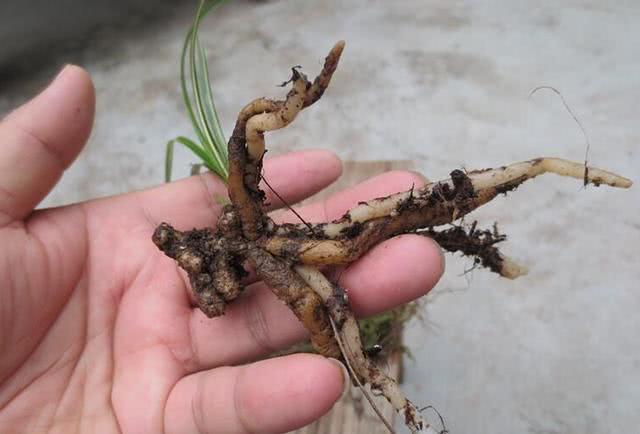
Recently, quite a few orchid growers have accidentally bought fake orchids, and 2000 yuan spent on introduced orchids went down the drain. Nowadays, fake plants, tech plants, and chemical-soaked plants can be found everywhere. Fellow orchid growers, don't introduce orchids from strangers to avoid losses. Below, the author shares with everyone the six key elements of ten years of orchid introduction experience and orchid selection and breeding.
1. Flower form: whether it is a real flower, and whether it has a "false nature." When we see petal flowers on the mountain (or at a roadside stall), we must still examine them carefully. If the flower is shrunken, thin, soft, dried and shriveled, dull and lusterless, not spreading freely, and not upright and spirited, then it may be a flower that failed to open fully due to a long drought without rain and dry air causing water loss. We call this a "false nature" flower quality. "False nature flower qualities" are mostly unstable. After planting, once the flower absorbs water fully, the petal bases will rapidly elongate, greatly changing the original form, and when it blooms again later it will be even harder to reproduce that beautiful appearance. Only flowers that open under moderate dry and wet conditions can be evaluated and selected. After long rains, I believe it is not a big problem if the petal bases of the opened flower are a little longer; as long as the form is good and the color beautiful, after potting and maintaining it slightly dry, the petal bases will no longer appear long when it blooms again.
Precious Orchids
2. Bract shell: The bract shell is originally one of the important bases for evaluating flower quality. If the bract shell is a "rotten garment shell," even if a fairly good flower is seen for a moment, I think it is still an accidental coincidence and absolutely difficult to stabilize. A good bract shell has "thickness," "hardness," and "length" all together. Only a bract shell that is both thick and glutinous yet firm, and also long and brightly colored, with vein patterns running to the top, and from outside to inside one layer more brightly colored and luminous than the next, can a good flower be stable. One with a "green clinging shell" will never revert to the ancient form and become ordinary.
3. Column: If the petals show male characteristics, that is, the column has a white head and a deep pouch, then the flower form will inevitably be stable. The stronger the male characteristics, the more stable it is. The reverse is also true, and it is obvious.
4. Characteristics of each part of the plant: Good-flower plants mostly have the characteristics of a sudden sharp turn downward (but having some of these characteristics does not necessarily mean a good flower will emerge). If a plant has no good characteristics at all yet produces a good flower, this is only a temporary stroke of luck. 1. For a lotus-petal flower plant, the roots should be round and well-proportioned, the pseudobulb large and full, shaped like a "pure vase"; the leaf sheath high, thick and solid, concave inward or shaped like a "horse hoof," the midrib highly raised, with obvious hook grooves, and veins running to the top; the inner leaves upright, the outer leaves slanting upright, the marginal teeth coarse and even, the bract shell thick and long and also pointed and hard, the central vein not raised, the tongue difficult to make round and large; the vein patterns colorless, the color difficult to make bright. 2. For a pouch-petal plant, the roots should be even, fine, and round, the pseudobulb round and large, shaped like a "water chestnut"; the leaf sheath straight and long, concave inward, firm and upright like a needle; some outer sheaths are even curled, the vein patterns reaching the top, and compared with lotus petals it is finer, more delicate, and heavier; the leaf blades concave inward, sharply contracting to a point; the leaf texture thick and glutinous, with veins reaching the top like silver threads; the hook grooves deep, the marginal teeth fine and even, the plant form strict, with straight feet and drooping tails like a ring shape; there are also characteristics of upright leaves that are hard and thick, feeling moist, glutinous, soft, and fine to the touch. 3. For butterfly-petal and strange-flower plants, the fleshy roots should be much branched, the "dragon roots" luxuriant, and "ridges" frequent; the pseudobulb large, with varying shapes: some "ginger"-shaped, some "block"-shaped, some growing buds between the leaves, some buds growing at the top of the pseudobulb, and some buds growing new buds within buds; some have clusters of buds growing densely, the leaf sheaths variously twisted, and the sheath tips often have colored tops or rice-like beads. The leaf blades are in a thousand postures; observe carefully, and how could a strange flower fail to appear?
Precious Orchids
5. True or false flower color: When selecting colored flowers collected from the mountain, one must look at both the front and back sides: if the front is brightly colored but the back is dark, the color of this flower is hard to count as precious; if the flower changes color after being off the mountain for a long time, do not fall in love at first sight; pure color without mixture is true color, and only true color that is bright is precious.
6. There is true meaning in floral fragrance: The two edges of the leaf are clearly seen, and the deeper the marginal teeth, the stronger the fragrance; a toothless Cymbidium ensifolium has a rich fragrance, and if there is fakery in it, one must find the reason; never be careless and "pay tuition." New excellence in orchid qualities is endless, and famous flowers must have famous characteristics. In practice, observe much, and the truth comes from many outstanding growers working together.
Precious Orchids
Fellow orchid growers, have you learned the 6 key elements of orchid introduction? If you also like growing orchids, you are welcome to follow and share, and thank you for your comments and likes, thank you!