This plant can be propagated by cuttings into a bonsai; its elegant charm and upright posture are simply beautiful.
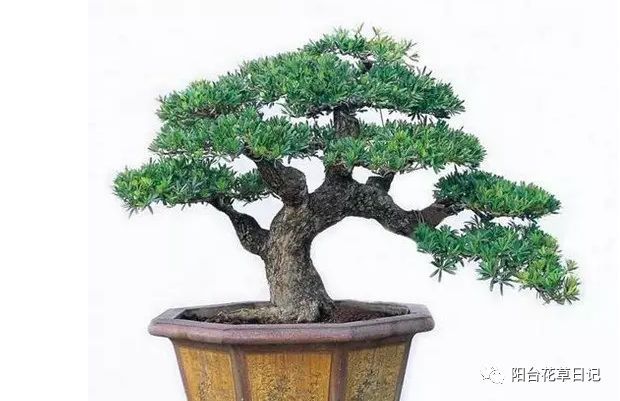
Podocarpus (Podocarpus macrophyllus) is a fairly common bonsai material; its graceful figure is often seen in home life, and it is also a very popular bonsai tree species. Moreover, in our traditional culture, Podocarpus carries very auspicious connotations, often symbolizing longevity and wealth attraction, and among the people there has long been a saying: "With a Podocarpus at home, generation after generation will never know poverty."
If you want to grow Podocarpus, you don't need to specially go to the market to buy one; you can cultivate it by cuttings. Flower lovers who enjoy bonsai might as well give the Podocarpus cutting method a try and easily grow a Podocarpus. Did you know this?
1. Cutting time
Podocarpus cuttings can be taken in either spring or autumn. Among these, spring cuttings give better results; in the south, mid-April is the suitable time, when Podocarpus has not yet sprouted, and after cutting it is exactly its growing season, which is good for the survival and growth of the cuttings.
2. Preparation before cutting
The cutting medium is also very important; sand, ordinary garden soil mixed with perlite can all serve as cutting media. Using 1/2 river sand mixed with 1/2 vegetable garden soil as the cutting soil is most suitable.
3. Selection of cuttings
Choose healthy Podocarpus branches about 10cm in length; branches that are lignified or have pests and diseases are not suitable for cutting. Some flower lovers think that old branches root more easily than tender branches, but this is actually a misconception; in spring, using tender branches of the current year for cuttings gives a higher survival rate than using 1-2 year old woody branches.
4. Cutting
Cut off 1/4 of the leaves, two leaves, and soak or coat them in carbendazim or rooting solution; you can also put one aspirin tablet into clean water and soak the cutting branches and leaves in the rooting solution for 24 hours. After cutting, pay attention to shading, place the cutting pot in a cool place, avoid direct sunlight, and use a spray bottle to spray water to keep the leaves and soil moist.
5. Temperature and humidity control
During the hot summer days, you can spray water on the Podocarpus to cool it down and increase air humidity; when air humidity reaches above 80%, it can better promote the rooting and sprouting of Podocarpus.
6. Fertilizer and water management
Wait until the cutting branches have rooted and sprouted, then you can add fertilizer; choose monopotassium phosphate or ordinary chemical fertilizer available on the market, sprinkle a little on the soil. Too much fertilizer easily causes root burn.
After the root system has grown and stabilized, the Podocarpus can be transplanted with soil into a larger flower pot. Whenever the soil looks dry, water until thoroughly soaked, keep sufficient light, and the growth rate will far exceed expectations. The Podocarpus branches become Podocarpus seedlings through cutting, until they grow into a beautiful and dense Podocarpus bonsai.
Some key care points for Podocarpus:
For household potted Podocarpus, it should be kept outdoors in a ventilated place all year round and should not be left indoors for a long time, otherwise the leaves will turn yellow and fall off, leading to death. In summer, high temperatures make direct sunlight unsuitable, so it needs to be kept in semi-shade.
During the growing season, water can be slightly more; in the hot summer, when the pot soil is dry, water promptly, and watering should be sufficient and thorough; in autumn and winter, water can be appropriately reduced. In East China, in winter when the temperature drops to 5°C, it should be brought indoors to overwinter, and the amount of watering should be controlled, with the pot soil preferably on the drier side.
In the daily care of Podocarpus, the environment and watering are actually the two most important aspects. As the saying goes, "A person moves and thrives, a tree moves and dies." Frequently changing the environment is a great taboo for plants, so we had best choose a suitable location in advance.
In summer, Podocarpus should be placed in a warm, humid, and airy place; in winter, it should be placed indoors above 5°C, but the temperature should not be too high, so as not to affect its dormancy.
Podocarpus likes moist soil; during the growing season it should be watered frequently to keep the pot soil moist, but water should not accumulate in the pot. In summer, frequently spray water on the leaves or the ground to keep the leaf color bright and beautiful.
▍Comprehensive editing: Balcony Flowers and Plants Diary hcrj520