What price might top-grafted pears pay for using growth regulators? Chen Xingzong explains
There is always a dream, a long-held hope that top-grafted pears could become a premium export product for Taiwan, China.
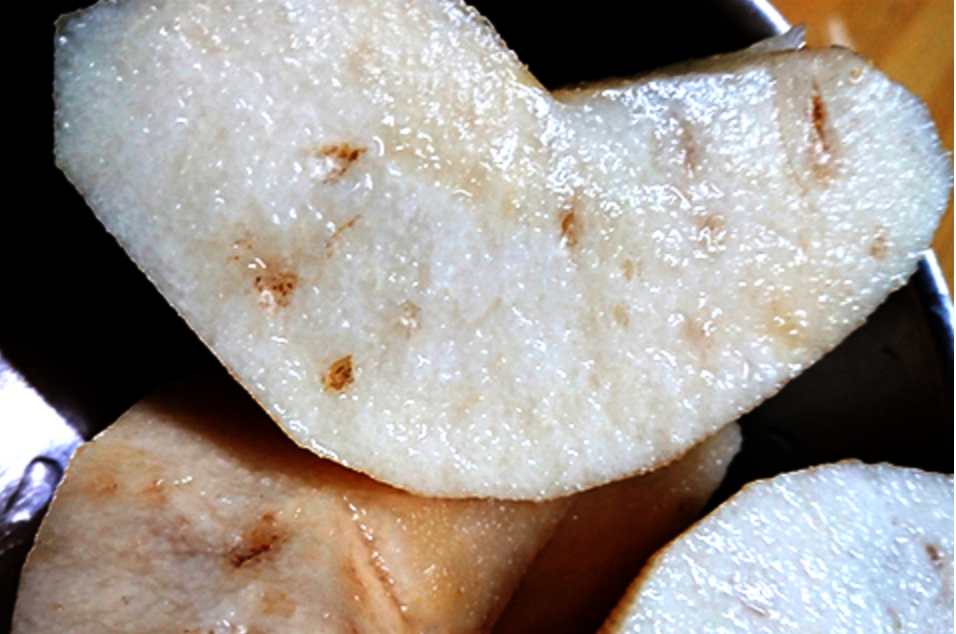
Recently I cut open several lowland top-grafted pears, and all of them were worrying. Among the producers, some growers admitted to using growth regulators, while others stated they had not used them at all. As a consumer, even if you are not a domineering big shot, you probably do not want to be a sucker either.
These brown spots and pits inside the flesh are signs of calcium and boron deficiency. They look alarming but do not affect food safety, and the underlying causes are complex. Regardless, consumers who encounter such products will certainly add another layer of negative impression toward top-grafted pears, and may even generalize and conclude that this is simply what top-grafted pears are like.
Respect the condition of the crop, do the basic work well, and do not joke around with your own income
The crop's environment, the nutrients accumulated in the tree, the mineral fertility in the root zone, the arrangement of branches, the health status of the soil, the carbon-to-nitrogen ratio at each position... many major weighting factors that affect quality must be continuously monitored and managed. In the case of top-grafted pears, if you want to achieve quality that is clearly distinguished from the market, the above factors are even more important, and require long-term patient management and arrangement.
For crops, growth regulators merely give a stimulus signal, and the crop produces a corresponding response after receiving the stimulus. But growth regulators do not provide the crop with the resources it needs; they only give signal instructions, not resources. This kind of situation often amounts to pulling up seedlings to help them grow.
Growth regulators may solve an immediate problem for the moment, but if those fundamental major weighting factors that require long-term management and arrangement are never properly addressed, pear growers will certainly enter a risk zone of steadily rising costs and continuously declining good-fruit rates, and will ultimately be eliminated by the market.
So do not optimistically and flippantly expect that growth regulators can bring easy, painless salvation.
The smartest strategy for a manager is still to respect the crop's opinion, provide suitable living conditions, and remove unnecessary burdens. It is recommended to consider using growth regulators only after complete preparation and experience have been acquired; otherwise, you are just joking around with your own income.
The first pear of the Northern Hemisphere each year appears in Taiwan, China, but we have not seized the advantage
Each year the first pear of the Northern Hemisphere appears in Taiwan, China; high-quality pears from high-latitude regions can be produced in Taiwan, China; and there is complete cultivation and management information and technology... These are our production advantages in top-grafted pears. Unfortunately, we have never grasped the opportunities that these advantages bring us.
In the production process of top-grafted pears, pruning, grafting, repeated bagging, bag removal, harvesting, and grading consume extremely high costs for growers. If it is only discovered on the day of harvest that the fruit has no commercial value, all the costs invested earlier will turn into nothing. Even more frightening, there are many internal abnormalities that cannot be seen from the appearance, only to be complained about when they reach the customer's dining table. All the wonderful future can then only remain a dream, and this fundamentally kills the possibility of healthy development for top-grafted pear exports from Taiwan, China.