The crape myrtle blooms for as long as half a year, which is why it is known as the "hundred-day red."
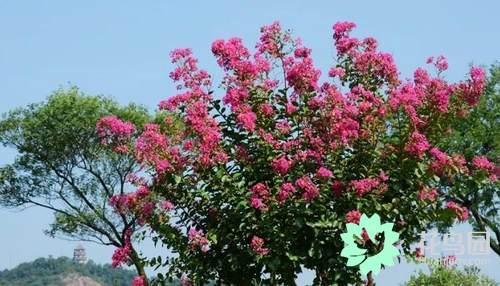
In the scorching heat of midsummer, you may see the blazing red, graceful crape myrtle flowers in your residential neighborhood, blooming gorgeously and exceptionally profusely. As an important ornamental flowering tree of the hot season, it enjoys the reputation of "midsummer green shading the eyes, crape myrtle red filling the hall."
Vol.01 Crape Myrtle: Admired by Both Refined and Popular Tastes
Two Crape Myrtles Before the Condensation Dew Hall
[Song Dynasty] Yang Wanli
Bright clouds glow brilliantly over the eaves, crimson snow falls thickly on the steps of sand.
Never mind that I am not an incense-table official; I too move my couch to face the crape myrtle flowers.
Crape myrtle (Lagerstroemia indica) is a deciduous shrub of the genus Lagerstroemia in the family Lythraceae. It has many alternative names, such as hundred-day red, hall-filling red, and itchy tree, among others. Most of its alternative names fit its growth habits very well. For example, "hundred-day red" refers to its long flowering period, lasting as long as a hundred days from July to September. "Hall-filling red" refers to how, when planted in a courtyard, new flowers follow the old branches in an endless succession of blooms, enough to fill the whole hall with radiance. The name "itchy tree" is the most widely used alternative name for the crape myrtle. This is because the crape myrtle's trunk is very distinctive: its bark is pale in color, often grayish-white, and smooth and clean, giving the impression at first glance that it has no bark at all. It is said that if you scratch its trunk with your hand, the whole tree can be seen trembling, as if it cannot bear being tickled. A poem says: "The crape myrtle blooms in hundred-day red; gently stroke the branch and the whole tree moves."
The crape myrtle is an excellent flowering plant resource native to China, with a very long history of cultivation in our country. Over time, four major cultivar groups have formed: red crape myrtle, purple crape myrtle, silver crape myrtle, and green crape myrtle. At Chenshan Botanical Garden, you can admire an excellent variety from abroad, the bi-colored dwarf crape myrtle ("Berlingot Menthe"), whose plant form is low and compact, with petals that are red at the base and white at the edges. Planted in clusters along the water's edge, it is very fresh and elegant.
Vol.02 Crape Myrtle: The Glory of the Powerful
Crape Myrtle Flowers
[Tang Dynasty] Bai Juyi
In the Silk-Edict Pavilion the documents are still, in the Bell and Drum Tower the water-clock drips long.
Sitting alone at dusk, who is my companion? The crape myrtle flowers face the Crape Myrtle Official.
The ancients divided the sky into three star regions: the Purple Forbidden Enclosure, the Supreme Micro Enclosure, and the Heavenly Market Enclosure. The Purple Forbidden Enclosure is at the center, with the Supreme Micro Enclosure and the Heavenly Market Enclosure on either side. At the core of the Purple Forbidden Enclosure is the Purple Micro Star, which is what we now call the "Big Dipper." Because the North Star aligns directly with the Earth's axis, it appears in the same position no matter the season, and all the stars in the sky seem to revolve around it. For this reason, the ancients called the Purple Micro Star the "Emperor Star." A person whose ruling star in the natal palace is the Purple Micro Star has the bearing of an emperor, and the place where the emperor lived was called the Purple Forbidden City.
From this it can be seen that the development of crape myrtle culture was closely connected from the very beginning with the "Purple Micro Star," which symbolized imperial power. In the first year of the Kaiyuan era of the Tang Dynasty (713), the Secretariat was renamed the Purple Micro Secretariat, the Secretariat Director was renamed the Purple Micro Director, and large numbers of crape myrtles were planted in the courtyard where they worked. Because the Purple Micro Secretariat was responsible both for drafting imperial edicts and for the initial review of memorials from all regions, it held a pivotal position in imperial politics. The crape myrtle quickly became a "flower of wealth and honor" that people competed to plant. At the time there was a folk rhyme that went: "Plant a crape myrtle by your gate; wealth and prosperity will fill your estate."
Vol.03 The Crape Myrtle Blooms for Half a Year
Crape Myrtle Flowers
[Song Dynasty] Yang Wanli
Dazed as if drunk, lovely and fair; pressed by dew and bullied by wind, it leans all the more.
Who says no flower stays red for a hundred days? The crape myrtle blooms long for half a year.
The petals of the crape myrtle are thin and deeply crinkled. At the slightest touch of a clear breeze, they dance without cease. Liu Hao of the Qing Dynasty, in his Expanded Compendium of Flowers, said: "A single branch of crape myrtle bears several spikes, and each spike bears several flowers. Whenever a faint breeze arrives, they tremble with enchanting grace; dancing swallows and startled swans are not enough to describe them." The flowers are like dancing girls, graceful as startled swans, their flowing immortal sleeves seeming like heavenly garments. No wonder the ancients called the crape myrtle "the highbrow guest among flowers."
According to differences in flower color, horticultural varieties of crape myrtle fall into 4 major groups: the purple crape myrtle (including green crape myrtle), red crape myrtle, silver crape myrtle, and bi-colored crape myrtle cultivar groups.
Vol.04 Why Does the Crape Myrtle Tree Feel "Itchy"?
Crape Myrtle Flowers
[Tang Dynasty] Du Mu
At dawn it greets the autumn dew, one branch fresh and new, not claiming the garden's finest spring.
Where are the silent peach and plum blossoms now? Facing the wind, it alone laughs at those who bask in the bright sun.
Through careful observation and experiments by earlier generations, it was found that the crape myrtle's branches have a notable characteristic: the base and the top of the branches are roughly similar in thickness. Compared with those trees and shrubs that are clearly thinner at the top and thicker at the bottom, the crape myrtle appears more "top-heavy." When you gently scratch its branches, the vibration caused by the friction is easily transmitted through the hard branches to the twigs, leaves, and flowers at the top, causing them to shake. The shaking gradually accumulates, and its amplitude grows larger and larger.
This phenomenon of "being ticklish" is also obvious in other flowering shrubs whose thickness is not markedly different, such as heavily pruned lilacs, viburnums, and Amur honeysuckle. Conversely, on large crape myrtle stumps with obvious main trunks and branches that differ greatly in thickness, the ticklish phenomenon is not obvious. Sometimes even if you scratch until your fingernails break, the branches at the top do not move at all, appearing extremely "numb."