Climbing and trailing plants form a world of their own, a veritable independent kingdom in the plant world
Naodong Handmade
You have 40 friends following this official account!
If you want to create a wall of flowers, consider planting some - climbing plants, also known as vines or climbers, that is, plants whose stems are generally slender and cannot stand upright, and must cling to a support to grow upward. They are used for vertical greening, making full use of space, occupying little ground and producing quick results. Placing climbing plants on walls, trellises, hedges, pergolas, columns, doors, ropes, poles, dead trees and rocks can also achieve an ornamental effect beyond that of ordinary greening.
Climbing plants are extremely diverse and come in a myriad of forms. Most of them are woody vines, while the rest are annual, biennial and perennial herbaceous plants. According to their climbing ability and method, climbing plants can be divided into twining, tendril, adhesive and trailing types:
1. Twining climbing plants:They extend upward by twining around a support themselves, with strong climbing ability, but they need a trellis or climbing net for assistance. Common examples include wisteria, akebia, honeysuckle, mucuna, cypress vine and morning glory.
The fragrance of honeysuckle is mild, especially at dusk. Its varieties are numerous and almost all are climbing plants. A single honeysuckle plant can easily cover a large arbor.
2. Tendril climbing plants:They climb by means of special organs called tendrils (stem tendrils, leaf tendrils, etc.), and their climbing ability is also very strong, requiring a trellis and manual guidance. Examples include grape, ornamental pumpkin, gourd, loofah, passionflower, flame vine, sweet pea and clematis.
As an outstanding member of the vine family, clematis is known as the queen of vines for its graceful posture, elegant flowers and rich variety. Clematis has sparse, graceful branches and leaves; some have large, brightly colored flowers, while others have many small flowers gathered into large inflorescences, full of unique charm, making it an indispensable excellent material in climbing greening. It can be planted by walls and windows, or beside trees and shrubs, arranged among rockeries and rocks, clinging to flower columns, flower gates and fences, and can also be grown in pots for viewing.
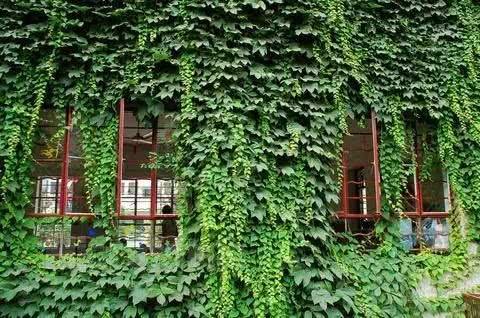
3. Adhesive climbing plants:They have aerial roots or suction cups and climb by adhesion, requiring no manual guidance, and are often used on walls. Examples include Boston ivy and Virginia creeper, which have suction cups, and ivy, Chinese trumpet creeper, wintercreeper, star jasmine and creeping fig, which have aerial roots.
Its flowers bloom like tiny pinwheels, hence the name "pinwheel jasmine." Large-leaf star jasmine prefers semi-shade and cool conditions, is cold- and heat-tolerant, semi-evergreen, with branches reaching up to ten meters in length, blooming in early May (slightly later than banksia rose), with a strong fragrance, making it an excellent choice for vertical greening.
4. Trailing climbing plants:They have no special climbing organs and rely only on slender, trailing branches, with the weakest climbing ability, often requiring auxiliary tying. Common examples include Rosa multiflora, banksia rose and climbing roses.
Banksia rose, though lacking the gorgeous large flowers of climbing roses, is a evergreen or semi-evergreen climbing shrub that is better suited for vertical greening arrangements on private garden pergolas, flower walls, hedges and rock faces. Its corymbs are terminal, blooming in early summer. The white banksia rose has flowers as white as snow, with a distant fragrance, blooming in sheets like a waterfall, and after many years the effect is truly spectacular.
Speaking of climbing roses, many people may mistake them for Rosa multiflora. Roses and Rosa multiflora look alike, and many people cannot tell them apart. To distinguish them, first look at the leaves: rose leaves generally have 3 to 5 leaflets, flat, smooth and glossy, while Rosa multiflora leaves have 5 to 9 leaflets, flat but with fine hairs. Second, most roses bloom in multiple seasons, commonly known as "monthly red"; rose flowers are large, brightly colored and varied in form, while Rosa multiflora generally has only pink and white flowers, with smaller blooms, generally only 3 to 5 cm, blooming only once a year in spring, and with relatively strong climbing ability.
Key points for the planting design of climbing plants
When using climbing plants for landscaping, suitable climbing plants must be selected. Plant selection should be based on the climbing ability, adaptability and ecological requirements of the climbing plants themselves, as well as the site conditions of the relevant environment.
Due to differences in climbing ability and method, different climbing plants are suited to different locations. For example, adhesive plants with strong climbing ability are suitable for vertical greening of buildings, walls, rockeries and columns; twining and tendril climbing plants can be used for hedge-style arrangements. They can also be applied to high platforms of buildings and other places, showcasing their natural drooping characteristics.
The site conditions of the planting area, such as light, water, temperature and soil, must be analyzed before plant selection. Light-loving Chinese trumpet creeper, wisteria and most annual herbaceous climbing plants (loofah, cypress vine, gourd, etc.) can be used in sunny environments; shade-tolerant pothos, ivy, kadsura and others are suitable for landscaping under forest canopies and on the shady sides of buildings.
Different landscaping forms have different landscaping purposes. For example, hedge-style landscaping mostly aims at flower viewing, so brightly colored flowers should be chosen, such as climbing roses and clematis. Pergola-style landscaping, while ornamental, also provides shade, so large vines should be chosen, mainly woody vines.
In the landscaping of climbing plants, combinations of different species should be used as much as possible to extend the ornamental period and create a four-season landscape.
By planting the abundantly flowering large-flowered clematis together with climbing roses, the climbing rose becomes the most natural trellis for the clematis, while the harmony of the two's flower colors must also be considered.
Climbing plants can not only be appreciated for their leaves, flowers and fruits, with excellent seasonal color changes; they also serve to divide space and create resting environments; at the same time, they can increase green space and expand greening areas. As long as you understand the habits of climbing plants and provide the conditions necessary for their growth, they can be planted in any position you can imagine.
All the excitement, all in Huayipai Youzan Mall
Flowers and love | Huayipai