Korea's national flower is very common in our country, blooming in endless profusion, and has the lovely name "desert rose"
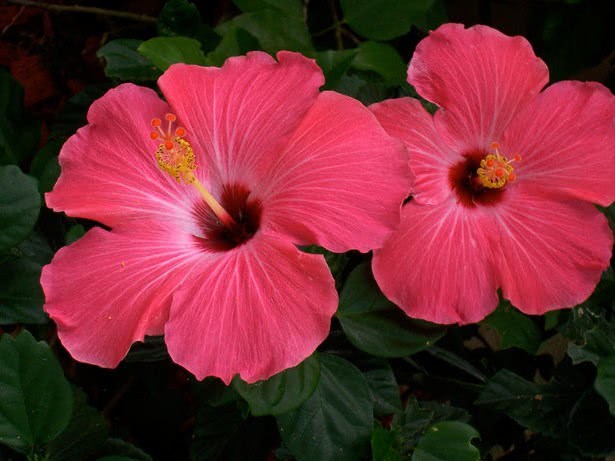
The rose of Sharon is a common garden flowering shrub variety, with nearly a thousand varieties worldwide, and flower colors numbering in the hundreds, with flower forms divided into single-petaled and double-petaled types. The rose of Sharon plant grows quickly, with luxuriant branches and leaves and abundant, brilliant flowers, with the purple series, red series and yellow series being the most beloved. In 1990, the single-petaled red-centered series variety was chosen as the national flower of Korea. In North America it has the lovely name "desert rose."
The branches of the rose of Sharon produce many flower buds. The leaves and flower buds develop and grow at the same time, and although each flower blooms for only one day, the other buds will open one after another, so that in summer and autumn the blooming flowers cover the lush rose of Sharon tree. Therefore, in Korea, it is called the "flower of infinity," symbolizing the national spirit of endless life from generation to generation.
About the flower language of the rose of Sharon
The rose of Sharon, blooming at dawn and falling at dusk, withers each time only for the next brilliant bloom. Like the sun repeating each day's sunrise and sunset, like spring departing and autumn arriving in the cycle of the four seasons, it is endless life, it is inexhaustible.
Single-petaled rose of Sharon
The rose of Sharon has especially tenacious vitality, symbolizing a character that grows firmer in purpose through hardship, and also symbolizing prosperity, deep affection and nostalgia.
About the legend of the rose of Sharon
In ancient Yuzhou, the story of three flower deities, Shenhou, Shengan and Shenzhong, was long passed down, handed down orally through many generations in numerous versions. In fact, these three flower deities are the rose of Sharon trees we often see. How the trees became immortals must be told from ancient times.
The ancient emperor Rendong had a hill called Lishan, and at the foot of Lishan grew three rose of Sharon trees, two chi tall, with crowns spanning several mu. Every summer and autumn, the whole trees bloomed, as gorgeous as brocade.
In July of one year, "Taotie," one of the so-called "Four Evils," saw this beautiful scene and vainly tried to transplant them and claim them for himself. After the rose of Sharon trees were dug down by the villain, they quickly withered and shed their leaves. Seeing this, "Taotie," worried that after expending effort they would be hard to plant and keep alive, left dejectedly.
Double-petaled rose of Sharon
When Hebo, who farmed at Lishan, heard of it, he immediately came, called together the nearby farmers to replant the three rose of Sharon trees, and irrigated them with spring water from deep in Lishan. The three rose of Sharon trees revived at once, blooming as before, with luxuriant branches and leaves. Hebo and the farmers cheered joyfully.
To repay the debt of saving their lives, on the very night of their revival the three rose of Sharon fairies paid Hebo a visit in his dream. The fairies expressed their thanks to him and promised to protect the rivers and mountains and the people of Lishan for all their lives.
Afterward Hebo led the farmers in clearing the land and breaking the soil at Lishan and founded the state of Xia. The rose of Sharon was then designated the national flower.