Succulents grow all over the front and back of the house, so many they can only be fed to cows
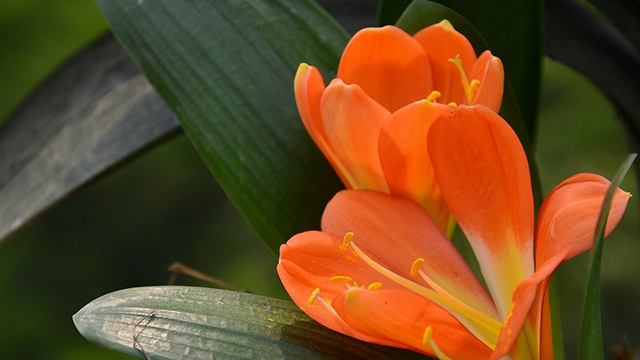
The clivia in front of and behind the house, each one looks like a big napa cabbage!
While your clivia still refuses to bloom and even has yellowing leaves, someone else's clivia grown in the yard has already become glossy big napa cabbages, blooming however they please!
In front of and behind the house, in every nook and cranny, they are all clivia blooming like crazy! We painstakingly repot them and tend to their roots in spring and autumn, afraid they will freeze to death in winter and scorch to death in summer, yet they are no match for someone else's clivia that needs no care at all!
If you want your clivia at home to bloom as much as one grown in the ground, you can place some oil crops like peanuts or sunflower seeds at the bottom of the pot. The leftover beer from home in summer can also be mixed with water at 1:10, and used with a soft cloth to gently wipe the leaves, which will make the clivia leaves greener and shinier!
The cactus in front of and behind the house works even better than a security window!
When it comes to growing cacti, many flower lovers frown, wondering why theirs always rot at the roots and die? Hurry and take a look at someone else's cactus, climbing up along the wall, more effective than a security window! Let's see who dares climb the wall!
Actually, most people know that cactus is considered a very easy flower to grow. If you cannot grow it into the shape of a security window, then growing it to bloom should at least be no problem, right?
If you want your cactus at home to grow to bloom and fruit, you can choose slightly alkaline soil, place it outdoors in a spot with good light for care, water less to prevent root rot, and occasionally add a bit of compound fertilizer, and that is completely enough!
The Graptopetalum paraguayense in front of and behind the house, tough and easy to grow!
Every time I hear someone say their Graptopetalum paraguayense died, Huahua says she doesn't know what to say! Among succulents, Graptopetalum paraguayense is considered a relatively tough flower. If you don't believe it, look at someone else's rooftop, where blooming Graptopetalum paraguayense grow in clusters upon clusters!
If grown on a balcony, that's no problem either, it can just hang down as a curtain. Grown at the front door, or on top of a wall, it immediately hangs down and becomes a waterfall!
Graptopetalum paraguayense is very easy to grow. Normally you just need to make sure it gets plenty of sun and water it a bit less, generally waiting until the potting soil is completely dry before watering, to prevent root rot, and it will quickly grow into a large patch, and even growing it into an old stump is no problem at all!
The moss rose in front of and behind the house, so many they turn into a carpet!
Huahua still remembers when she was little, scattering a handful of seeds in the yard back home, and within 1 month, the whole yard was overrun by moss roses. Even after mom cleared them all out, by the next year, the fallen seeds sprouted into another big patch!
Moss rose is considered a very easy flower to grow, even a 3-year-old child can keep it alive! As long as you give it plenty of light, and water it with a big pot of water when it lacks water, it will immediately shoot up and grow like crazy!
If your moss rose never blooms, then Huahua suggests that during the growing season you can grab 3-5 granules of compound fertilizer and sprinkle them on, or spray a 0.2% potassium dihydrogen phosphate solution before blooming, and it will make the moss rose burst into bloom like crazy!
The Orostachys in front of and behind the house, hang it up and it becomes a curtain!
Speaking of Orostachys, many older people may not be too clear about it, but if you mention jewel flower, then everyone will surely know! Besides Graptopetalum paraguayense, in the countryside, the ones grown the most in front of and behind houses are definitely Orostachys!
Besides climbing all over the walls and conquering the rooftops, actually the main use of Orostachys is of course as a curtain! Plant Orostachys next to a railing and let its old stump hang down, and within a few months it becomes a natural curtain!
If you want Orostachys to become a curtain as quickly as possible, why not try giving it more sun. Placing it in a spot with direct sunlight on an open balcony is best. Once you notice dried-up leaves on the Orostachys, cut them off in time to prevent bacteria from breeding in summer and causing black rot.
The Orostachys fimbriata all over the mountains and plains, so many you can't dig them all up!
When Huahua was little, she once saw plants growing one by one on the roof, but at that time she had no idea they were Orostachys fimbriata. Only later, after growing up and getting into succulents, did she learn that those were all treasures. If any household's roof had a big patch of Orostachys fimbriata, that was truly something to envy!
Besides rooftops, the place where wild Orostachys fimbriata most easily appears is generally on mountains. If you flower lovers have mountains nearby, you can take advantage of your free time to take a stroll up the mountain, especially in those cracks between rocks, and see if there aren't especially many Orostachys fimbriata?
Of course, besides those Huahua introduced, there are quite a few flowers planted in front of and behind houses that do much better than when grown at home! Everyone might as well follow along with Huahua and take a look!