How to Prevent and Fix Leggy Succulents
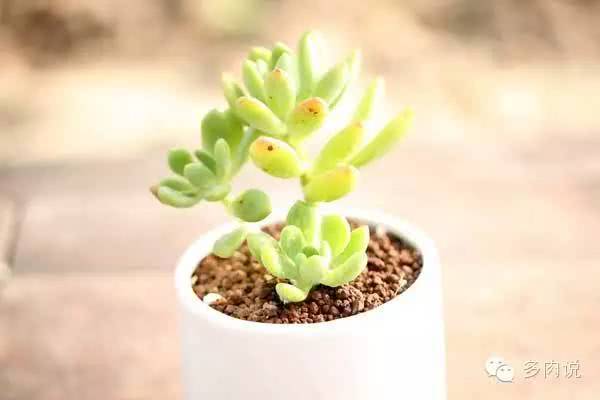
Whether during the growing season or the dormant season, succulents are very prone to becoming leggy as long as there is insufficient light or too much watering. Legginess causes them to lose their originally short, sturdy shape, with stems and leaves stretching out wildly, while the leaf color fades and the leaf flesh becomes thinner, which greatly reduces the plant's own ornamental value.
What should you do if a succulent becomes leggy? Don't worry. Although it can't return to its original appearance, you can learn to reshape it by hand and make your succulent even more beautiful.
1. Snap off old leaves
Snap off the old leaves. The so-called snapping means leaving the leaf stalk on the stem and letting it dry up and fall off naturally, to avoid leaving very ugly scars. Then move the plant to a spot with light. This method can quickly cultivate an old-stem succulent with a distinctive charm. It is worth noting that for plants grown outdoors, while the wounds have not yet healed, they should be placed in a rain-sheltered, ventilated spot, and should not be watered.
2. Beheading
1) When you notice that a succulent has become leggy, you can perform beheading.
Author: Kite's Home Garden Source: Sina Blog
2) For the beheading cut, generally start cutting at the lower leaves of the leggy stem. Before beheading, you can snap off a ring of leaves at the beheading point to make it easier to cut.
Author: Kite's Home Garden Source: Sina Blog
3) After beheading, the mother succulent must be placed in a cool, ventilated spot to dry so the wound can heal quickly. The small cutting that was cut off must also be placed in a cool, ventilated spot to dry.
Author: Kite's Home Garden Source: Sina Blog
4) Once the wound on the small cutting has dried, it can be inserted into the soil for propagation. The propagation soil can be a 1:1 mix of peat soil and perlite, mainly loose and breathable, and a layer of clean fine sand can be spread on the surface of the potting soil.
Author: Kite's Home Garden Source: Sina Blog
5) The leaves previously removed from the plant can also be used for propagation. Afterward, place the propagated plants in a well-ventilated spot with indirect light for care, such as under the shadow of a tree or on a desk by a window, and they will quickly take root.
Author: Kite's Home Garden Source: Sina Blog
How to avoid leggy succulents:
Besides letting succulents get enough sun every day (except at noon in summer), do not water too much in normal care. Overwatering not only causes legginess, but also waterlogs the roots and causes root rot.
Because the water stored in the stems and leaves of succulents reaches a saturated state, they are very drought-tolerant, and forgetting to water for two or three days does not affect their growth. Watering should follow the principle of watering once the soil is completely dry, and not watering if it is not dry.
Some succulents, such as the Crassula species Fire Storm (Crassula capitella 'Campfire') and Pagoda Village (Crassula 'Pagoda Village'), have their top branches stretch out as their flowering season approaches. It looks like legginess, but it is actually a very normal phenomenon. Don't worry, it means they are about to bloom!