Bonsai Master Zhao Qingquan: Hold Fast to the Root of Our National Culture
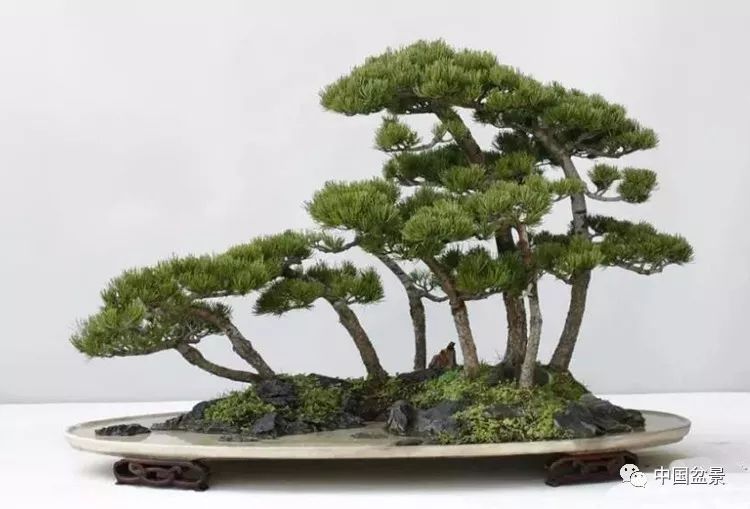
Hold Fast to the Root of Bonsai's National Culture
- Another Discussion on the Inheritance and Innovation of Bonsai
Original author | Zhao Qingquan
This article is recommended by Li Guobin, selected from "Pen Yi", and the copyright belongs to the original author, Teacher Zhao Qingquan
The inheritance and innovation of bonsai is a much-talked-about topic, and many bonsai enthusiasts have expressed very reasonable views on it. However, judging from the current reality of bonsai development in China, I believe it is still necessary to continue the discussion.
Bonsai is an ancient traditional art of China. Like other cultural arts, it gradually came into being and was perfected under the combined influence of certain socioeconomic conditions and cultural and ideological factors. Over the past 30-plus years, with socioeconomic development, Chinese bonsai has advanced at an unprecedented rate, the ranks of enthusiasts have grown unprecedentedly large, and the level of skill has risen markedly. At the same time, the issue of its inheritance and innovation has become increasingly prominent.
Inheritance here means, first of all, activating the valuable resources in traditional bonsai culture so that they become the living source for today's bonsai; innovation means, on this basis, creating works that bear the characteristics of the new era and suit modern aesthetic tastes, and spreading them through a globalized context so that they become an organic part of world bonsai culture.
That bonsai originated in China is by no means accidental; it is the result of China's broad and profound culture. Today's bonsai is built precisely on the traditional foundation left by our predecessors; without this foundation, we would have to start from zero. Therefore, innovation cannot be separated from its traditional roots. We should treasure and inherit the excellent tradition and seek breakthroughs for innovation within it, rather than applying "disruptive innovation."
In inheriting the art of bonsai, we must first understand what tradition is. For various reasons, few ancient bonsai survive in China today, and even those that do may not all be in their original form. But we can learn what ancient Chinese bonsai looked like from the descriptions in a great many ancient poems and writings as well as from paintings. From the very beginning of its birth, bonsai was an art form led by Chinese literati, with the naturalistic style full of poetic charm as the mainstream. Even for formal styles, there are artistic techniques worth drawing on, such as their unique approaches to the handling of space, the use of lines, and the expression of layers.
The inheritance of the art of bonsai is not limited to bonsai itself. The traditional culture of the Chinese nation is broad and profound, and its three main philosophical systems - Confucianism, Daoism, and Chan - have had a deep influence on all kinds of art, including bonsai, so we should draw nourishment from the whole of traditional culture. Chinese poetry, literature, painting, calligraphy, sculpture, gardens, music, and dance can all be drawn on, and landscape painting and its theories in particular are most useful as a reference for the art of bonsai.
Innovation in the art of bonsai should be a combination of traditional culture and modern concepts. While inheriting tradition, one must also place oneself in society, broaden one's knowledge and experience, take in the spirit of the times, and keep pace with the times, so as to produce the aesthetic standards and tastes of a new era and abandon stale conventions and fixed formulas.
Innovation in the art of bonsai requires deep observation of the mountains, waters, and trees of nature, drawing wisdom and inspiration from ever-changing natural landscapes, and finding a natural basis for bonsai creation.
Innovation in the art of bonsai should reflect the creator's individuality. Art most sameness; as modern cultural life becomes richer, formulaic works that all look alike are increasingly unwelcome. In creation, the author's "self" must permeate the work, reaching a state where seeing the work is like seeing the person.
Innovation in the art of bonsai should, with Chinese culture as the leading principle, be inclusive and absorb the good techniques of foreign bonsai, drawing on their expressive methods and forms, so as to enrich our nation's bonsai art. Art knows no borders, and advocating "walking one's own path and winning through national characteristics" does not mean rejecting learning from abroad.
Only when a tree has good roots will its branches and leaves grow well. The same principle applies to bonsai: only by holding fast to the root of national culture can it have strong vitality. I look forward to bonsai enthusiasts working together so that China, a major bonsai country, can soon become a strong bonsai country.
Title: Into the Clouds
Specifications (cm): 132
Tree species: Chinese juniper
Author: Zhao Qingquan
Title: Gazing
Specifications (cm): 105
Tree species: Japanese black pine
Author: Zhao Qingquan
Selected comments:
@Stainless Steel (Liu Chuangang):
This is a fine article that every bonsai enthusiast should study carefully: concise in language and clear in meaning, well-reasoned and well-supported, explaining the profound in simple terms, and closely tied to reality. It is not only the fruit of Teacher Zhao Qingquan's decades of experience in bonsai creation and practice, but also correct guidance for the direction of development in today's bonsai field, with very strong practical relevance and guiding significance. I sincerely give Teacher Zhao a thumbs-up.
@Airport:
Holding fast to the root of bonsai's national culture should be the original aspiration of Chinese bonsai enthusiasts. As a Chinese person, what reason is there not to follow one's own national path? The timeless classics and brilliant philosophical thought created by Chinese culture have educated generation after generation of Chinese people. Teacher Zhao is a model for us to learn from; his works are full of poetic charm and always contain the soul of the nation.
Rather than saying that poetic charm is the foundation of the traditional cultural art of Chinese bonsai, it is better to say that it is an inevitable trend in the development of world bonsai art.
I believe China will certainly develop into a strong bonsai country in the world.
@Mountain Guest Thatched Cottage (Liu Zhiyun):
Teacher Zhao speaks well! Each bonsai should carry the creator's personal thoughts, rather than simply imitating the works of masters. Without personal thoughts, it becomes a soulless imitation,
@Pu Mu Yi Nian (Lianyungang Chenyuan):
Teacher Zhao's article is something we bonsai enthusiasts must deeply understand the meaning of. If bonsai enthusiasts do not study it carefully and understand this article, they will take detours on the road of creating and producing bonsai, and will not be able to create good works.
@Xu Guofu:
In the process of innovating and developing Chinese bonsai art, creators should learn from and absorb Chinese traditional culture in many aspects and disciplines, thereby grounding their own hearts! Only then can the world within the pot be broad, with artistic conception arising from the heart, and scenes formed at a touch, entrusting and expressing one's feelings! Teacher Zhao Qingquan has touched on the most fundamental point! A thumbs-up for Teacher Zhao.
@Zhao Qingquan:
Thank you all for your encouragement! What is stated in the article is in fact not only my personal view; it also includes the results of everyone's discussions on bonsai theory over many years.
Highlights replay:
Chinese bonsai welcomes you!
Enjoyanytimeat the bonsai exhibition hall
Promote bonsai culture, exchange bonsai skills!
Appreciate bonsai art, share a happy life!