Soybeans can yield a thousand jin per mu in the US, so why can't we do it in China?
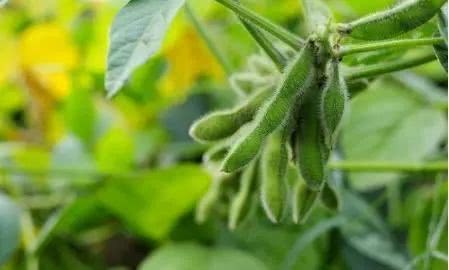
Soybean yields can indeed reach the level of a thousand jin per mu, but such a yield really requires the right timing, the right place, and the right people, and all other factors to come together. In 2017, in the US state of Missouri, a soybean high-yield myth was created that the world has still not been able to break: 1388.5 jin/mu! Believe your eyes, you read that right. One mu is equivalent to the combined soybean yield of three to four mu in China.
Such a yield does not prove much, and it truly does not have broadly representative significance, because the local climate, environment, management, and all other aspects in Missouri all reached an excellent level, and it was even strongly related to the climate factors of 2017. Otherwise, such a high-yield record would not have gone without being reproduced to this day. However, such a high-yield level also gives us some inspiration: the high-yield potential of soybeans still awaits further exploration by us!
As mentioned earlier, a high-yield record like that in the US cannot be replicated, so what level is China's soybean high-yield record at? Next, Science Agriculture will also give everyone an overview:
Xinjiang, China (2010) 811.78 jin,
Haicheng, Liaoning Province (2000) 654.7 jin,
Haocheng District, Hebei Province (2016) 664.2 jin,
Dengzhou, Henan (1994) 650.7 jin.
That is to say, more than 600 jin already counts as a super-high-yield level, and being able to exceed 800 belongs to a super first-class high yield! Even if we refer to other countries in the world, Italy's 800 jin (1997) and Japan's 640 jin (1984), they are all likewise ordinary, and breaking through 800 is a very difficult problem.
Replace with high-definition large image
For China, the current soybean high-yield record is in Shihezi, and a large part of the reason is still closely related to the climate of the Shihezi area. On this point alone, it has many similarities with Missouri, the US high-yield record location, and the large day-night temperature difference in the Shihezi area is conducive to the accumulation of dry matter, with an annual accumulated temperature of more than 4000°C. It is the unique climate characteristics that enabled Xinjiang to obtain a soybean high-yield record that has so far been difficult to break.
As for the Huang-Huai-Hai region and China's main soybean-producing area in the Northeast, an average soybean yield of 400 jin per mu counts as a good level, and more than 500 jin counts as a high-yield field. And being able to break through 600 can only be seen by visiting experimental fields; under ordinary circumstances, such a high yield level cannot be obtained.
Replace with high-definition large image
For China, 1000 jin, no matter what seed is used, at least for now still cannot break through such a critical line. It should be said that China's agricultural scientific research still has a long way to go, and everyone should not easily believe those so-called advertisements claiming a thousand-jin soybean potential. They may fool people, but as far as the facts are concerned, it really is not possible. The road ahead is long and far to go. Here, I also hope that China's agriculture can quicken its pace and achieve greater breakthroughs as soon as possible.
This is Science Agriculture. You are welcome to add a follow and learn together.