A Detailed Guide to Spatial Layering Techniques in Artistic Flower Borders
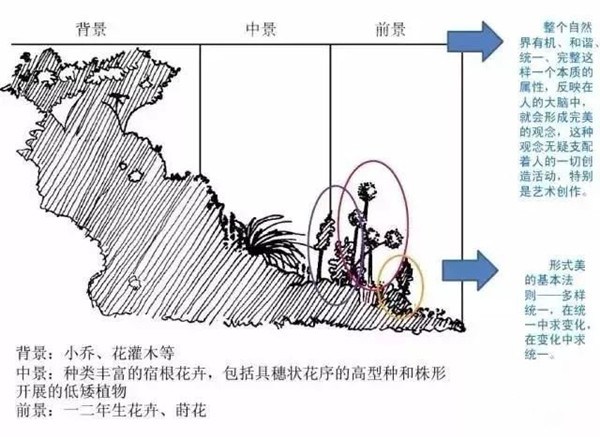
For a flower border design to achieve a good effect and fully express the beauty of plant communities, the plants must be arranged with varied heights and well-defined layers of flower color. By making full use of the ornamental characteristics of plants, such as growth habit, plant height, inflorescence and texture, a rich and beautiful landscape is created.
The spatial layers of a flower border can be divided into three:foreground, middle ground and background. The main feature is best placed in the middle ground and is often repeated.
The principle of spatial layering in a flower border: plant the tallest plants at the back and the shortest at the front or around the edges. But if you follow this principle blindly, the result will be completely exposed to view and dull.
Reasonable combinations, changing scenery with every step
For the foreground of a flower border, prostrate plants with dense foliage and branches are generally chosen, while the background usually features tall, spicate or linear plants. Enrich the plant species as much as possible to achieve the effect of changing scenery with every step; in terms of time, pay attention to "differences across the four seasons", so that through reasonable combinations people can enjoy distinctive landscapes in different seasons.
Determine plant species according to different terrain
Flower borders include three modes: single-sided viewing, double-sided viewing and corresponding style.
Single-sided viewing flower borders are mostly set close to roads, often with buildings, low walls, tree clusters, hedges and the like as the background, and low edge plants in front, so that the border as a whole is low in front and high at the back, for viewing from one side.
Double-sided viewing flower borders are mostly set on lawns or among tree clusters, with no background, and the plants are arranged high in the middle and low on both sides, for viewing from two sides.
Corresponding style flower borders are mostly set on both sides of garden paths, in the middle of lawns or around buildings; generally there are two corresponding flower borders, and these two borders are arranged in two left-right rows.
Adapt to local conditions and shape the landscape according to the terrain
According to the terrain and site conditions, the first consideration should be the length and width of the flower border.
The length of a flower border generally does not exceed 20 m, and overly long sections should be divided into segments. For planting, the technique of variation within a segment and repetition between segments can be adopted, but attention must be paid to the sense of rhythm in the plant arrangement.
Each flower border needs a planting rule that harmonizes with the surrounding environment and has an obvious theme, and the plant landscape should show regular changes as the flower border extends.
The width of the flower border should be appropriate; too narrow makes it hard to reflect the community effect, while too wide exceeds the visual range and is also inconvenient for maintenance and management.
Combining annual and perennial plants and choosing plants with strong vitality that are easy to maintain are both good approaches to plant selection in creating a flower border.
Planar design: flat planting adopts a natural block mixed-planting method, with each block as a group of flower clusters, the size of each flower cluster varying, and the main flower material plants divided into several clusters and planted in different positions in the flower border.
The flower border is the epitome of garden beauty. Everyone's thoughts and views on the flower border may differ, and flower borders of various styles can create gardens with a hundred different kinds of beauty. Understanding the growth habits of plants is the most fundamental and most basic requirement for creating a perfect flower border.