Taiwan's pesticide usage hits a 17-year high! A US court orders massive damages over glyphosate and bans chlorpyrifos to protect infants - will Taiwan follow suit?
Text / by Upstream and Downstream reporters Liu Yixin, Cai Jiashan
Monsanto sold the potentially carcinogenic herbicide "glyphosate," and the San Francisco Superior Court recently ruled that it must pay $290 million USD (about 9 billion TWD) in damages to Dewayne Johnson, a school groundskeeper who developed cancer. In addition, a US court also ordered a ban on "chlorpyrifos," which may harm infants' nervous systems. Yet in Taiwan, sales of these two pesticides ranked second and sixth respectively (2016). Is Taiwan exposed to a high-risk environment? Should these pesticides be further regulated or banned?
In addition, our country's pesticide use per unit area ranks among the highest in the world. In the case of herbicides, between 2000 and 2014, our country's average herbicide use per hectare was 4.22 kg (calculated as active ingredient), about 3 times that of France and Germany, and 1.5 times that of the Netherlands, Japan, and South Korea. Even Brazil, which ranks second in the world in area planted with genetically modified crops, uses less herbicide per unit area than our country. The latest 2017 data rose further to 5.54 kg per hectare, setting a record high in nearly 20 years.
The Council of Agriculture introduced a ten-year policy to halve pesticide use, but in 2017 our country's total pesticide use came to 10,549 metric tons, a 17-year record high and an increase of 1,045 metric tons over the previous year. The two pesticides that recently sparked controversy are both used heavily domestically. According to Bureau of Animal and Plant Health Inspection and Quarantine statistics, glyphosate use in 2017 was 1,463.9 metric tons, making it the most-used herbicide. Chlorpyrifos use was 535.1 metric tons, accounting for 19% of all insecticides. (All calculated as active ingredient.)
Why has the goal of "pesticide reduction" moved backward instead of forward? Feng Haidong admits that this increase is an abnormal fluctuation and should be related to last year's rush to buy paraquat. In addition, because pesticide manufacturers, importers, and retailers were only required to report to the Bureau of Animal and Plant Health Inspection and Quarantine starting last year, "some previously unreported volumes may have surfaced."
Bureau of Animal and Plant Health Inspection and Quarantine: The Monsanto ruling was a jury decision, not scientific evidence
"At present, countries around the world all believe glyphosate has no carcinogenic risk." Feng Haidong, director-general of the Bureau of Animal and Plant Health Inspection and Quarantine, said that in 2015 the World Health Organization's cancer research agency (IARC) adjusted glyphosate to Group 2A, a probable carcinogen. At that time, the European Food Safety Authority (EFSA), the US Environmental Protection Agency (EPA), and others all restarted evaluations, but evaluation bodies in various countries all concluded there was no carcinogenic risk.
Feng pointed out that IARC presented scientific evidence and determined that glyphosate may be carcinogenic, but the evidence was insufficient. "Everyone keeps misunderstanding the research results. The evidence now is only that it may be carcinogenic, not proof that it does cause cancer." He believes the Monsanto ruling was a collective decision by a jury, not scientific evidence proving glyphosate causes cancer.
Feng pointed out that in terms of food safety, glyphosate is a systemic agent, and farmers use it very carefully for the sake of their harvests and do not apply it directly to crops. But among the 373 pesticides in the multi-residue analysis method, the officially announced method for testing pesticide residues in food in our country, glyphosate is not included. How can we know whether there is no residue? Feng said that although this method does not include glyphosate, there are still individual methods to test its residues, and current sampling results all meet standards.
Should glyphosate products carry warning labels? Bureau of Animal and Plant Health Inspection and Quarantine: If it is confirmed carcinogenic, it will not be allowed for sale
Feng Haidong said the Monsanto case concerns the risk of users being exposed to pesticides, not food safety, so the Bureau of Animal and Plant Health Inspection and Quarantine will further assess the exposure situation of users in Taiwan. From the standpoint of protecting farmers, risks will be raised if found, but that does not necessarily mean a ban; protective measures can achieve the same goal. As for whether products might carry a cancer warning label in the future? Feng responded that if a pesticide is confirmed to cause cancer, it would simply not be allowed to be registered or sold.
Agricultural Chemicals and Toxic Substances Research Institute: Consumers should have no exposure risk; farmers and workers need further research and assessment
"The glyphosate assessment was only launched in the first half of the year, and the decision was that the exposure risk to consumers is low, but monitoring and assessment will continue." Fei Wenqi, director-general of the Agricultural Chemicals and Toxic Substances Research Institute, explained that whether a chemical is banned must be assessed according to the agent's own toxicology, national usage patterns, and exposure risk. On the toxicology of the agent, the World Health Organization's cancer research center found that glyphosate can cause cancer in animals, but at least two animal species are needed to prove that it definitely causes cancer, and there are differences between animals and humans. Various countries have launched assessments, but so far none have imposed further controls.
Fei Wenqi explained that because the United States grows genetically modified crops, glyphosate is widely sprayed on crops there. But Taiwan does not grow genetically modified crops, so it is not sprayed directly on crops, and farmers also use it very carefully to avoid affecting crops.
Regarding exposure risk, Fei Wenqi further pointed out that the assessment results confirm consumers have no exposure risk, while farmers and pesticide factory workers who come into contact with larger amounts of glyphosate do indeed need further research, which is currently underway.
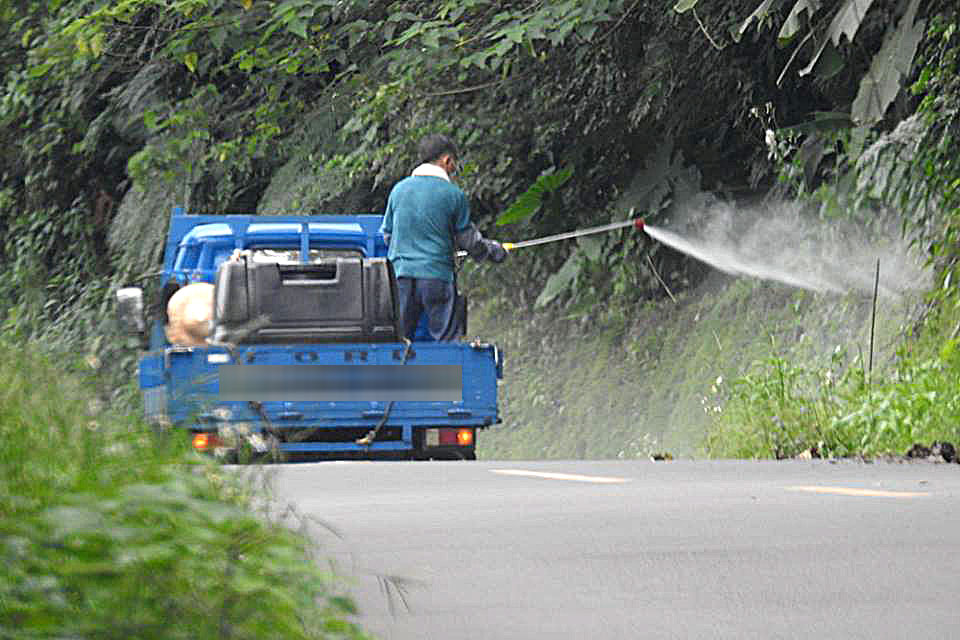
Feng Haidong: Both chlorpyrifos and glyphosate have been placed on the assessment list
Feng Haidong pointed out that both chlorpyrifos and glyphosate have been placed on the assessment list. Chlorpyrifos is both high-use and high-risk, while glyphosate is high-use. Control measures will only be announced after the assessment is completed.
Regarding the management mechanism for high-risk pesticides, Feng said that in addition to finding substitute agents, the overall system will make high-risk pesticides harder to purchase. Purchases may be limited to those with a prescription, or the agents may be purchasable only by professional applicators or those with certain protective measures.
Relatively safe pesticides, by contrast, will be cheaper and more convenient to buy, and subsidies will be given for biological pesticides to create incentives. In addition, the concept of integrated pest management must be promoted so that people do not rely excessively on chemical agents.
Total pesticide use hits a 17-year high; Bureau of Animal and Plant Health Inspection and Quarantine: caused by the rush to buy paraquat and truthful reporting
The Council of Agriculture introduced a ten-year policy to halve pesticide use, but in 2017 our country's total pesticide use came to 10,549 metric tons, a new high since 2000 and an increase of 1,045 metric tons over the previous year.
Why has the goal of "pesticide reduction" moved backward instead of forward? Feng Haidong admits that this increase is an abnormal fluctuation and should be related to last year's rush to buy paraquat. Because paraquat was about to be banned, many farmers rushed to buy and stockpile it, roughly two years' worth of normal sales.
But beyond herbicides, the use of insecticides and fungicides was also 300 to 400 metric tons more than the previous year. Feng Haidong explained that because pesticide manufacturers, importers, and retailers were required to file electronic reports starting last year, there was nowhere to hide, so "some previously unreported volumes may have surfaced," and future statistics will move closer to the real situation.
The pesticide section of the Bureau of Animal and Plant Health Inspection and Quarantine explained that in the past the figures were reported by pesticide businesses themselves to their associations on an honor system, but starting last year they were required to report to the bureau, and upstream and downstream records would be cross-checked. So although the usage figures appear to have risen, electronic reporting was further promoted in January this year, and from now on businesses must report truthfully.