Plant These 9 Plants in the Yard and Neighbors Will Come Visiting Every Day
Compared with balcony gardeners, those who have a yard are truly lucky. Many plants can be planted directly in the ground, saving you from buying flower pots. Which plants are suitable for planting directly in the yard? Today the Hao Yanghu editor recommends 9 plants that are suitable for planting directly in the ground and are impossibly beautiful.
1. Rose of Sharon
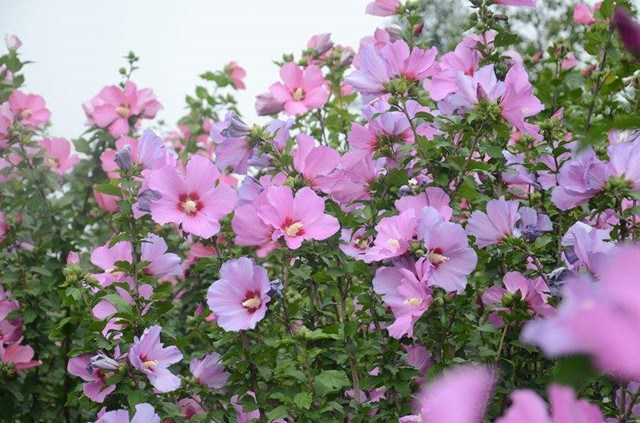
A deciduous shrub, with oval leaves that are often three-lobed and have three main veins. It blooms in summer and autumn, with solitary flowers in the leaf axils. The flowers are trumpet-shaped, about 4 to 10 cm in diameter. The whole plant can reach 2 to 4 m in height. The flowering period is from July to September. Rose of Sharon flowers open in the morning and wither at dusk; a single flower lasts only one day, opening in the morning and fading in the evening. The flowers bloom one after another in succession, and the flowering period is very long, so in South Korea it is called the flower of infinity. When the flowers bloom, the branches of the rose of Sharon produce many buds. After one flower fades, the other buds continue to open without pause, blooming with abundant spring vitality and brilliant spring light.
Rose of Sharon is highly adaptable, with an optimum growth temperature of 15-28°C. It likes sunlight and can also tolerate partial shade. In most areas of North China and Northwest China it can overwinter outdoors. It is not demanding about soil; neutral to slightly acidic soil is fine. It is relatively tolerant of poor soil and partial shade.
2. Nasturtium
Nasturtium, also known as golden lotus flower, is a plant in the order Brassicales, family Tropaeolaceae, genus Tropaeolum, and is different from another plant of the same name, golden lotus. Nasturtium is native to the Andes Mountains from Bolivia to Colombia in South America. What is commonly called golden lotus in Taiwan, China is actually nasturtium.
Nasturtium has very attractive miniature lotus-like leaves and brilliant flowers. It is practically a land version of the lotus, and it can climb as a vine, which is excellent.
3. Purple Coneflower
Yellow purple coneflower, or yellow echinacea, is a perennial plant in the family Asteraceae, genus Echinacea, and is the only species in the genus that does not bloom with purple flowers. The plant height is about 24 to 36 cm. It blooms in summer, with yellow to orange-yellow petals. The leaves are about 4 to 8 feet long, hairless, and dark green in color.
This little daisy-like flower looks very appealing, and the buds on top are like pinecones. It really is beautiful! It is slightly cold-tolerant, prefers to grow in warm, sunny places, and likes fertile, deep soil rich in organic matter.
4. Clematis
The flowers of clematis 'Josephine' are beautiful double blooms, with deep pink stripes in the pale pink petals. The flowering period is long, and you can enjoy the flowers throughout the summer.
5. Daylily
Golden needle flower, also known as daylily, xuancao, or lemon daylily, is a plant in the family Hemerocallidaceae, native to the central and southern provinces of mainland China. The flowers are steamed and sun-dried and processed into dried vegetables. Fresh golden needle flowers can also be eaten, but they must be fully heated before eating, otherwise they may cause poisoning. The main producing areas include Hunan, Jiangsu, Shaanxi, Sichuan, Gansu and other provinces. It is often confused with xuancao, but xuancao is not edible.
Daylily blooms in the morning and withers and fades by night. It is a flower that can bloom most beautifully in a brief life, and it is full of passion. It looks gorgeous and delicate, with large and beautiful flowers. It is loved by people all over the world, and it can also be eaten. It tastes pretty good too.
6. Thyme
Thyme or common thyme is a herb harvested from plants of the genus Thymus, with culinary and medicinal value. It is rich in iron, and its aroma and preservative function come from its own thymol. It likes dry, sunny environments and is not picky about soil; good soil drainage is enough.
7. Lamb's Ear
Lamb's ear is a species in the family Lamiaceae, genus Stachys. This is a variety that greatly likes light and tolerates cold. Gardeners in the north do not need to worry about it freezing to death; it can tolerate -29°C low temperatures. It is quite suitable for planting in the yard. The leaves have a layer of silvery-white soft fuzz, and it makes you want to touch them.
8. Chinese Lantern Hibiscus
Chinese lantern hibiscus is a species in the family Malvaceae, genus Hibiscus. Hibiscus is a famous flower in China and is very commonly cultivated in South China. Its most special feature is its very long flowering period, almost throughout the year, with large, brightly colored flowers and abundant blooms. The hibiscus flower looks warm and bold on the outside, yet has a unique flower center. This is formed by many small stamens linked together and wrapped around the large pistil. The structure is quite delicate, and it is truly gorgeous.
9. Scented Geranium
This variety is a newly bred variety with a mosquito-repelling effect. It is generally grown for its foliage, and the flowers are relatively small. Scented geranium is a type of geranium, native to southern Africa, especially South Africa. They are sometimes called cranesbill or mosquito-repelling grass because they belong to the same family Geraniaceae, but they actually belong to the genus Pelargonium. Scented geranium holds a very important position in the perfume industry. They are cultivated in large quantities, and the leaves are distilled for their scent. Scented geranium has many scents, including rose, citrus, mint, coconut and cardamom, as well as many fruit flavors.
A common name for scented geranium is rose geranium. The leaves of scented geranium are not the "bay leaf" used as a cooking spice. Bay leaf is the leaf of the laurel tree.