These closely related plants look alike, how many can you recognize?
Naodong Handmade
You have 40 friends following this official account!
There are countless beautiful flowers, but how many do people actually know? There are many "close relatives" among plants that are just as extraordinarily beautiful, but the tiny differences between them are really hard to tell apart!
1. Qiangwei, Chinese rose and rugosa rose
These three names are the most troublesome, because they all have both narrow and broad senses.
First, the narrow sense:
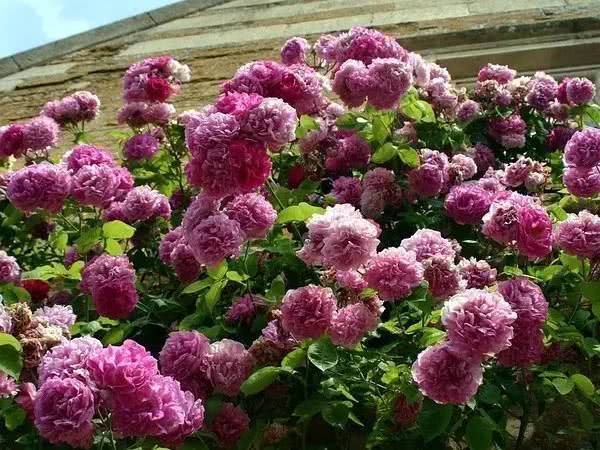
Qiangwei generally refers to wild Rosa multiflora, called Baby Rose in English, including the original variety of Rosa multiflora and its various varieties such as Rosa multiflora var. cathayensis, Seven Sisters, and Rosa multiflora var. alboplena.
Seven Sisters Seven Sisters
Yueji refers to Rosa chinensis, called China rose in English, and to Rosa ×odorata (Rosa ×odorata is generally considered to be a hybrid of Rosa chinensis and Rosa gigantea), called Tea rose in English. But in fact, the vast majority of yueji circulating today are hybrids; historically, after Chinese yueji were introduced to Europe, breeders crossed them with roses from all over the world to obtain a wide variety of modern roses, while most of the yueji cultivated in ancient China have been lost.
Several yueji first introduced to Europe:
Slater's Crimson China Slater's Crimson China
Parsons' Pink China Parsons' Pink China
Park's Yellow Tea-Scented China Park's Yellow Tea-Scented China
Meigui refers to Rosa rugosa, called Japanese rose in English; traditional rose tea, rose distillate, rose paste and so on are made from this flower. What the cut-flower trade calls meigui is actually the Hybrid Tea group of modern roses; true Rosa rugosa is not suitable as a cut flower.
Rosa rugosa Rosa rugosa
Double white rugosa rose Rosa rugosa f. albo-plena
Now the broad sense:
All three can refer to all plants of the genus Rosa, but by convention qiangwei refers to those with small flowers and a climbing habit, yueji refers to those with large flowers that bloom in all four seasons, and meigui refers to those that can be eaten.
2. Forget-me-not and wavyleaf sea-lavender
The "forget-me-not" used as a cut flower is actually Limonium sinuatum, also called xingchenhua, known in English as Wavyleaf sea-lavender.
Limonium sinuatum Limonium sinuatum
The forget-me-not that everyone fantasizes about in myths, legends and literature is actually a plant of the genus Myosotis, called Forget-me-not in English.
Myosotis sylvatica Myosotis sylvatica
3. Daisy, marguerite and oxeye daisy
Daisy is called Daisy in English, and it too has both broad and narrow senses. In the broad sense, Daisy refers to plants of the Asteraceae; in the narrow sense, it refers to Bellis perennis, also called yanmingju.
Bellis perennis Bellis perennis
Marguerite is called Marguerite in English, and usually can refer to two plants: Leucanthemum vulgare, also known as French daisy; and Argyranthemum frutescens, also known as marguerite daisy and penghaoju.
Leucanthemum vulgare Leucanthemum vulgare
Argyranthemum frutescens Argyranthemum frutescens
Niuyanju refers to Buphthalmum salicifolium, called Yellow oxeye daisy in English. But the English word oxeye daisy actually refers to Leucanthemum vulgare, so in some translated texts "niuyanju" may also refer to Leucanthemum vulgare.
Buphthalmum salicifolium Buphthalmum salicifolium
4. Datura and mandrake
Mandala generally refers to Datura stramonium, and can also refer to plants of the genus Datura; it is also another name for camellia. Datura is associated with Buddhist legend.
Datura stramonium Datura stramonium
Mandrake refers to plants of the genus Mandragora, called Mandrake in English. The plant in European legend that screams when pulled up refers to this.
Mandragora officinarum Mandragora officinarum
5. Delphinium and larkspur
Many people treat larkspur as another name for delphinium, because both are called Larkspur in English. In fact, they are different plants, even belonging to different genera.
Cuique refers to plants of the genus Delphinium; specifically Delphinium grandiflorum, called Siberian larkspur or Chinese larkspur in English.
Delphinium grandiflorum Delphinium grandiflorum
Feiyancao refers to plants of the genus Consolida; specifically Consolida ajacis, called Rocket larkspur in English.
Consolida ajacis Consolida ajacis
6. Wutong and French plane tree
Wutong, also known as qingtong (Firmiana simplex), is native to China.
Firmiana simplex Firmiana simplex
French plane tree actually refers to Platanus ×hispanica, whose true name should be London plane, called London Plane in English. It is a hybrid of Platanus occidentalis, the American sycamore, and Platanus orientalis, the oriental plane. It is widely cultivated in China as a street tree, but it easily causes allergies in some people.
Platanus ×hispanica Platanus ×hispanica
Whether one ball, two balls or three balls, the plane tree is not native to China, and its cultivation history in China is very short, so how could the ancients have written poems praising it?
7. Chinese scholartree and black locust
Huai is Sophora japonica (Styphnolobium japonicum), native to China.
Styphnolobium japonicum Styphnolobium japonicum
Cihuai is Robinia pseudoacacia, native to the United States.
Robinia pseudoacacia Robinia pseudoacacia
8. Plum blossom and wintersweet
Mei (Prunus mume) blooms in early spring, with red, pink or white flowers.
Prunus mume Prunus mume
Lamei (Chimonanthus praecox), also written as namei, blooms in winter, with yellow flowers.
Chimonanthus praecox Chimonanthus praecox
9. Haitang and begonia
Haitang refers to Malus spectabilis, and can also serve as a general term for some plants of the genus Malus and the genus Chaenomeles; the best known are the four haitang: Malus ×micromalus, Malus halliana, Chaenomeles speciosa (i.e. wrinkled-skinned quince) and Chaenomeles cathayensis (i.e. hairy-leaved quince).
Malus spectabilis Malus spectabilis
Malus ×micromalus Malus ×micromalus
Malus halliana Malus halliana
Chaenomeles speciosa (Malus spectabilis) Chaenomeles speciosa
Chaenomeles cathayensis (Malus spectabilis) Chaenomeles cathayensis
Qiuhaitang refers to plants of the genus Begonia, and specifically to Begonia grandis.
Begonia grandis Begonia grandis
10. Mugua and papaya
Mugua refers to Chaenomeles sinensis, and can also serve as a general term for plants of the genus Chaenomeles. But the "mugua" sold in the market is actually papaya.
Chaenomeles sinensis flower
Chaenomeles sinensis fruit
Papaya (Carica papaya) is native to the Americas, and because it resembles mugua in shape, it is called fanmugua.
Carica papaya flower (male flower)
Carica papaya fruit
11. Grass hydrangea, wood hydrangea, hydrangea, pink snowball and snowball flower
Yet another series of confusing names.
Cardiandra mollendorffii is mostly wild in China, so it is not commonly seen.
Cardiandra mollendorffii Cardiandra mollendorffii
Wood hydrangea refers to Viburnum macrocephalum, and qionghua is one of its varieties. But some people mistakenly take Hydrangea paniculata as wood hydrangea.
Viburnum macrocephalum Viburnum macrocephalum
Hydrangea generally refers to Hydrangea macrophylla, and can also refer generally to plants of the genus Hydrangea.
Hydrangea macrophylla Hydrangea macrophylla
Fentuanhua is a name given by the ancients; in the Flora of China it is considered to be Viburnum plicatum, while in traditional Chinese pharmacology it refers to Hydrangea paniculata. Personally, I rather agree with the latter, because in late autumn the sterile flowers of Hydrangea paniculata turn red, forming big "pink snowballs".
Viburnum plicatum Viburnum plicatum
Hydrangea paniculata Hydrangea paniculata
Snowball flower refers to Viburnum opulus. It is worth mentioning that the "red berry flower" and "kalinka" in the famous Russian songs "Red Berry Blossoms" and "Kalinka" refer to the snowball flower.
Viburnum opulus Viburnum opulus
All the excitement is at Huayipai Youzan Mall
Flowers and love | Huayipai