Dipladenia is tough and highly ornamental; plant it in the courtyard and the whole garden is filled with fragrance
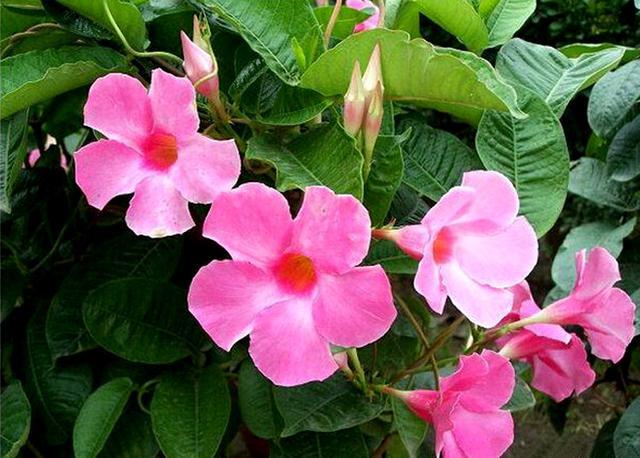
Dipladenia is also known as Mandevilla. As a type of vine, its tough, wiry branches are its trademark. It is usually suitable for growing on a balcony or climbing along fences and trellises in a courtyard, and it is very ornamental. Its blooming has its own characteristics: when in flower, the number of blooms is usually far greater than the number of leaves and branches, and as the season progresses, the flower color becomes deeper and deeper, from light pink all the way to deep red, making it endlessly endearing.
I. Planting Dipladenia
Cuttage propagation is the most commonly used method for cultivating Dipladenia. Cuttings are usually taken in spring or early summer. From a robustly growing Dipladenia, cut a certain number of semi-lignified stems as cutting material, while keeping the buds at the stem nodes. Choose a flower pot of suitable size as the container for the Dipladenia. When taking cuttings, to ensure the stems root smoothly, leave a certain distance between the stems, generally about 3-5 cm is suitable; after cutting, the plant takes a relatively long time to root, usually between one month and one and a half months. During this period, besides watering the plant appropriately, there is no need for fertilizing or other measures. One to two weeks after the plant successfully roots and sprouts, the plant can enter normal management. If you feel the rooting time is too long, you can add a small amount of rooting powder to speed up its rooting.
II. Caring for Dipladenia
1. Light conditions
Dipladenia is suitable for growing under conditions of sufficient light, so during the plant's growing period, it must be placed in a well-lit environment; generally, keeping about eight hours of sunlight per day is enough. If the summer weather is relatively hot, Dipladenia must be shaded; long periods of strong light will cause the branches and leaves of Dipladenia to wither and turn yellow, thereby affecting its flowering process, and in severe cases it will also cause the flowers to wither ahead of time.
2. Soil conditions
Because Dipladenia has strong adaptability to the environment, there are not many requirements for choosing its growing soil. Generally, you can use humus soil or sandy soil that is well fertile and has good looseness. If you mix the potting soil yourself, it is best to disinfect it to a certain degree, then add an appropriate amount of sufficient base fertilizer before taking plant cuttings; this is beneficial to the plant's growth and reduces the possibility of it suffering from diseases during its growth process.
3. Watering and fertilizing
Watering Dipladenia must be moderate. If you water too little and the potting soil dries out, it will affect the plant's absorption of nutrients; secondly, the plant cannot absorb sufficient water, and yellow leaves or leggy branches may appear. Excessive watering, on the other hand, easily causes water accumulation in the potting soil, leading to root rot or root rot disease in the plant, which has a very big impact on the plant's flowering. Especially in autumn and winter, the plant should be watered less, and the soil should be kept in a semi-dry state. After early spring arrives, the plant can gradually resume normal watering.
On the other hand, spring and summer each year are the peak growing seasons for Dipladenia, so fertilizing should also be more frequent than usual; generally, fertilizing once every 7-10 days is enough. If fertilizing in spring, add more nitrogen and phosphorus fertilizer, while if fertilizing in summer, add more phosphorus and potassium fertilizer. When fertilizing, it needs to be diluted with clean water to ensure the plant can absorb it smoothly and at the same time avoid burning the plant.
4. Pruning
The main purposes of pruning are, first, to make the plant's appearance more beautiful; second, to ensure the plant blooms smoothly the next time. Pruning can be divided into two stages. It can be done in spring, mainly cutting off tangled branches, weak branches and leggy branches, while the second pruning is after the flowers fade, mainly targeting spent flowers, remaining branches and the plant's shape for pruning.