The 7-meter rainforest aquascape is grand in scale, a feat comparable to that of a Japanese aquascaping master
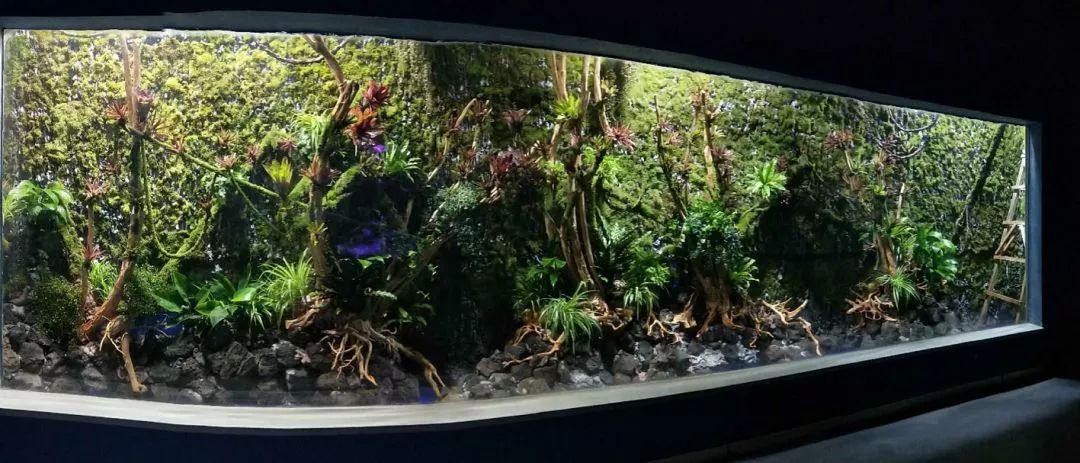
We often post impressive aquascaping works by some master from abroad. The editor randomly visited our fellow hobbyist (the 9th Earring) aquascaping team, and their work is no less impressive! Come take a look, take a look!
Not bad, right~
7-meter rainforest aquascape setup
Length: 7 m * 1.5 m * 2.5 m. Converted from an original marine breeding tank (giant acrylic tank, curved tank)
Lighting: Qingxi LED 40 watts * 15 units, 10 hours of light per day.
Materials: black volcanic stone, large tree-shaped azalea root.
Filtration system: external submersible pump 1000 watts.
Plants in the tank: small gray moss, large gray moss, Neoregelia, bb grass, orchid grass, etc. Too many to list one by one. (Too lazy)
Background wall construction: Qinglong stone-colored expanding foam.
Misting system: mist for half a minute every hour.
Difficulty: because it is a large fish tank with a fully enclosed design, moving things up and down for aquascaping is very awkward, and the 2.5 m ceiling height is no small pressure for someone with acrophobia. Many times you have to stand on top of the tank to work. Forgive me for being timid, once I stood up there I did not dare to take photos. Wiping the tank walls is difficult, and the difficulty with misting is that there must be no standing water on the tank walls.
Starting the aquascape
01 Entering the site for construction
02 Expanding foam as the base, background board construction begins
03 Materials prepared to go into the tank
The space is too small, making it very troublesome to work, plus the lingering smell of the original water inside. We had to wear masks to work. These two brothers really had it tough!
04 The large skeleton is complete, planting begins
05 Starting to handle the details
Aquascape finished
Look at the changes in the aquascape as a whole
Project difficulties:
1. Because it is a conversion of a finished tall tank, imagine a height of 2.5 m. Working with it is extremely difficult. First is the construction of the background wall. Because the tank walls are acrylic, expanding foam has a very hard time sticking to the wall. You need to first stick a row of transparent tape at the very bottom of the intended position to prevent the expanding foam from falling and contaminating other parts of the tank wall (acrylic cannot be wiped like glass, otherwise it scratches easily).
2. The tank body is 1.5 m wide and curved. In our imagination, the width is quite sufficient, but in actual operation you will find that you have no room to move at all. Once a large irregular azalea root is placed inside, there is basically no extra space to move around.
3. Transportation is difficult; the stones and wood all had to be hoisted.
4. The misting design is very difficult. Hanging it high gives a wide spray area, but it easily drips onto the tank walls, making maintenance hard. Hanging it low makes the spray uneven, easily causing some areas to be too wet while the outside is dry. In short, adjusting the misting took about two days. Longer than the aquascaping itself.
5. Working while standing on top of 15 cm thick, 2.5 m high acrylic requires a lot of courage. Anyway, I am afraid.
6. No landscape can do without diligent maintenance afterward.
There is still a surprise here