Osmanthus bonsai care: beautiful and fragrant, it's the right choice
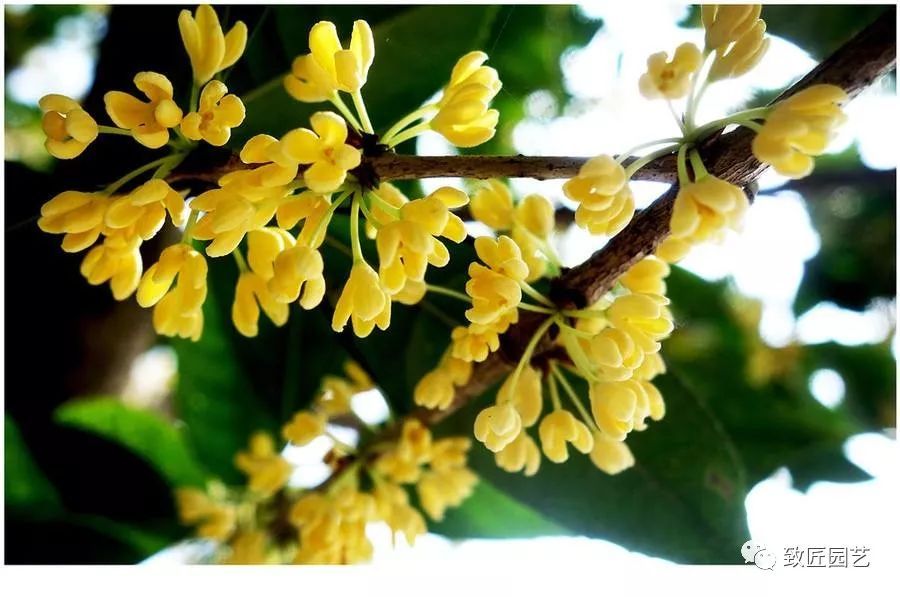
Osmanthus stays evergreen all year round, with luxuriant branches and leaves, blooms in autumn, and is filled with fragrance. It is widely used in gardens, often as a landscape tree, planted as a single specimen, in pairs, or in clumps and groves. So what is the cultivation technique for bonsai osmanthus trees? What are the cultivation and management methods for osmanthus bonsai?
Osmanthus bonsai cultivation techniques:
1. Pot selection: Osmanthus has green leaves and yellow flowers and stays evergreen through the four seasons, so it is best to choose a relatively deep round pot or square pot. The diameter of the pot mouth should roughly match the spread of the osmanthus branches and leaves, which benefits root development and growth. For the pot material, purple clay ceramic pots or glazed ceramic pots are best.
2. Soil: Osmanthus likes fertilizer, so it is best to use fertile, loose, well-drained sandy loam. The growing soil for potted osmanthus is usually made by mixing garden soil, composted manure and river sand in a 1B3 ratio. Pay attention to disinfection treatment so that pests and diseases are not introduced.
3. Planting: Osmanthus is best planted in early spring or autumn. Before potting, place a layer of river sand or vermiculite at the bottom of the pot to improve aeration and drainage, then spread a layer of peat soil or fine mud about 2-3 cm thick on top, reaching 1B3 of the pot depth. Then place the osmanthus seedling with its root ball into the pot, fill with growing soil, press firmly with your fingers, and fill soil until it is close to the pot mouth. The soil surface should be 2-3 cm lower than the pot mouth to make watering and fertilizing easier. After planting, water thoroughly, then move it to a shaded place for about 10 days so it can "adapt to the pot" and gradually resume growth.
4. Training: Osmanthus has strong sprouting ability and tolerates pruning. One or two years after potting, shape it during the plum rain season or after autumn flowering, using a combination of wiring and pruning. The trunk can be wired into a curved-trunk or slanting-trunk form. If the trunk is relatively tall, it can be appropriately shortened to encourage new branches and trunks to sprout from the base, so the lower part does not become bare, or heavily prune the upper branches and excessively dense branches to stimulate new branches from the lower trunk, maintain balance between top and bottom, and make the tree shape beautiful with abundant flowers and leaves.
5. Tree form: For osmanthus styling, curved-trunk, slanting-trunk or flowing forms are best. The tree extends at an angle, with dense branches and leaves, simple and natural, and is most enjoyable to appreciate. When it blooms, the rich fragrance fills the air and refreshes the heart.
Osmanthus bonsai cultivation and management:
1. Placement: Osmanthus tree bonsai is suitable for a warm, sunny place, and in summer it should be properly shaded to avoid direct strong light. North of the Yangtze River, it must be brought indoors for winter, and a room temperature of 0-5°C is relatively safe. Around Jingzhe in the following spring, it can be taken outside.
2. Watering: For osmanthus tree pot soil, grasp the principle of not watering when dry and watering thoroughly when watering. Generally, in spring and autumn, water once every 3-4 days; in summer high temperatures, water once a day; in winter, water once every 7-10 days. In summer, water in the morning and evening; in winter, water around noon, so the water temperature is close to the soil temperature and does not cause sudden cold or heat that damages the roots. In autumn, watering should be moderate, and during the plum rain season, prevent the pot soil from becoming too wet or waterlogged.
3. Fertilizing: Osmanthus tree bonsai is mainly grown for flowers, so it should be supplied with sufficient fertilizer. When new shoots emerge, apply nitrogen fertilizer 1-2 times to promote branch and leaf growth. Before flower bud differentiation and flowering, mainly apply phosphorus fertilizer. Before fertilizing, the pot soil should be slightly dry, and it is best to loosen the soil first so the fertilizer can be absorbed. On the second day after fertilizing, water once. If using compost or manure, it must be fully decomposed before use. If using the chemical fertilizer superphosphate, its concentration must not exceed 2%.
4. Pruning: For osmanthus tree shaping and pruning, it is best to do it after autumn, cutting off overly strong upper branches to balance the tree vigor. Excessively dense branches should be thinned out, and diseased and weak branches removed, so nutrients are concentrated and flowering is favored. Shaping and pruning combined with water and fertilizer management can improve the healthy growth of osmanthus bonsai and maintain a beautiful form.
5. Repotting: Osmanthus bonsai can be repotted and have its soil changed once every 2-3 years. The new pot should be somewhat larger to benefit osmanthus root growth. Along with repotting, cut off some old roots and dead roots, remove some old soil with a bamboo stick, replace it with loose, fertile new growing soil, and place decomposed cake fertilizer at the bottom of the pot as base fertilizer. When filling soil, be sure to press it firmly. This can promote abundant osmanthus flowers and leaves.
6. Diseases: Common osmanthus diseases include leaf spot, sooty mold, algal leaf spot, root rot, iron deficiency, and so on, and prevention and control should target the disease condition. Leaf spot, sooty mold and algal leaf spot can be controlled by spraying 0.5 Bordeaux mixture or 5% carbendazim 500-1000 times solution. For root rot, pay attention to keeping the soil loose and breathable, and do not let it become waterlogged. If root rot is caused by fungi, irrigate the root area with 200-300 times amobam solution.
7. Insect pests: Common osmanthus pests include sawflies, whiteflies, mites, white peach scale, and yellow-spotted slug moths. Sawflies, whiteflies and mites can be killed by spraying 100% dimethoate 1500-3000 times solution. For white peach scale, besides manual brushing, during the first and second instar nymph stages it can be killed by spraying 400% omethoate 1000 times solution or 40% fenitrothion 500 times solution.
Osmanthus bonsai propagation methods:
1. Sowing: Osmanthus fruit usually matures in April-May, and can be harvested when the peel turns from green to purplish black. Osmanthus seeds have after-ripening and need at least half a year of sand storage. After harvesting, sprinkle water and pile them to ferment, remove the flesh, place in a cool place to let the seeds dry naturally, and store mixed with sand. After sand storage, they can be sown in autumn or spring. Before sowing, prepare the land well and apply sufficient base fertilizer; they can also be sown in indoor seedbeds. When sowing, place the seed hilum sideways to avoid bending the radicle and young stem, which would affect seedling growth in the future.
2. Grafting: For osmanthus grafting, the rootstock is often glossy privet, small-leaf privet, Chinese privet, water privet, etc. When propagating seedlings in large quantities, small-leaf privet is often used. Before spring sprouting, cut off the rootstock 5 cm above the ground, cut a robust 1-2-year-old osmanthus branch 10-12 cm long, cut one side of the base into a 2-3 cm cut surface, cut the opposite side into a small 45-degree slope, make a vertical cut about 2-3 cm deep at about 1/3 of one side of the rootstock, insert the scion into the cut so the cambium layers align, tie tightly with a plastic bag, then bury in soil for cultivation.
3. Cuttings: Usually before spring sprouting, use fully developed one-year-old branches, cut them into 5-10 cm lengths, remove the lower leaves, keep 2-3 green leaves at the top, insert them into a river sand or loess seedbed at a plant-row spacing of 3*20 cm. After inserting, water or spray promptly, shade, and maintain a temperature of 20-25°C and relative humidity of 85-90%. After 2 months, they can root and be transplanted.
4. Layering: Osmanthus can be divided into low layering and air layering. The low layering method is to select, from spring to early summer, a relatively robust 1-2-year-old branch on the lower part of a low-trunk mother tree, choose an easily bendable part, cut or ring-bark it with a sharp knife, press it into a 3-5 cm deep furrow, and fix the pressed branch with a wooden stick. The air layering method is to select a robust 1-2-year-old branch from the mother tree in spring, cut a ring or ring-bark it as in the low layering method, then smear the wound with growing medium, tie it tightly above and below with a plastic bag, and after roots form in autumn, cut it from the mother plant for care.
Wonderful content