Creeping sedum is a succulent plant in the genus Cremnosedum of the family Crassulaceae
Text
Photos and text: Zhijiansha
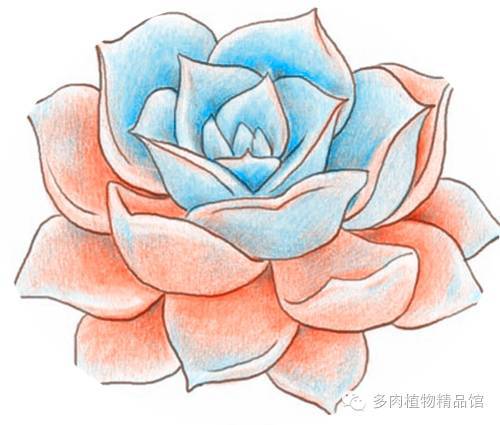
Creeping sedum, a succulent plant in the genus Cremnosedum of the family Crassulaceae, is native to Mexico, growing in rock crevices at 1200-2100 m elevation, and has a brief dormant period in summer. Its plant height can reach 15-20 cm, and its leaves are tightly arranged in a rosette, with perennial plants able to form cushion-like colonies. It has a short stem, with lateral buds borne at the base and stolons growing from the leaf axils. The leaves are tongue-shaped, elongating slightly and extending outward during the growing season, closing toward the center in the dry season, usually pale blue to pale green. In sufficient light, the leaf edges take on a slight pink tint; the leaf tips are pointed and slender, smooth and translucent, similar in this respect to Moon Shadow series succulents, with a feel of warm, moist jade.
The flower has five petals, the sepals joined at the base, obovate, sharp-pointed; the petals are somewhat elliptical and lanceolate, with pointed tips, 7-10 mm long, green on the lower side, and on the inner side the base color is pale yellow-green, scattered with brown spots or stripes at the base, while the middle to the tip is a uniform color; the tip is yellow-green, and the lower side has red stripes along the margins; the filaments are white-green, tinged with red at the tips. The small flowers are star-shaped, with ovate-triangular petals, pale green, marked with dark red spots and blotches.
Growing environment: Creeping sedum's native habitat is in rock crevices at elevations of one to two thousand meters, which shows that it prefers a cool, shady environment; in summer, attention should be paid to shading and ventilation, and stuffy heat and long-term soggy potting soil should be avoided.
Light and care: During the spring and autumn growing seasons, give as much full light as possible; with sufficient light, creeping sedum's form can be more compact and plump, and its color more pink and beautiful. If light is insufficient, the plant easily turns green or even becomes leggy; in midsummer, appropriate shading should be provided.
Watering and care: Water thoroughly when the soil has dried out completely; in midsummer, give a tiny amount of water, and do not let the roots dry out completely in summer. When winter temperatures fall below 3 degrees, watering should gradually be stopped. On sunny winter middays, a tiny amount of water can be given to ensure the plant's moisture is not used up during winter; when temperatures rise in early spring, it will recover quickly after watering.
Soil choice: For planting creeping sedum, choose a loose, breathable medium such as peat/coco coir; because creeping sedum has fine roots, the proportion of peat can be relatively high, as a high proportion of gritty soil can easily prevent the plant from absorbing water and growing well.
Propagation points: Creeping sedum plants readily produce stolons. Creeping sedum can also be propagated by leaf cuttings, but cutting stolons and side shoots is relatively faster, with a very high survival rate. Simply cut off a stolon or side shoot, let the wound dry, and insert it into slightly moist soil. After it dries out, give a small amount of water, avoid direct sun exposure, and new roots generally grow in about 10-15 days. Once roots have formed, water normally.
This article was compiled by the Succulent Boutique House; copyright belongs to the original author. For some articles the source cannot be identified and they are marked as from the internet. If there is any infringement, please contact us immediately and we will handle it promptly.