How to prune succulents? Master the correct pruning methods
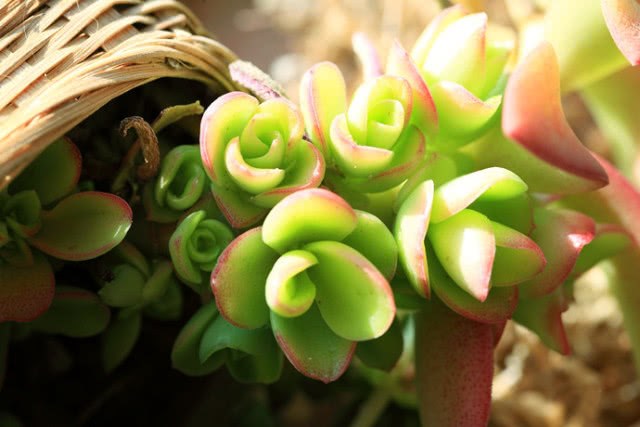
Shaping and pruning, in most cases, should be applied to trees and shrubs or woody and herbaceous flowers. General succulents have no obvious main trunk and no obvious branches. So shaping and pruning work is not very important, but timely and reasonable pruning can lower the plant shape, promote branching, make succulents grow more robustly and give them a more beautiful plant shape. At the same time, the pruned branches can also be used for propagating succulents again. Now let's learn with Succulent Jun how to shape your succulents!
1
Pinching
Through pinching, succulents are encouraged to branch more, form more flower buds, and bloom more, making the plant shape more compact and dwarfed. Pinching means cutting off the top of the succulent's stem, above the leaves. It is suitable for Kalanchoe blossfeldiana, Cotyledon tomentosa, Tradescantia sillamontana, Kalanchoe rhombopilosa, Ceropegia woodii, and others.
2
Thinning branches
The main purpose is to keep the succulent's appearance neat. Generally speaking, focus on pruning overly dense overlapping branches, irregular crossing branches, leggy branches that are not worth keeping, basal sprouting branches, as well as dead branches and diseased or pest-infested branches. It is suitable for plants of the Crassulaceae family, genus Tylecodon, and plants of the Geraniaceae family, genus Sarcocaulon, and Sedum pachyphyllum 'Red'. The pruning period is best after flowering or after leaf fall.
3
Hard pruning
Also called heading back, the entire plant should be cut off or pruned 10-20 cm from the base of the main trunk, to encourage new branches to sprout from the base of the main trunk or from the roots. It is often used for succulents that are too tall or whose growth vigor is extremely weak. It is suitable for Euphorbia tirucalli, Euphorbia trigona, Adenium obesum, Euphorbia tirucalli 'Firesticks', and others.
4
Removing spent flowers
For succulents that are not being kept for seed, spent flowers should be cut off in time to avoid consuming too much nutrients for seed production, which is beneficial to the formation of new flower branches. This is too broad to give examples.
5
Bud removal (including bud thinning)
During the growing season, remove excess lateral buds or new small tender shoots from the plant to reduce nutrient consumption and concentrate nutrients for the development of the main bud. Bud removal generally means peeling off the lateral buds so as not to affect the growth of the main bud. It is often used for Haworthia cooperi, Sempervivum 'Red', Haworthia fasciata, Hoya, and others.
6
Root pruning
It is often carried out when succulents are transplanted or repotted. When transplanting, trim and tidy overly long main roots or injured roots. When repotting, properly thin and tidy old roots, rotten roots, and overly dense roots. After root pruning, apply sulfur powder if conditions permit; if you cannot buy it, you can dip the roots in diluted fungicide.
Before root pruning:
After root pruning: