This chicken can turn invisible at night. Have you ever seen one?
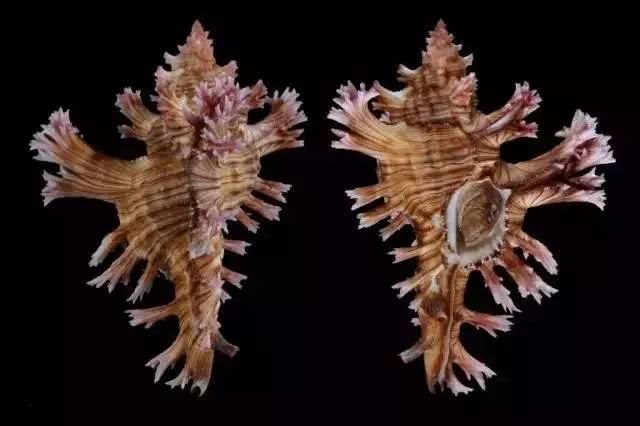
In his historical novel The Black Tulip, Alexandre Dumas wrote about an honest and upright Dutch tulip enthusiast who devoted himself to cultivating a pure black flower, and nearly ruined his reputation as a result. Specifically, he met this misfortune due to a despicable plot by a neighbor, who envied the protagonist's cultivation skills and so fabricated a political charge to send him to prison. The novel's plot is crude and laughably exaggerated, but the author got one thing right: in order to possess a strangely colored and beautiful creature, people will fall into madness.
For example, the rose-like beauty of the rose murex. Have you also picked up shells with small holes on the beach? Let me tell you who did it! >Image: Haus der Natur – Cismar / einzigartige-museen.de
This is a chicken that speaks for Gothic culture
The Dutch tulip craze of 400 years ago once pushed the price of some flowers to absurd heights, and today, a large number of American poultry enthusiasts have become obsessed with a new man-made product: the Ayam Cemani. This chicken breed is pitch black from comb to claw tips, with skin that is black with a blue tinge, eyes as black as coal, and a black tongue too. Its feathers have a black metallic sheen, andeven its internal organs are black. It really is a chicken like a Goth musician.
An Ayam Cemani raised at Greenfire Farms. Image: Greenfire Farms
The Ayam Cemani comes from Indonesia, and because of concerns about spreading avian influenza, the United States Department of Agriculture bans direct imports of poultry from this country. These extraordinary black chickens are therefore very hard to bring into the United States, and their price has become extremely high. The most reputable breeder in the United States is Greenfire Farms, which asks more than 1,000 USD for a pair of chicks; a one-day-old chick of unknown sex sells for 199 USD, plus shipping and handling fees.
Not yet cultivated to pitch black in its chick stage. Image: Greenfire Farms
There are also advertisements claiming to sell cheaper Ayam Cemani, but related chicken-keeping forums warn enthusiasts to beware of being cheated: you can absolutely order eggs on eBay, but the result may hatch intosilver or brown fake Ayam Cemani。
The eggs are actually a normal color, which is inexplicably a pity. Image: Greenfire Farms
So black, did it grow up drinking ink?
The Ayam Cemani is not the only black bird, but most other black birds have pink tongues and dark brown eyeballs, and their internal organs are normal in color too. A small number of bird species are naturally black; because of genetic mutations, more pigment is deposited in their feathers or skin. Their feathers are darker than those of ordinary birds, often brown or smoky gray.
However, the Ayam Cemani is black even on its tongue and larynx. Image: Greenfire Farms
The phenomenon of internal organs turning black is called "Fibromelanosis" (Fibromelanosis). Besides Indonesia's Ayam Cemani, it appears to occur in only three other breeds: the Swedish Black Hen (Bohusl?n-Dals svarth?na), the Vietnamese Black H'Mong, and the Silkie. This third breed is very ancient; it is fluffy, has five toes, and its plumage is like hair.
The Silkie, a rising star in the world of fluffballs. Image source: see watermark
In 2011, a group of researchers from Sweden, the United States, and China discovered the genetics behind this strange phenomenon. The team leader was Leif Andersson, a geneticist at Uppsala University in Sweden, who has long been interested in the genetic causes of peculiar phenotypes in poultry and livestock. This group of researchers found that fibromelanosis in all three chicken breeds is caused by one mutation, and this mutation affects the migration route of pigment-producing cells in the early stages of development.
Generally speaking,precursor cellsbefore becoming melanocytes, travel along specific routes inside the developing embryo and finally settle among the tissues that will develop into skin and eyes. But in these black birds, these precursor cells alsoturn inward into the body, invade and colonize certain tissues, and these tissues will later become the fibers that connect the body's parts - such as the abdominal lining, and the connective tissue and sheaths wrapped around muscles and organs. After entering these tissues, the precursor cells continue to divide, and as a result a large amount of black pigment is deposited inside those birds' bodies.
Black! And! Shiny! Image: Greenfire Farms
This genetic accident originated from two large segments of DNA duplicated within the chromosome (one of which is upside down). Within this, Andersson's team also identified a gene called "endothelian-3" (EDN3), which is currently known to participate in the regulation of pigment-producing melanocytes. The expression of the EDN3 gene in the skin of adult black chickens is about ten times that of other breeds. But the beautiful black metallic sheen of the Ayam Cemani has nothing to do with this gene; in fact, some Silkies actually have white feathers, and only their skin and bones are black.
Silkies are not all white either. Image: The Huffington Post
Being black is not the fault of you two-legged beasts!
The research results show that although the samples the researchers had came from China, Vietnam, Sweden, and Indonesia respectively, they all share the same genetic characteristics.DNA tells the background of the story: long ago, a traveler from Europe saw an all-black chicken somewhere in East Asia, and then brought it back to Europe to raise. Andersson points out: "Interestingly, every chicken with this phenotype carries the same mutation. This shows that someone back then saw these black birds, became deeply interested, and then brought them back to raise and sell, causing them to spread all over the world."
Black birds are actually not uncommon, for example the bowerbird. Image source: see watermark
The Ayam Cemani has a long history on the Indonesian island of Java.It has traditionally been an animal kept by elites and royalty. It rarely appears on the market, and no one eats its meat. Veronika Kusumaryati, who is pursuing a PhD in the Department of Anthropology at Harvard University, says thatthis chicken has an exalted status in Java, and even before the local people converted to Islam, it was already used in religious rituals, perhaps dating back to the 12th century AD. (Kusumaryati comes from Yogyakarta in Java, and her grandmother once raised Ayam Cemani for sale.)
Because of its pitch-black color, the Ayam Cemani became an ideal intermediary,an envoy traveling between the human and supernatural worlds. Kusumaryati explains that in traditional Javanese culture, "there are many spirits roaming between heaven and earth, some good and some bad, and humans can invoke their power to obtain authority, fame, and wealth. For these purposes, people must offer Ayam Cemani, because ghosts and spirits like the meat and blood of this chicken."
Huh? Image: Greenfire Farms
Even today, before starting a major plan (such as running for public office or founding a company), Javanese people may first go to a shaman for help,and the shaman will respectfully offer a black chicken to the spirits, in order to please them. Wealthy Javanese also keep this animal because it looks beautiful, and that is exactly what American chicken enthusiasts love about it too.
Paul Bradshaw, the owner of Greenfire Farms, began importing Ayam Cemani from a breeder in the Netherlands a few years ago, and he believes that outside Indonesia itself, this Dutchman had the best stock. At the time, some other people were also selling Ayam Cemani in the United States, but Bradshaw says many of them were not honest, showing only one chicken foot rather than the whole chicken in their advertisements. His chickens, by contrast, were purebred and always hatched all-black chicks. Soon, the Ayam Cemani became highly sought after, and his first pair sold for 5,000 USD. "You can never guess what the public will like," he says. By his estimate, he has sold about 500 Ayam Cemani over the past few years.
Feathers with a metallic sheen. Image: Greenfire Farms
When Bradshaw first began importing this rare chicken breed, establishing a domestic population, and selling chicks at high prices, other breeders laughed at him. Because by convention, chicken keepers should compete on price, not compete over the rarity or appearance of their chickens. "This was a groundbreaking idea at the time," he says. But in the end, the trend set off by the Ayam Cemani proved he was right. He now also supplies dozens of specialty breeds, such asthe Swedish Black Hen, which looks very similar to the Ayam Cemani but can adapt to cold environments, and is also cheaper, with each chick selling for 99 USD.
Also a black chicken, the Swedish Black Hen refuses to accept this. Image: Martin Olofsson / flickr
Bradshaw really enjoys raising these birds, and he also feeds and maintains some unprofitable breeds just so that these bloodlines can continue. But mainly, Greenfire Farms caters to (or creates) the tastes of chicken enthusiasts. "Someone is willing to pay 1,500 USD for a designer chicken coop, so naturally they want a fine breed," he says. "What they are after is something special, something with a history and a beautiful appearance. That is exactly the market we serve."
Who made humans think looks are justice!
While studying the genetics of poultry and livestock, Andersson again and again caught glimpses ofthe quirks in the human heart: people look for genes in animals that produce strange colors and keep them going, even at great expense. A few years ago, his team discovered that white horses all over the world descend from the same ancestor with a coat-color mutation. This mutation occurred only once in the history of horses, and it makes horses prone to melanoma and shortens their lifespan. But even so, humans still retained this mutation and spread it all over the world.
After all, both princes and Tang Sanzang need to ride a white horse. Image: Wordpress
In more recent times, the Holstein, the world's main dairy cattle breed, also produced a mutation that caused a brick-red-and-white variant to appear within its original black-and-white coat. Andersson points out thatthere is no evidence that cattle with this coat color produce more milk or are healthier, but people just like it. "If all the other cows are black and you have a red one, everyone will like this red cow." In the DNA sequences of these animals, he saw the evidence: some say people choose animals based on meat quality or the milk and eggs they produce, but in the end, people still like to spend money on good-looking animals.
It is just for producing milk, and the requirements are still so high? Image: Les Meloures / lb.wikipedia
Compiled by: Hongzhu
Source: Inside the Goth Chicken: Black Bones, Black Meat, and a Black Heart
You may also want to read
Calendar Lady's avatar today
Phasianidae, Red Junglefowl