Detailed guide to aquatic plant pruning precautions, these key points cannot be ignored
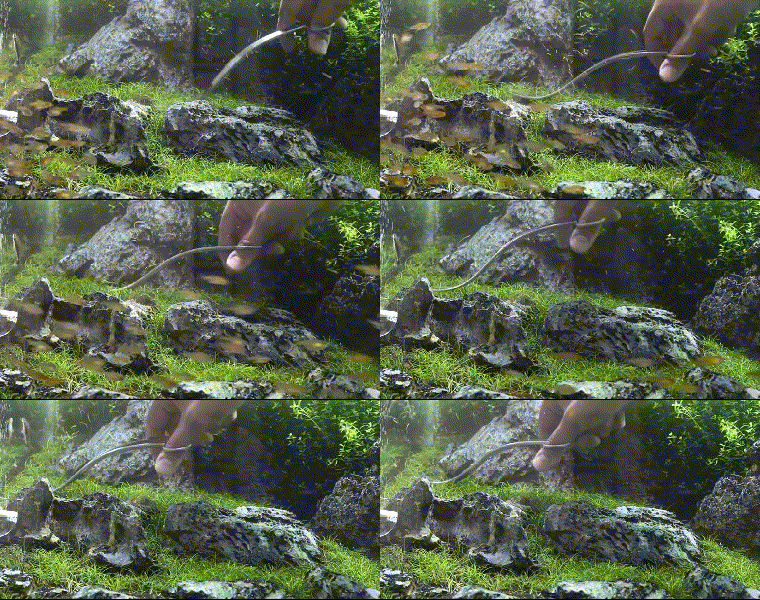
1. When pruning, it is best to turn off the surface skimmer. For foreground plants like dwarf hairgrass, mini dwarf hairgrass, and dwarf baby tears, their density is lower than water, so during pruning many fragments will float on the water surface. These fragments are very likely to enter the filter canister through the skimmer's float and toothed comb, causing excessive debris buildup inside the filter canister and even blockage.
Even if blockage does not occur immediately, excessive aquatic plant debris decaying in the dark, lightless filter canister will pollute the water quality, while also causing reduced filter canister flow and a noticeably decreased filtration effect. Therefore, before pruning, it is best to temporarily turn off the surface skimmer. Usually you only need to lower the central screw rod.
2. Do not prune too many aquatic plants at one time
For the area to be pruned, beginners are advised to prune at most only one third of the total at one time. After the pruned plants have grown new shoots, then prune another two thirds of the area in turn. This can keep the entire planted tank in a very stable state, preventing algae from seizing the opportunity to break out because the aquatic plants have lost too much and algae have lost their competitors. Moreover, pruning in three sessions means the labor intensity each time will not be too great.
You can prune in the order of left, middle, right, or you can first prune the background plants, then the midground plants, and finally the foreground plants. This method has the least impact on the viewing effect of the planted tank. (If there are large numbers of tall and lush midground and background plants in the tank, it is not recommended to prune the foreground plants first, because it will block light.) More experienced fish keepers can prune all aquatic plants in two sessions, and master-level aquarists can prune all aquatic plants at one time.
3. Pruning movements should be gentle, not rough. Except for very few species, aquatic plants are all very fragile. Any excessive twisting or squeezing may cause irreversible damage to the stems and leaves of aquatic plants. An important reason for black stems in parts of Rotala rotundifolia is that the aquatic plant stems were once bent by external force (human hands, water flow, fish, etc.) to an angle that may cause partial breakage. The aquatic plant itself has a certain ability to repair, usually growing large numbers of aerial roots at one or more stem nodes above the crease, while the crease area is very likely to first turn black, then rot, and finally break apart.
A detail that is often overlooked is that after stem plants are cut in half, if the upper section that needs to be replanted is taken out of the water, it is very likely to twist the aquatic plant to a large angle. It would be better to plant it directly in the water.
4. It is not advisable to turn off the filter when pruning
This issue is open to different opinions. Some people also advocate turning off the filter when pruning. Their reasons are, first, they fear that strong water flow will blow aquatic plant debris all over the tank, making it difficult to clean up, and second, they think that since a large water change will be done after pruning anyway, it does not matter if the water is made a bit cloudy now. But from the perspective of protecting the organisms in the tank, turning off the filter when pruning will have adverse effects on the organisms.
After the water flow is interrupted, first, it will cause temporary oxygen deprivation for aquatic organisms; second, if the toxic and harmful substances stirred up from the substrate cannot be immediately sucked away by the filter, they will not only cloud the water but also cause serious harm to organisms such as shrimp and snails. Limpet snails often die after major pruning, and this is the reason. By comparison, fish are much more resistant, but fragile fish such as Siamese algae eaters and otocinclus also need attention. If they are found gasping at the surface, they should be taken out and kept separately or oxygenated with an air pump.
5. After pruning, carbon dioxide supply should preferably be increased
Carbon dioxide is the material basis for photosynthesis in aquatic plants, and it also has a protective effect on aquatic plants under strong light. After pruning, on the one hand, the lighting received by the aquatic plants suddenly increases (the light fixture has not changed, but shading has decreased, which is equivalent to increased lighting intensity); on the other hand, the carbohydrates needed to repair wounds are also in short supply.
If carbon dioxide supply is insufficient at this time, the aquatic plants may suffer burns from strong light, and may also become infected with bacteria due to wounds not healing for a long time, causing large areas of rot. Therefore, after major pruning, be sure not to stint on that bit of carbon dioxide. Better to waste a little than to give too little.
6. After pruning, liquid fertilizer dosage should be temporarily reduced
Because cutting the stems and leaves of aquatic plants creates many wounds, these wounds will not only lose precious carbon dioxide and nutrients, but may also become infected with bacteria or viruses, causing the plants to become sick or even die. At this time the plants will put all their energy into repairing wounds. At this stage the plants are basically in a state of suspended growth. After injury, plant metabolism slows down noticeably, and it takes a period of repair before the original growth rate can be restored. Therefore, at this time the demand of aquatic plants for fertilizer will correspondingly decrease.
Moreover, after pruning, the absolute number of aquatic plants is also greatly reduced. If the original fertilizer dosage is still used, it is very likely that the fertilizer will not be fully used up, accumulate, and cause algae blooms. So after pruning, it is best to adjust the liquid fertilizer to a smaller dosage, and it can even be halved. After the aquatic plants grow new shoots, if no strings of tiny bubbles appear at the cut surfaces, it indicates that the plant wounds have completed repair, and then the liquid fertilizer dosage can be gradually increased.
7. It is not advisable to clean the filter on the day of pruning
When pruning aquatic plants, it is unavoidable to disturb the substrate (commonly seen when uprooting plants, planting, changing aquascapes, etc.). Even if the tank is not made dusty, the water may still be made turbid. At this time, besides changing water, some people also want to clean the filter canister at the same time. But being too diligent is sometimes not necessarily a good thing. Fish and shrimp deaths often occur after cleaning the filter canister.
This is because stirring the substrate releases large amounts of toxic substances such as nitrite and ammonia. Under normal circumstances, these toxic substances are processed by nitrifying bacteria into relatively harmless nitrate and ammonium. But if the filter canister is also cleaned at the same time, the result of losing large amounts of nitrifying bacteria is that the toxic substances cannot all be effectively processed, and the remaining portion will have a fatal effect on organisms. Therefore, the correct procedure is to wait one or two days first, and then clean the filter canister. When washing, use water from the original tank as much as possible, and do not wash it too clean. If there is a pre-filter canister, it is simpler: just replace all the pre-filter media.
8. It is best to do a large water change on the day of pruning
Changing water is the best method to remove toxic and harmful substances in the water, with immediate results. After pruning aquatic plants, whether or not the substrate was disturbed, it is best to perform one large water change to prevent algae blooms or sudden fish and shrimp deaths. However, when adding water to the planted tank, be careful not to let the water flow directly impact the substrate, otherwise it will not only easily damage the original aquascape, but may also cause large amounts of toxic substances in the substrate (such as hydrogen sulfide, etc.) to be released into the water, poisoning shrimp and snails or relatively fragile fish (such as otocinclus, Siamese algae eaters, etc.).
As for how much water to change, that depends on the quality of the local tap water. If the water quality is good, you can change more, even one half or two thirds at a time. If the water quality is poor (tap water hardness or pH is relatively high) and you need to mix in purified water or use an RO machine to make water, it is recommended to change only one third or one quarter at a time.
There is also a surprise here